

2.3. DIMENSIONAL ANALYSIS METHODOLOGY
35
provided all original variables appear at least once in one of the
dimensionless products.
The only time the rule given by the Buckingham pi theorem does not
hold is when the value of r for a particular set of variables depends on the
system of units chosen. For example, if the process variables consisted of
only force and length, then r = 2 in a force-length-time system and r = 3
in a mass-length-time system (see Example 2.8). A more formal method
exists3 for absolute determination of the number of dimensionless products
in a complete set, but the above rule should hold true for the overwhelming
majority of coastal applications.
See Langhaar (1951) for details of this method.
Determining the number of fundamental dimensions in a set of variables
is eased by setting up a matrix of the variables and their fundamental
dimensions. (Table 2.1 will aid in this process for a mass system of units.)
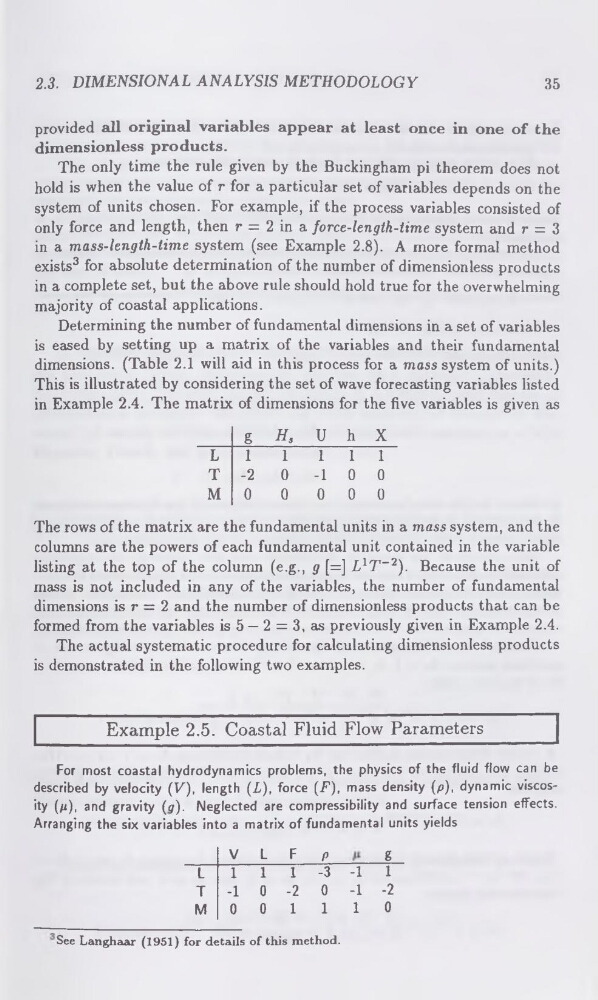
This is illustrated by considering the set of wave forecasting variables listed
in Example 2.4. The matrix of dimensions for the five variables is given as
g Hs U h X
LI
1
111
T -2
0-100
MO
0
0 0 0
The rows of the matrix are the fundamental units in a mass system, and the
columns are the powers of each fundamental unit contained in the variable
listing at the top of the column (e.g., g [=] LlT~2). Because the unit of
mass is not included in any of the variables, the number of fundamental
dimensions is r = 2 and the number of dimensionless products that can be
formed from the variables is 5 — 2 = 3, as previously given in Example 2.4.
The actual systematic procedure for calculating dimensionless products
is demonstrated in the following two examples.
Example 2.5. Coastal Fluid Flow Parameters
For most coastal hydrodynamics problems, the physics of the fluid flow can be
described by velocity (V), length (Z), force (F), mass density (p), dynamic viscosity (/z), and gravity (
V
1
-1
0
L
T
M
L
F
p
1
1 -3
0-2 0
0
1 1
___g_
-1 1
-1 -2
1
0
35
provided all original variables appear at least once in one of the
dimensionless products.
The only time the rule given by the Buckingham pi theorem does not
hold is when the value of r for a particular set of variables depends on the
system of units chosen. For example, if the process variables consisted of
only force and length, then r = 2 in a force-length-time system and r = 3
in a mass-length-time system (see Example 2.8). A more formal method
exists3 for absolute determination of the number of dimensionless products
in a complete set, but the above rule should hold true for the overwhelming
majority of coastal applications.
See Langhaar (1951) for details of this method.
Determining the number of fundamental dimensions in a set of variables
is eased by setting up a matrix of the variables and their fundamental
dimensions. (Table 2.1 will aid in this process for a mass system of units.)
This is illustrated by considering the set of wave forecasting variables listed
in Example 2.4. The matrix of dimensions for the five variables is given as
g Hs U h X
LI
1
111
T -2
0-100
MO
0
0 0 0
The rows of the matrix are the fundamental units in a mass system, and the
columns are the powers of each fundamental unit contained in the variable
listing at the top of the column (e.g., g [=] LlT~2). Because the unit of
mass is not included in any of the variables, the number of fundamental
dimensions is r = 2 and the number of dimensionless products that can be
formed from the variables is 5 — 2 = 3, as previously given in Example 2.4.
The actual systematic procedure for calculating dimensionless products
is demonstrated in the following two examples.
Example 2.5. Coastal Fluid Flow Parameters
For most coastal hydrodynamics problems, the physics of the fluid flow can be
described by velocity (V), length (Z), force (F), mass density (p), dynamic viscosity (/z), and gravity (
V
1
-1
0
L
T
M
L
F
p
1
1 -3
0-2 0
0
1 1
___g_
-1 1
-1 -2
1
0