

428
CHAPTER 7. LABORATORY WAVE GENERATION
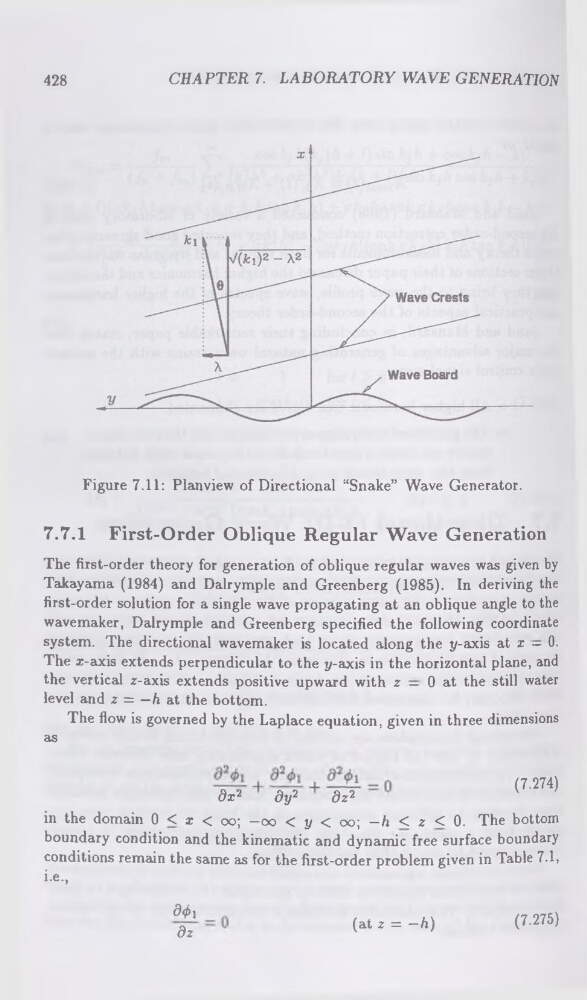
Figure 7.11: Planview of Directional “Snake” Wave Generator.
7.7.1 First-Order Oblique Regular Wave Generation
The first-order theory for generation of oblique regular waves was given by
Takayama (1984) and Dalrymple and Greenberg (1985). In deriving the
first-order solution for a single wave propagating at an oblique angle to the
wavemaker, Dalrymple and Greenberg specified the following coordinate
system. The directional wavemaker is located along the y-axis at x — 0.
The x-axis extends perpendicular to the j/-axis in the horizontal plane, and
the vertical z-axis extends positive upward with z — 0 at the still water
level and z = -h at the bottom.
The flow is governed by the Laplace equation, given in three dimensions
as
dx2
dy2
dz2
(7.274)
in the domain 0 < x < oo; -oo < y < oo; -h < z < 0. The bottom
boundary condition and the kinematic and dynamic free surface boundary
conditions remain the same as for the first-order problem given in Table 7.1,
i.e.,
Oh
dz
(at z = — h)
(7.275)
CHAPTER 7. LABORATORY WAVE GENERATION
Figure 7.11: Planview of Directional “Snake” Wave Generator.
7.7.1 First-Order Oblique Regular Wave Generation
The first-order theory for generation of oblique regular waves was given by
Takayama (1984) and Dalrymple and Greenberg (1985). In deriving the
first-order solution for a single wave propagating at an oblique angle to the
wavemaker, Dalrymple and Greenberg specified the following coordinate
system. The directional wavemaker is located along the y-axis at x — 0.
The x-axis extends perpendicular to the j/-axis in the horizontal plane, and
the vertical z-axis extends positive upward with z — 0 at the still water
level and z = -h at the bottom.
The flow is governed by the Laplace equation, given in three dimensions
as
dx2
dy2
dz2
(7.274)
in the domain 0 < x < oo; -oo < y < oo; -h < z < 0. The bottom
boundary condition and the kinematic and dynamic free surface boundary
conditions remain the same as for the first-order problem given in Table 7.1,
i.e.,
Oh
dz
(at z = — h)
(7.275)