

426
CHAPTER 7. LABORATORY WAVE GENERATION
^3.,
fm
cos kj h(kj(h + /) sin kj h 4- cos kj h — A)
~~ (/n + fm)
(kjh2 +
k h
4- 2
3 -— 2 ,
- crkjh2 - 2(TÀ?/A[tanh akjh] kjh tan fcj/i)Q3
Ç kj h “f“ crkjh J
(7.268)
with
1
for I > 0
A = cos(kjl) for I < 0
(7.269)
and
—kjh(kj h2 — akjh2)
3
(k2h2 4- crkjh2) cos kjh cosh akjh
for I > 0
(7.270)
—
2k2h2akjh sin kjlsinh akjl — kjh(kjh2 — crkjh2) cos kjl cosh akjl
(kjh2 4- crkjh2) cos kjh cosh akjh
for I < 0
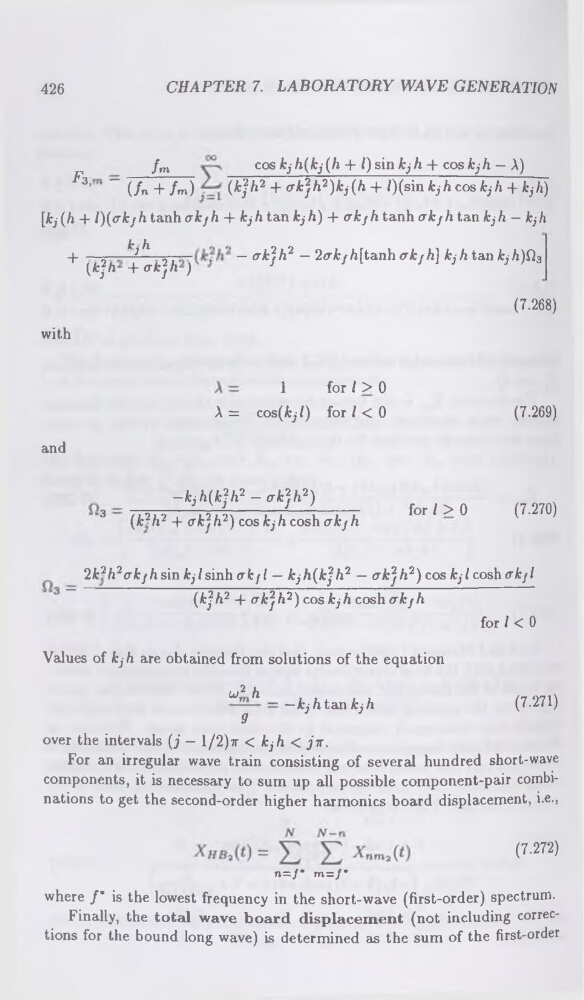
Values of kjh are obtained from solutions of the equation
u2 h
g
— kjh tan kjh
(7.271)
over the intervals (j - l/2)?r < kjh < jir.
For an irregular wave train consisting of several hundred short-wave
components, it is necessary to sum up all possible component-pair combinations to get the second-order higher harmonics board displacement, i.e.,
(7-272)
«=/ *
m=/ *
where f * is the lowest frequency in the short-wave (first-order) spectrum.
Finally, the total wave board displacement (not including corrections for the bound long wave) is determined as the sum of the first-order
CHAPTER 7. LABORATORY WAVE GENERATION
^3.,
fm
cos kj h(kj(h + /) sin kj h 4- cos kj h — A)
~~ (/n + fm)
(kjh2 +
k h
4- 2
3 -— 2 ,
- crkjh2 - 2(TÀ?/A[tanh akjh] kjh tan fcj/i)Q3
Ç kj h “f“ crkjh J
(7.268)
with
1
for I > 0
A = cos(kjl) for I < 0
(7.269)
and
—kjh(kj h2 — akjh2)
3
(k2h2 4- crkjh2) cos kjh cosh akjh
for I > 0
(7.270)
—
2k2h2akjh sin kjlsinh akjl — kjh(kjh2 — crkjh2) cos kjl cosh akjl
(kjh2 4- crkjh2) cos kjh cosh akjh
for I < 0
Values of kjh are obtained from solutions of the equation
u2 h
g
— kjh tan kjh
(7.271)
over the intervals (j - l/2)?r < kjh < jir.
For an irregular wave train consisting of several hundred short-wave
components, it is necessary to sum up all possible component-pair combinations to get the second-order higher harmonics board displacement, i.e.,
(7-272)
«=/ *
m=/ *
where f * is the lowest frequency in the short-wave (first-order) spectrum.
Finally, the total wave board displacement (not including corrections for the bound long wave) is determined as the sum of the first-order