

7.6. IRREGULAR (2-D) WAVE GENERATION
425
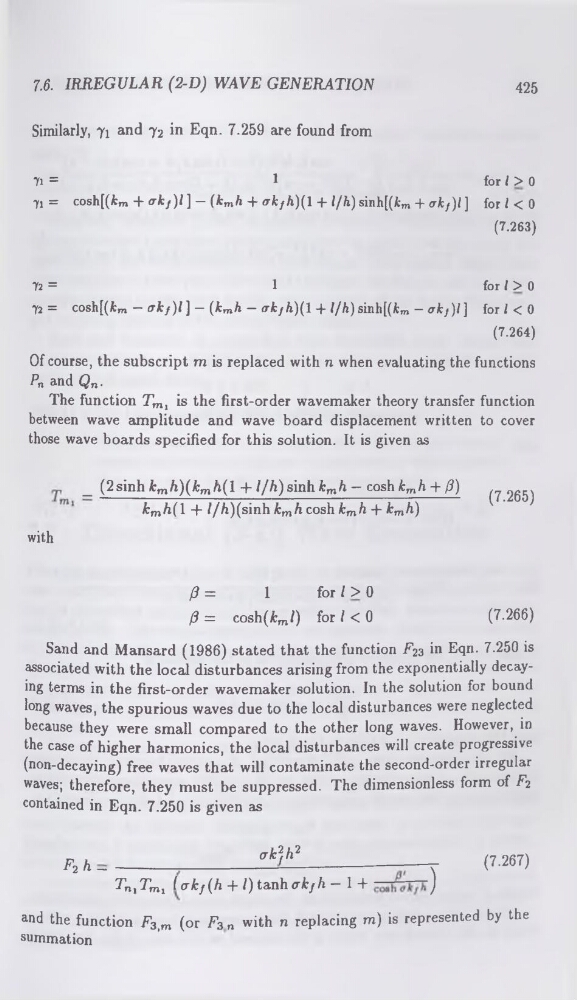
Similarly, 71 and 72 in Eqn. 7.259 are found from
7i =
1
71 = cosh[(fcm +
for I < 0
(7.263)
72 =
1
72 = cosh[(fcm —
for I < 0
(7.264)
Of course, the subscript m is replaced with n when evaluating the functions
Pn and Qn.
The function Tmi is the first-order wavemaker theory transfer function
between wave amplitude and wave board displacement written to cover
those wave boards specified for this solution. It is given as
_ (2sinh kmh)(kmh(l + l/h) sinh kmh — cosh kmh + (I)
kmh(I + Z//i)(sinh kmh cosh kmh + kmh)
with
(7.265)
(3 =
1
for I > 0
(3 = cosh(ArmZ) for I < 0
(7.266)
Sand and Mansard (1986) stated that the function F23 in Eqn. 7.250 is
associated with the local disturbances arising from the exponentially decaying terms in the first-order wavemaker solution. In the solution for bound
long waves, the spurious waves due to the local disturbances were neglected
because they were small compared to the other long waves. However, in
the case of higher harmonics, the local disturbances will create progressive
(non-decaying) free waves that will contaminate the second-order irregular
waves; therefore, they must be suppressed. The dimensionless form of F2
contained in Eqn. 7.250 is given as
ak2 fh2
F2hf
y
TniTrnï lakf(h + I) ta.nhakjh - 1 +
)
(7.267)
and the function F3>rn (or Fin with n replacing m) is represented by the
summation
425
Similarly, 71 and 72 in Eqn. 7.259 are found from
7i =
1
71 = cosh[(fcm +
for I < 0
(7.263)
72 =
1
72 = cosh[(fcm —
for I < 0
(7.264)
Of course, the subscript m is replaced with n when evaluating the functions
Pn and Qn.
The function Tmi is the first-order wavemaker theory transfer function
between wave amplitude and wave board displacement written to cover
those wave boards specified for this solution. It is given as
_ (2sinh kmh)(kmh(l + l/h) sinh kmh — cosh kmh + (I)
kmh(I + Z//i)(sinh kmh cosh kmh + kmh)
with
(7.265)
(3 =
1
for I > 0
(3 = cosh(ArmZ) for I < 0
(7.266)
Sand and Mansard (1986) stated that the function F23 in Eqn. 7.250 is
associated with the local disturbances arising from the exponentially decaying terms in the first-order wavemaker solution. In the solution for bound
long waves, the spurious waves due to the local disturbances were neglected
because they were small compared to the other long waves. However, in
the case of higher harmonics, the local disturbances will create progressive
(non-decaying) free waves that will contaminate the second-order irregular
waves; therefore, they must be suppressed. The dimensionless form of F2
contained in Eqn. 7.250 is given as
ak2 fh2
F2hf
y
TniTrnï lakf(h + I) ta.nhakjh - 1 +
)
(7.267)
and the function F3>rn (or Fin with n replacing m) is represented by the
summation