

422
CHAPTER 7. LABORATORY WAVE GENERATION
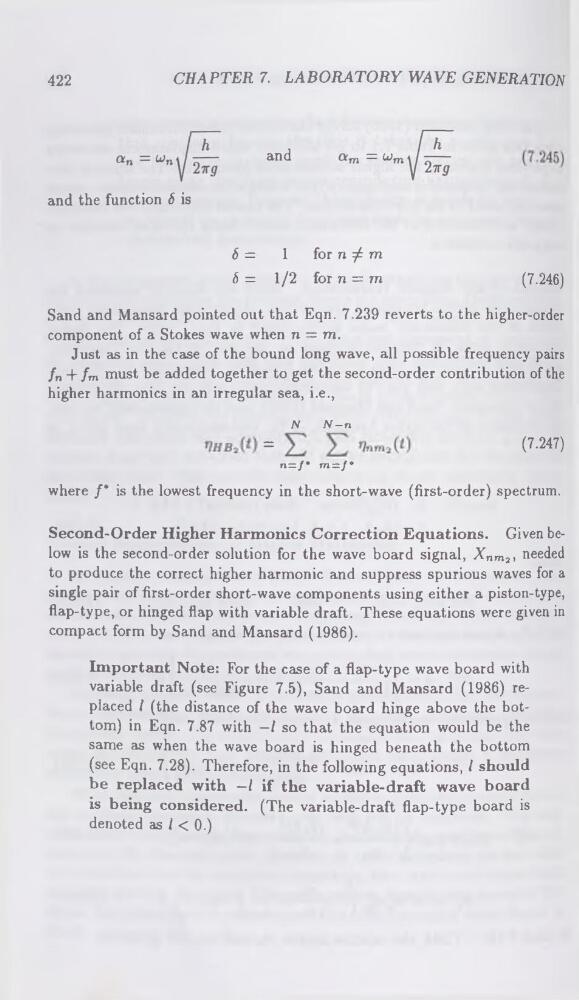
and
and the function 6 is
6 =
1
for n / m
è = 1/2 for n = m
(7.246)
Sand and Mansard pointed out that Eqn. 7.239 reverts to the higher-order
component of a Stokes wave when n = m.
Just as in the case of the bound long wave, all possible frequency pairs
fn + fm must be added together to get the second-order contribution of the
higher harmonics in an irregular sea, i.e.,
N
N-n
=
n=/ *
m=J°
(7.247)
where / * is the lowest frequency in the short-wave (first-order) spectrum.
Second-Order Higher Harmonics Correction Equations. Given below is the second-order solution for the wave board signal, Xnm2, needed
to produce the correct higher harmonic and suppress spurious waves for a
single pair of first-order short-wave components using either a piston-type,
flap-type, or hinged flap with variable draft. These equations were given in
compact form by Sand and Mansard (1986).
Important Note: For the case of a flap-type wave board with
variable draft (see Figure 7.5), Sand and Mansard (1986) replaced I (the distance of the wave board hinge above the bottom) in Eqn. 7.87 with —/ so that the equation would be the
same as when the wave board is hinged beneath the bottom
(see Eqn. 7.28). Therefore, in the following equations, I should
be replaced with — I if the variable-draft wave board
is being considered. (The variable-draft flap-type board is
denoted as I < 0.)
CHAPTER 7. LABORATORY WAVE GENERATION
and
and the function 6 is
6 =
1
for n / m
è = 1/2 for n = m
(7.246)
Sand and Mansard pointed out that Eqn. 7.239 reverts to the higher-order
component of a Stokes wave when n = m.
Just as in the case of the bound long wave, all possible frequency pairs
fn + fm must be added together to get the second-order contribution of the
higher harmonics in an irregular sea, i.e.,
N
N-n
=
n=/ *
m=J°
(7.247)
where / * is the lowest frequency in the short-wave (first-order) spectrum.
Second-Order Higher Harmonics Correction Equations. Given below is the second-order solution for the wave board signal, Xnm2, needed
to produce the correct higher harmonic and suppress spurious waves for a
single pair of first-order short-wave components using either a piston-type,
flap-type, or hinged flap with variable draft. These equations were given in
compact form by Sand and Mansard (1986).
Important Note: For the case of a flap-type wave board with
variable draft (see Figure 7.5), Sand and Mansard (1986) replaced I (the distance of the wave board hinge above the bottom) in Eqn. 7.87 with —/ so that the equation would be the
same as when the wave board is hinged beneath the bottom
(see Eqn. 7.28). Therefore, in the following equations, I should
be replaced with — I if the variable-draft wave board
is being considered. (The variable-draft flap-type board is
denoted as I < 0.)