

7.6. IRREGULAR (2-D) WAVE GENERATION
421
Sand and Mansard (1986) solved the second-order wavemaker governing
equations given in Table 7.1 to get the wave board displacement necessary
to produce correctly the higher second-order harmonics. The solution procedure they followed is analogous to the solution for the second-order bound
wave discussed in the previous section. The results from Sand and Mansard
(1986) are presented in the following sections using the same notation as
originally published.
Second-Order Higher Harmonics. Sand and Mansard examined the
second-order higher harmonics arising from the simplest wave group comprised of two first-order waves as expressed in Eqn. 7.210. The higher
harmonics occur at frequencies equal to the sum of the two first-order
component frequencies, even if the two first-order frequencies are identical.
Considering only that part of the second-order solution that contributed
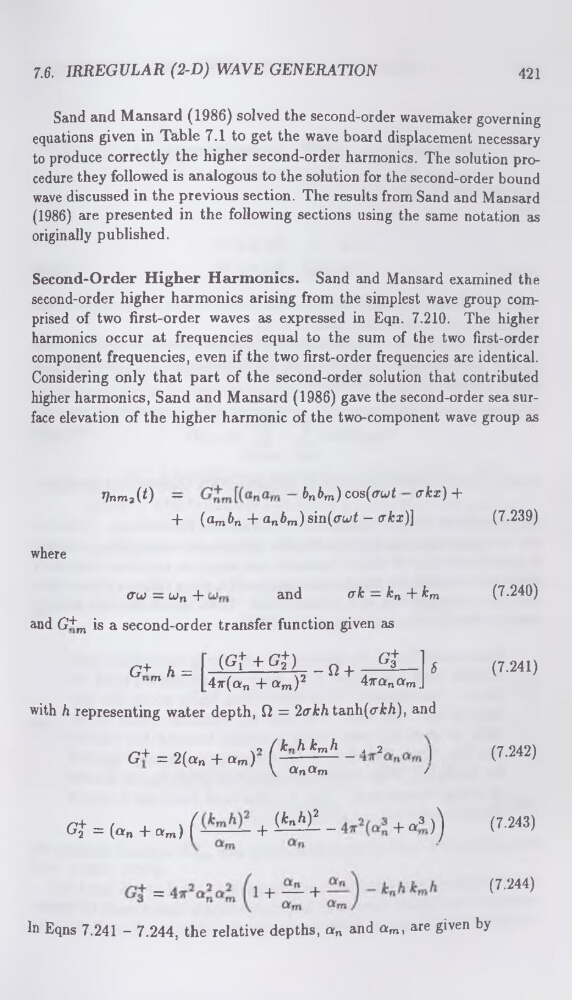
higher harmonics, Sand and Mansard (1986) gave the second-order sea surface elevation of the higher harmonic of the two-component wave group as
^nm3(0 —
6n6m) COs((TWf O~kx) +
+ (am6n+an6m) sin(crwf - afo:)]
(7.239)
where
aw — wn 4and
afc — kn 4- km
(7.240)
and G+m is a second-order transfer function given as
G+mh =
(Gt + Gt)__a+_GL_]6
47r(an + am)2
47ranam_
with h representing water depth, Q = 2c kh tanh(crfc/i), and
j
n (krih kmh
j 2
I
G + = 2(ttn 4- Ofm) (--------------1
\ O!nO!m
/
(7.241)
(7.242)
Gi = (a„ + am) (+ &ÈE _
+ «’))
(7.243)
=
+ - +
(7-244)
In Eqns 7.241 - 7.244, the relative depths, an and am, are given by
421
Sand and Mansard (1986) solved the second-order wavemaker governing
equations given in Table 7.1 to get the wave board displacement necessary
to produce correctly the higher second-order harmonics. The solution procedure they followed is analogous to the solution for the second-order bound
wave discussed in the previous section. The results from Sand and Mansard
(1986) are presented in the following sections using the same notation as
originally published.
Second-Order Higher Harmonics. Sand and Mansard examined the
second-order higher harmonics arising from the simplest wave group comprised of two first-order waves as expressed in Eqn. 7.210. The higher
harmonics occur at frequencies equal to the sum of the two first-order
component frequencies, even if the two first-order frequencies are identical.
Considering only that part of the second-order solution that contributed
higher harmonics, Sand and Mansard (1986) gave the second-order sea surface elevation of the higher harmonic of the two-component wave group as
^nm3(0 —
6n6m) COs((TWf O~kx) +
+ (am6n+an6m) sin(crwf - afo:)]
(7.239)
where
aw — wn 4and
afc — kn 4- km
(7.240)
and G+m is a second-order transfer function given as
G+mh =
(Gt + Gt)__a+_GL_]6
47r(an + am)2
47ranam_
with h representing water depth, Q = 2c kh tanh(crfc/i), and
j
n (krih kmh
j 2
I
G + = 2(ttn 4- Ofm) (--------------1
\ O!nO!m
/
(7.241)
(7.242)
Gi = (a„ + am) (+ &ÈE _
+ «’))
(7.243)
=
+ - +
(7-244)
In Eqns 7.241 - 7.244, the relative depths, an and am, are given by