

414
CHAPTER 7. LABORATORY WAVE GENERATION
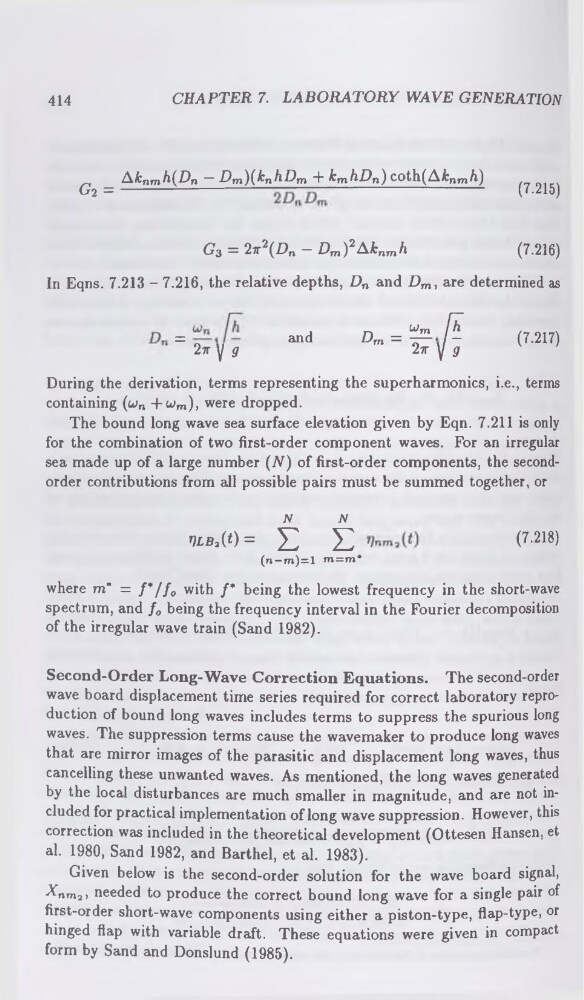
Aknmh(Dn — Dm)(knhDm 4- kmhDn} coth(A£nm/i)
°2 =----------------(7'215>
G3 = 27T2(Pn - Dmysknmh
(7.216)
In Eqns. 7.213 - 7.216, the relative depths, Dn and Dm, are determined as
=
and
Om=^/F
(7.217)
2% y g
27T y g
During the derivation, terms representing the superharmonics, i.e., terms
containing (wn 4-tUm), were dropped.
The bound long wave sea surface elevation given by Eqn. 7.211 is only
for the combination of two first-order component waves. For an irregular
sea made up of a large number (TV) of first-order components, the secondorder contributions from all possible pairs must be summed together, or
N
N
ilbm= £ £
<7-218)
(n-m)=l m=m *
where m‘ = f * /f 0 with / * being the lowest frequency in the short-wave
spectrum, and fo being the frequency interval in the Fourier decomposition
of the irregular wave train (Sand 1982).
Second-Order Long-Wave Correction Equations. The second-order
wave board displacement time series required for correct laboratory reproduction of bound long waves includes terms to suppress the spurious long
waves. The suppression terms cause the wavemaker to produce long waves
that are mirror images of the parasitic and displacement long waves, thus
cancelling these unwanted waves. As mentioned, the long waves generated
by the local disturbances are much smaller in magnitude, and are not included for practical implementation of long wave suppression. However, this
correction was included in the theoretical development (Ottesen Hansen, et
al. 1980, Sand 1982, and Barthel, et al. 1983).
Given below is the second-order solution for the wave board signal,
Xnm-t > needed to produce the correct bound long wave for a single pair of
first-order short-wave components using either a piston-type, flap-type, or
hinged flap with variable draft. These equations were given in compact
form by Sand and Donslund (1985).
CHAPTER 7. LABORATORY WAVE GENERATION
Aknmh(Dn — Dm)(knhDm 4- kmhDn} coth(A£nm/i)
°2 =----------------(7'215>
G3 = 27T2(Pn - Dmysknmh
(7.216)
In Eqns. 7.213 - 7.216, the relative depths, Dn and Dm, are determined as
=
and
Om=^/F
(7.217)
2% y g
27T y g
During the derivation, terms representing the superharmonics, i.e., terms
containing (wn 4-tUm), were dropped.
The bound long wave sea surface elevation given by Eqn. 7.211 is only
for the combination of two first-order component waves. For an irregular
sea made up of a large number (TV) of first-order components, the secondorder contributions from all possible pairs must be summed together, or
N
N
ilbm= £ £
<7-218)
(n-m)=l m=m *
where m‘ = f * /f 0 with / * being the lowest frequency in the short-wave
spectrum, and fo being the frequency interval in the Fourier decomposition
of the irregular wave train (Sand 1982).
Second-Order Long-Wave Correction Equations. The second-order
wave board displacement time series required for correct laboratory reproduction of bound long waves includes terms to suppress the spurious long
waves. The suppression terms cause the wavemaker to produce long waves
that are mirror images of the parasitic and displacement long waves, thus
cancelling these unwanted waves. As mentioned, the long waves generated
by the local disturbances are much smaller in magnitude, and are not included for practical implementation of long wave suppression. However, this
correction was included in the theoretical development (Ottesen Hansen, et
al. 1980, Sand 1982, and Barthel, et al. 1983).
Given below is the second-order solution for the wave board signal,
Xnm-t > needed to produce the correct bound long wave for a single pair of
first-order short-wave components using either a piston-type, flap-type, or
hinged flap with variable draft. These equations were given in compact
form by Sand and Donslund (1985).