

7.6. IRREGULAR (2-D) WAVE GENERATION
413
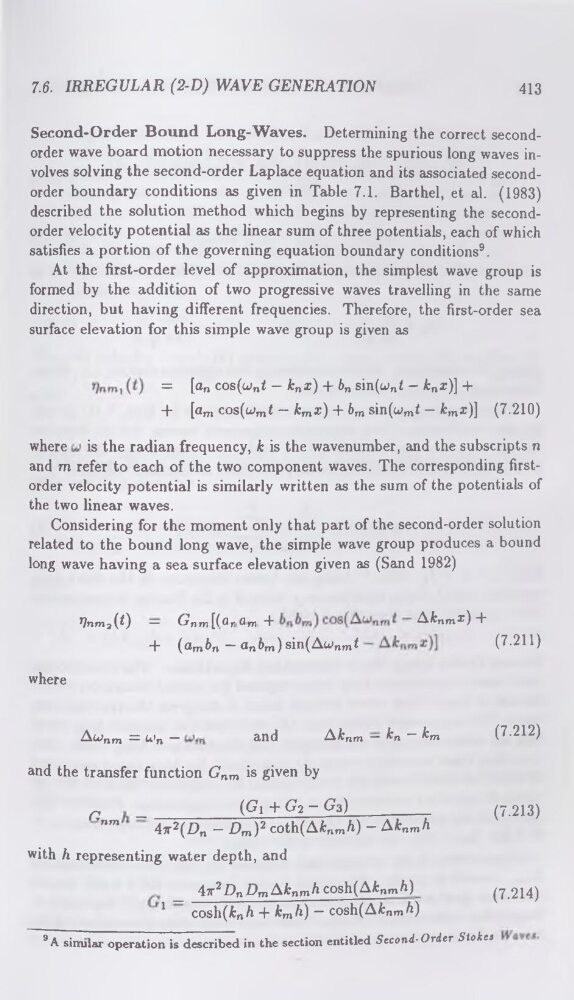
Second-Order Bound Long-Waves. Determining the correct secondorder wave board motion necessary to suppress the spurious long waves involves solving the second-order Laplace equation and its associated secondorder boundary conditions as given in Table 7.1. Barthel, et al. (1983)
described the solution method which begins by representing the secondorder velocity potential as the linear sum of three potentials, each of which
satisfies a portion of the governing equation boundary conditions9.
At the first-order level of approximation, the simplest wave group is
formed by the addition of two progressive waves travelling in the same
direction, but having different frequencies. Therefore, the first-order sea
surface elevation for this simple wave group is given as
= [fln cos(wnZ - knx) + bn sin(wnf - knx)\ +
+ [am cos(cumf - kmx) + bm sin(cumt - kmx)] (7.210)
where is the radian frequency, k is the wavenumber, and the subscripts n
and m refer to each of the two component waves. The corresponding firstorder velocity potential is similarly written as the sum of the potentials of
the two linear waves.
Considering for the moment only that part of the second-order solution
related to the bound long wave, the simple wave group produces a bound
long wave having a sea surface elevation given as (Sand 1982)
r)nm2(t) — Gnm[(,anam +
^knmx) +
+ ( am bn - an bm ) sin( Awnm t
(7.211)
where
Au>nm = u>n —
and
Aknm — kn — km
(7.212)
and the transfer function Gnrn is given by
r
_ ___________ (Gi +G2~ G3) _______
(7.213)
nm
4ir\Dn — Dmy coth(Afcnm/i) — &knrnh
with h representing water depth, and
_ 4tt2DnDm&knmh cosh(Afcnrnh)
(7.214)
1
cosh(fcn/i + kmh) — cosh ( A £nm/i)
9 A similar operation is described in the section entitled Second- Order Stokes
413
Second-Order Bound Long-Waves. Determining the correct secondorder wave board motion necessary to suppress the spurious long waves involves solving the second-order Laplace equation and its associated secondorder boundary conditions as given in Table 7.1. Barthel, et al. (1983)
described the solution method which begins by representing the secondorder velocity potential as the linear sum of three potentials, each of which
satisfies a portion of the governing equation boundary conditions9.
At the first-order level of approximation, the simplest wave group is
formed by the addition of two progressive waves travelling in the same
direction, but having different frequencies. Therefore, the first-order sea
surface elevation for this simple wave group is given as
= [fln cos(wnZ - knx) + bn sin(wnf - knx)\ +
+ [am cos(cumf - kmx) + bm sin(cumt - kmx)] (7.210)
where is the radian frequency, k is the wavenumber, and the subscripts n
and m refer to each of the two component waves. The corresponding firstorder velocity potential is similarly written as the sum of the potentials of
the two linear waves.
Considering for the moment only that part of the second-order solution
related to the bound long wave, the simple wave group produces a bound
long wave having a sea surface elevation given as (Sand 1982)
r)nm2(t) — Gnm[(,anam +
^knmx) +
+ ( am bn - an bm ) sin( Awnm t
(7.211)
where
Au>nm = u>n —
and
Aknm — kn — km
(7.212)
and the transfer function Gnrn is given by
r
_ ___________ (Gi +G2~ G3) _______
(7.213)
nm
4ir\Dn — Dmy coth(Afcnm/i) — &knrnh
with h representing water depth, and
_ 4tt2DnDm&knmh cosh(Afcnrnh)
(7.214)
1
cosh(fcn/i + kmh) — cosh ( A £nm/i)
9 A similar operation is described in the section entitled Second- Order Stokes