

366
CHAPTER 7. LABORATORY WAVE GENERATION
the plunger motion. Equation 7.111 assumes that there is no horizontal
flow though the plane beneath the plunger at x = 0.
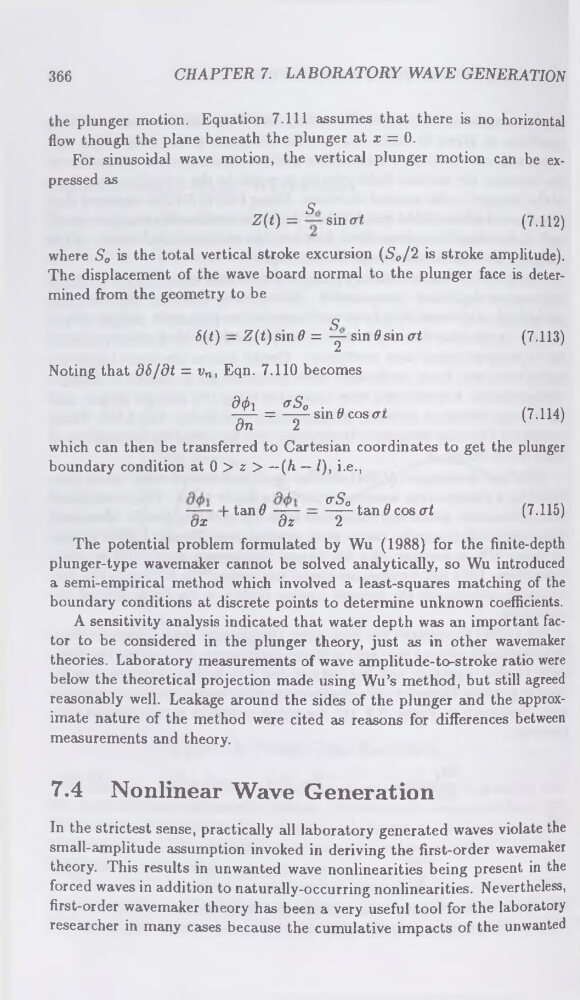
For sinusoidal wave motion, the vertical plunger motion can be expressed as
s
Z(t) =
sin at
(7.112)
where So is the total vertical stroke excursion (So/2 is stroke amplitude).
The displacement of the wave board normal to the plunger face is determined from the geometry to be
S
6(t) — Z(t ) sin 0 = -y- sin 0 sin at
Noting that df>/dt = vn, Eqn. 7.110 becomes
dfa
dn
2
(7.113)
(7-114)
which can then be transferred to Cartesian coordinates to get the plunger
boundary condition at 0 > z > — (/i — Z), i.e.,
I x a
°S0 . a
.
z7 i1(-\
—
F tan 0 -T— — —— tan 0 cos at
(7.115)
ox
dz
2
The potential problem formulated by Wu (1988) for the finite-depth
plunger-type wavemaker cannot be solved analytically, so Wu introduced
a semi-empirical method which involved a least-squares matching of the
boundary conditions at discrete points to determine unknown coefficients.
A sensitivity analysis indicated that water depth was an important factor to be considered in the plunger theory, just as in other wavemaker
theories. Laboratory measurements of wave amplitude-to-stroke ratio were
below the theoretical projection made using Wu’s method, but still agreed
reasonably well. Leakage around the sides of the plunger and the approximate nature of the method were cited as reasons for differences between
measurements and theory.
7.4 Nonlinear Wave Generation
In the strictest sense, practically all laboratory generated waves violate the
small-amplitude assumption invoked in deriving the first-order wavemaker
theory. This results in unwanted wave nonlinearities being present in the
forced waves in addition to naturally-occurring nonlinearities. Nevertheless,
first-order wavemaker theory has been a very useful tool for the laboratory
researcher in many cases because the cumulative impacts of the unwanted
CHAPTER 7. LABORATORY WAVE GENERATION
the plunger motion. Equation 7.111 assumes that there is no horizontal
flow though the plane beneath the plunger at x = 0.
For sinusoidal wave motion, the vertical plunger motion can be expressed as
s
Z(t) =
sin at
(7.112)
where So is the total vertical stroke excursion (So/2 is stroke amplitude).
The displacement of the wave board normal to the plunger face is determined from the geometry to be
S
6(t) — Z(t ) sin 0 = -y- sin 0 sin at
Noting that df>/dt = vn, Eqn. 7.110 becomes
dfa
dn
2
(7.113)
(7-114)
which can then be transferred to Cartesian coordinates to get the plunger
boundary condition at 0 > z > — (/i — Z), i.e.,
I x a
°S0 . a
.
z7 i1(-\
—
F tan 0 -T— — —— tan 0 cos at
(7.115)
ox
dz
2
The potential problem formulated by Wu (1988) for the finite-depth
plunger-type wavemaker cannot be solved analytically, so Wu introduced
a semi-empirical method which involved a least-squares matching of the
boundary conditions at discrete points to determine unknown coefficients.
A sensitivity analysis indicated that water depth was an important factor to be considered in the plunger theory, just as in other wavemaker
theories. Laboratory measurements of wave amplitude-to-stroke ratio were
below the theoretical projection made using Wu’s method, but still agreed
reasonably well. Leakage around the sides of the plunger and the approximate nature of the method were cited as reasons for differences between
measurements and theory.
7.4 Nonlinear Wave Generation
In the strictest sense, practically all laboratory generated waves violate the
small-amplitude assumption invoked in deriving the first-order wavemaker
theory. This results in unwanted wave nonlinearities being present in the
forced waves in addition to naturally-occurring nonlinearities. Nevertheless,
first-order wavemaker theory has been a very useful tool for the laboratory
researcher in many cases because the cumulative impacts of the unwanted