

7.3. FIRST-ORDER WAVE GENERATION
365
Laplace equation, free surface boundary condition, and bottom boundary
condition as given in Table 7.1. At far distances from the plunger, the
waves take on the form of progressive uniform waves; and at the surface of
the plunger, the normal fluid velocity is equal to the velocity component
of the plunger in the normal direction. Wang (1974) further assumed that
the physical plane of the plunger face could be conformally mapped into a
unit circle using two parameters; however, the mathematical details of the
mapping are beyond the scope of this chapter.
Wang (1974) stated that any plunger shape other than a circle or ellipse
will require significant computation. He believed, however, that far from
the plunger the wave height is not sensitive to geometric details of the
plunger other than its width at z = 0, its draft in its neutral position,
and a cross-sectional area coefficient. Design curves for wave height-tostroke ratio and force coefficients were presented for a variety of plunger
configurations. Experiments were conducted using two plunger shapes, and
the average deviation between measurements and theory was 6.5%. Wang
postulated that the deepwater theory may also be useful for estimations of
finite-depth waves.
Ellix and Arumugam (1984) studied first- and second-order waves generated by a plunger-type wavemaker in finite-depth water. They considered
second harmonic waves and reflections from the spending beach. Measured
wave amplitude-to-stroke ratios were smaller than Wang’s (1974) theory
by about 20% on average with the largest discrepancy about 50% at lower
frequencies. Ellix and Arumugam stated that part of the difference was due
to leakage underneath the plunger causing motion in the flume behind the
wavemaker.
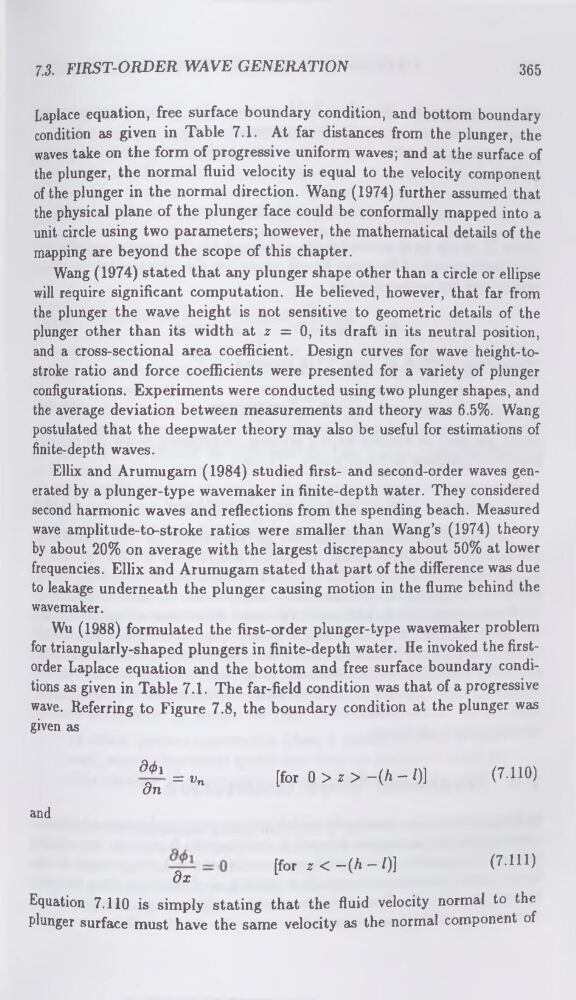
Wu (1988) formulated the first-order plunger-type wavemaker problem
for triangularly-shaped plungers in finite-depth water. He invoked the firstorder Laplace equation and the bottom and free surface boundary conditions as given in Table 7.1. The far-field condition was that of a progressive
wave. Referring to Figure 7.8, the boundary condition at the plunger was
given as
and
^1 _
dn ~Vn
[for 0 > z > —(h — 01
(7.110)
dx
[for z < — (A — /)]
(7.U1)
Equation 7.110 is simply stating that the fluid velocity normal to the
plunger surface must have the same velocity as the normal component of
365
Laplace equation, free surface boundary condition, and bottom boundary
condition as given in Table 7.1. At far distances from the plunger, the
waves take on the form of progressive uniform waves; and at the surface of
the plunger, the normal fluid velocity is equal to the velocity component
of the plunger in the normal direction. Wang (1974) further assumed that
the physical plane of the plunger face could be conformally mapped into a
unit circle using two parameters; however, the mathematical details of the
mapping are beyond the scope of this chapter.
Wang (1974) stated that any plunger shape other than a circle or ellipse
will require significant computation. He believed, however, that far from
the plunger the wave height is not sensitive to geometric details of the
plunger other than its width at z = 0, its draft in its neutral position,
and a cross-sectional area coefficient. Design curves for wave height-tostroke ratio and force coefficients were presented for a variety of plunger
configurations. Experiments were conducted using two plunger shapes, and
the average deviation between measurements and theory was 6.5%. Wang
postulated that the deepwater theory may also be useful for estimations of
finite-depth waves.
Ellix and Arumugam (1984) studied first- and second-order waves generated by a plunger-type wavemaker in finite-depth water. They considered
second harmonic waves and reflections from the spending beach. Measured
wave amplitude-to-stroke ratios were smaller than Wang’s (1974) theory
by about 20% on average with the largest discrepancy about 50% at lower
frequencies. Ellix and Arumugam stated that part of the difference was due
to leakage underneath the plunger causing motion in the flume behind the
wavemaker.
Wu (1988) formulated the first-order plunger-type wavemaker problem
for triangularly-shaped plungers in finite-depth water. He invoked the firstorder Laplace equation and the bottom and free surface boundary conditions as given in Table 7.1. The far-field condition was that of a progressive
wave. Referring to Figure 7.8, the boundary condition at the plunger was
given as
and
^1 _
dn ~Vn
[for 0 > z > —(h — 01
(7.110)
dx
[for z < — (A — /)]
(7.U1)
Equation 7.110 is simply stating that the fluid velocity normal to the
plunger surface must have the same velocity as the normal component of