

7.3. FIRST-ORDER WAVE GENERATION
363
wavemakers were designed with a draft of 2/3 the maximum wave tank
depth (i.e., f — ^/3)
allow future simultaneous injection of currents
into the wave tank. Leakage around the wave board was recognized as a
problem, so efforts were made to minimize leakage to the extent possible.
Wave height measurements were corrected for reflection from the absorbing
beach at the opposite end of the wave tank. Both wavemakers were used
to generate regular waves in a constant water depth of 1 m.
Comparison of theory and measurement for the flap-type wave board
was reported by Patel and lonnaou to be excellent for low steepness waves
(0.0056 < H/L < 0.02) with the eight data points showing about 2%
scatter about the theoretical curve. Waves with higher steepness (0.02 <
H/L < 0.046) exhibited a mean deviation of wave amplitude-to-stroke ratio
that was about 3% above the theoretical projection. They attributed this
deviation to their first-order method for correcting the measurements for
reflection.
Patel and lonnaou’s (1980) measurements from the wedge-type wave
generator produced values of wave height-to-stroke ratio that were about
9.6% below the theoretical values; however, scatter about the experimental
trend was stated to be low (æ 2%). It was not possible to seal adequately
between the wedge and supporting incline, and leakage was thought to be
the cause of this discrepancy between measurements and theory.
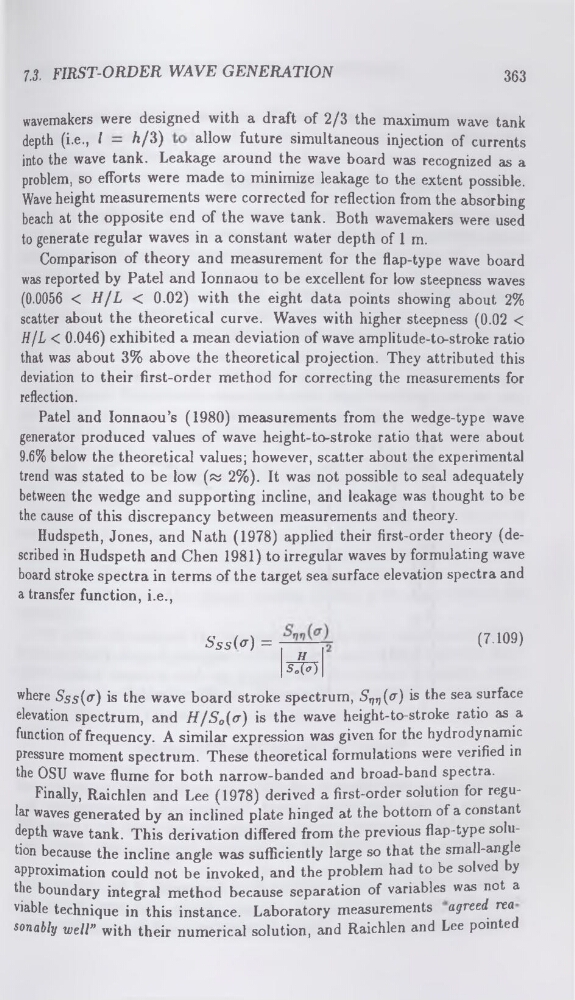
Hudspeth, Jones, and Nath (1978) applied their first-order theory (described in Hudspeth and Chen 1981) to irregular waves by formulating wave
board stroke spectra in terms of the target sea surface elevation spectra and
a transfer function, i.e.,
Sss(a) =
(7.109)
|^|
where Sss(
function of frequency. A similar expression was given for the hydrodynamic
pressure moment spectrum. These theoretical formulations were verified in
the OSU wave flume for both narrow-banded and broad-band spectra.
Finally, Raichlen and Lee (1978) derived a first-order solution for regular waves generated by an inclined plate hinged at the bottom of a constant
depth wave tank. This derivation differed from the previous flap-type solution because the incline angle was sufficiently large so that the small-angle
approximation could not be invoked, and the problem had to be solved by
the boundary integral method because separation of variables was not a
viable technique in this instance. Laboratory measurements agreed rea
sonably well” with their numerical solution, and Raichlen and Lee pointed
363
wavemakers were designed with a draft of 2/3 the maximum wave tank
depth (i.e., f — ^/3)
allow future simultaneous injection of currents
into the wave tank. Leakage around the wave board was recognized as a
problem, so efforts were made to minimize leakage to the extent possible.
Wave height measurements were corrected for reflection from the absorbing
beach at the opposite end of the wave tank. Both wavemakers were used
to generate regular waves in a constant water depth of 1 m.
Comparison of theory and measurement for the flap-type wave board
was reported by Patel and lonnaou to be excellent for low steepness waves
(0.0056 < H/L < 0.02) with the eight data points showing about 2%
scatter about the theoretical curve. Waves with higher steepness (0.02 <
H/L < 0.046) exhibited a mean deviation of wave amplitude-to-stroke ratio
that was about 3% above the theoretical projection. They attributed this
deviation to their first-order method for correcting the measurements for
reflection.
Patel and lonnaou’s (1980) measurements from the wedge-type wave
generator produced values of wave height-to-stroke ratio that were about
9.6% below the theoretical values; however, scatter about the experimental
trend was stated to be low (æ 2%). It was not possible to seal adequately
between the wedge and supporting incline, and leakage was thought to be
the cause of this discrepancy between measurements and theory.
Hudspeth, Jones, and Nath (1978) applied their first-order theory (described in Hudspeth and Chen 1981) to irregular waves by formulating wave
board stroke spectra in terms of the target sea surface elevation spectra and
a transfer function, i.e.,
Sss(a) =
(7.109)
|^|
where Sss(
function of frequency. A similar expression was given for the hydrodynamic
pressure moment spectrum. These theoretical formulations were verified in
the OSU wave flume for both narrow-banded and broad-band spectra.
Finally, Raichlen and Lee (1978) derived a first-order solution for regular waves generated by an inclined plate hinged at the bottom of a constant
depth wave tank. This derivation differed from the previous flap-type solution because the incline angle was sufficiently large so that the small-angle
approximation could not be invoked, and the problem had to be solved by
the boundary integral method because separation of variables was not a
viable technique in this instance. Laboratory measurements agreed rea
sonably well” with their numerical solution, and Raichlen and Lee pointed