

290
CHAPTER 6. SEDIMENT TRANSPORT MODELS
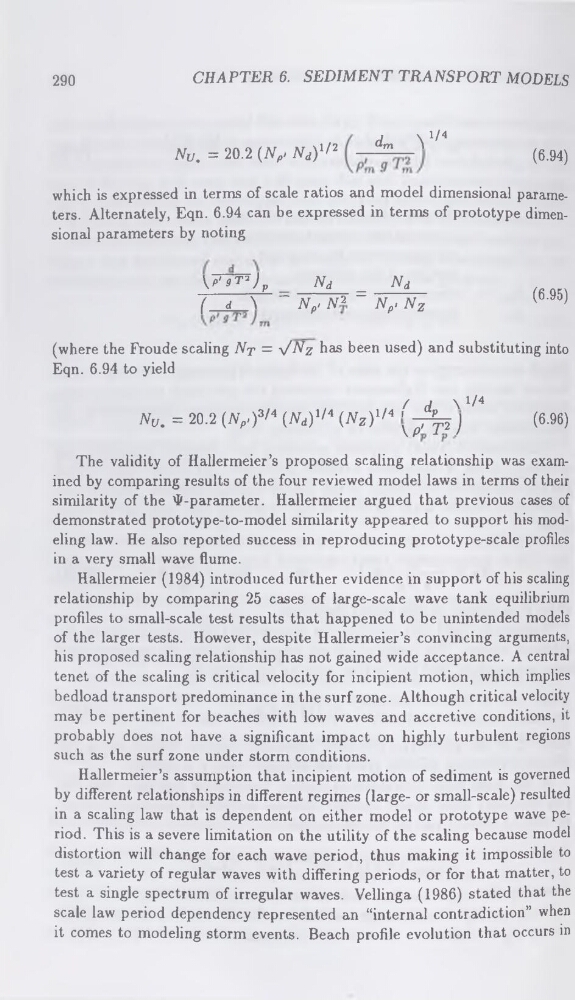
Nu, = 20.2 (Np> Ndy'2
d
\1/4
um
1
(6.94)
which is expressed in terms of scale ratios and model dimensional parameters. Alternately, Eqn. 6.94 can be expressed in terms of prototype dimensional parameters by noting
\p'gT^)p
Nd _
Nd
( d \ “ Np> N2 ~ Np> Nz
(6.95)
(where the Froude scaling Nr = \/Nz has been used) and substituting into
Eqn. 6.94 to yield
Ny, = 20.2 (TVp/)3/4 (Mi)1/4 (ATZ)1/4
/ d \V4
I
P
I
\P' T2 )
(6.96)
The validity of Hallermeier’s proposed scaling relationship was examined by comparing results of the four reviewed model laws in terms of their
similarity of the 'P-parameter. Hallermeier argued that previous cases of
demonstrated prototype-to-model similarity appeared to support his modeling law. He also reported success in reproducing prototype-scale profiles
in a very small wave flume.
Hallermeier (1984) introduced further evidence in support of his scaling
relationship by comparing 25 cases of large-scale wave tank equilibrium
profiles to small-scale test results that happened to be unintended models
of the larger tests. However, despite Hallermeier’s convincing arguments,
his proposed scaling relationship has not gained wide acceptance. A central
tenet of the scaling is critical velocity for incipient motion, which implies
bedload transport predominance in the surf zone. Although critical velocity
may be pertinent for beaches with low waves and accretive conditions, it
probably does not have a significant impact on highly turbulent regions
such as the surf zone under storm conditions.
Hallermeier’s assumption that incipient motion of sediment is governed
by different relationships in different regimes (large- or small-scale) resulted
in a scaling law that is dependent on either model or prototype wave period. This is a severe limitation on the utility of the scaling because model
distortion will change for each wave period, thus making it impossible to
test a variety of regular waves with differing periods, or for that matter, to
test a single spectrum of irregular waves. Vellinga (1986) stated that the
scale law period dependency represented an “internal contradiction” when
it comes to modeling storm events. Beach profile evolution that occurs in
CHAPTER 6. SEDIMENT TRANSPORT MODELS
Nu, = 20.2 (Np> Ndy'2
d
\1/4
um
1
(6.94)
which is expressed in terms of scale ratios and model dimensional parameters. Alternately, Eqn. 6.94 can be expressed in terms of prototype dimensional parameters by noting
\p'gT^)p
Nd _
Nd
( d \ “ Np> N2 ~ Np> Nz
(6.95)
(where the Froude scaling Nr = \/Nz has been used) and substituting into
Eqn. 6.94 to yield
Ny, = 20.2 (TVp/)3/4 (Mi)1/4 (ATZ)1/4
/ d \V4
I
P
I
\P' T2 )
(6.96)
The validity of Hallermeier’s proposed scaling relationship was examined by comparing results of the four reviewed model laws in terms of their
similarity of the 'P-parameter. Hallermeier argued that previous cases of
demonstrated prototype-to-model similarity appeared to support his modeling law. He also reported success in reproducing prototype-scale profiles
in a very small wave flume.
Hallermeier (1984) introduced further evidence in support of his scaling
relationship by comparing 25 cases of large-scale wave tank equilibrium
profiles to small-scale test results that happened to be unintended models
of the larger tests. However, despite Hallermeier’s convincing arguments,
his proposed scaling relationship has not gained wide acceptance. A central
tenet of the scaling is critical velocity for incipient motion, which implies
bedload transport predominance in the surf zone. Although critical velocity
may be pertinent for beaches with low waves and accretive conditions, it
probably does not have a significant impact on highly turbulent regions
such as the surf zone under storm conditions.
Hallermeier’s assumption that incipient motion of sediment is governed
by different relationships in different regimes (large- or small-scale) resulted
in a scaling law that is dependent on either model or prototype wave period. This is a severe limitation on the utility of the scaling because model
distortion will change for each wave period, thus making it impossible to
test a variety of regular waves with differing periods, or for that matter, to
test a single spectrum of irregular waves. Vellinga (1986) stated that the
scale law period dependency represented an “internal contradiction” when
it comes to modeling storm events. Beach profile evolution that occurs in