

6.4. SUSPENSION-DOMINATED MODELS
289
K
Lz
where
Vx - characteristic horizontal velocity
Vz - characteristic vertical velocity
U *
- critical velocity for incipient
motion of the sediment
Lx - characteristic horizontal length
Lz - characteristic vertical length
(6.90)
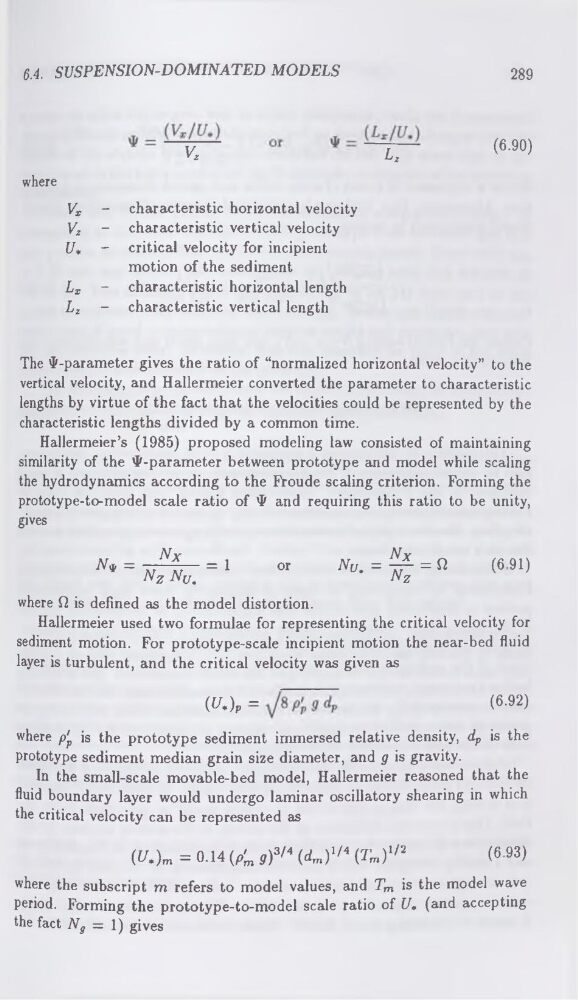
The ^-parameter gives the ratio of “normalized horizontal velocity” to the
vertical velocity, and Hallermeier converted the parameter to characteristic
lengths by virtue of the fact that the velocities could be represented by the
characteristic lengths divided by a common time.
Hallermeier’s (1985) proposed modeling law consisted of maintaining
similarity of the ^-parameter between prototype and model while scaling
the hydrodynamics according to the Froude scaling criterion. Forming the
prototype-to-model scale ratio of 'F and requiring this ratio to be unity,
gives
Ny
Nx
n^n^.=1
or
Nv- = ^ = a
<691)
where Q is defined as the model distortion.
Hallermeier used two formulae for representing the critical velocity for
sediment motion. For prototype-scale incipient motion the near-bed fluid
layer is turbulent, and the critical velocity was given as
(t/.)p =
(6.92)
where p'p is the prototype sediment immersed relative density, dp is the
prototype sediment median grain size diameter, and g is gravity.
In the small-scale movable-bed model, Hallermeier reasoned that the
fluid boundary layer would undergo laminar oscillatory shearing in which
the critical velocity can be represented as
((/.)„ = 0.14 (p'm g)3/* (dm)1/4 (Tra)1/2
(6 93)
where the subscript m refers to model values, and Tm is the model wave
period. Forming the prototype-to-model scale ratio of U * (and accepting
the fact Ng = 1) gives
289
K
Lz
where
Vx - characteristic horizontal velocity
Vz - characteristic vertical velocity
U *
- critical velocity for incipient
motion of the sediment
Lx - characteristic horizontal length
Lz - characteristic vertical length
(6.90)
The ^-parameter gives the ratio of “normalized horizontal velocity” to the
vertical velocity, and Hallermeier converted the parameter to characteristic
lengths by virtue of the fact that the velocities could be represented by the
characteristic lengths divided by a common time.
Hallermeier’s (1985) proposed modeling law consisted of maintaining
similarity of the ^-parameter between prototype and model while scaling
the hydrodynamics according to the Froude scaling criterion. Forming the
prototype-to-model scale ratio of 'F and requiring this ratio to be unity,
gives
Ny
Nx
n^n^.=1
or
Nv- = ^ = a
<691)
where Q is defined as the model distortion.
Hallermeier used two formulae for representing the critical velocity for
sediment motion. For prototype-scale incipient motion the near-bed fluid
layer is turbulent, and the critical velocity was given as
(t/.)p =
(6.92)
where p'p is the prototype sediment immersed relative density, dp is the
prototype sediment median grain size diameter, and g is gravity.
In the small-scale movable-bed model, Hallermeier reasoned that the
fluid boundary layer would undergo laminar oscillatory shearing in which
the critical velocity can be represented as
((/.)„ = 0.14 (p'm g)3/* (dm)1/4 (Tra)1/2
(6 93)
where the subscript m refers to model values, and Tm is the model wave
period. Forming the prototype-to-model scale ratio of U * (and accepting
the fact Ng = 1) gives