

282
CHAPTER 6. SEDIMENT TRANSPORT MODELS
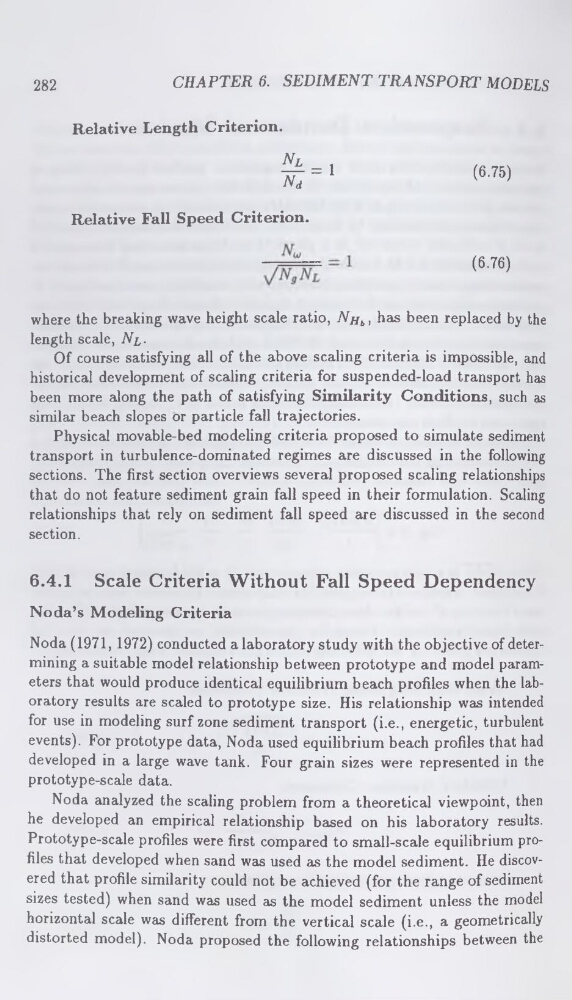
Relative Length Criterion.
^=1
Nd
(6.75)
Relative Fall Speed Criterion.
(6.76)
where the breaking wave height scale ratio, Nub, has been replaced by the
length scale, N^.
Of course satisfying all of the above scaling criteria is impossible, and
historical development of scaling criteria for suspended-load transport has
been more along the path of satisfying Similarity Conditions, such as
similar beach slopes or particle fall trajectories.
Physical movable-bed modeling criteria proposed to simulate sediment
transport in turbulence-dominated regimes are discussed in the following
sections. The first section overviews several proposed scaling relationships
that do not feature sediment grain fall speed in their formulation. Scaling
relationships that rely on sediment fall speed are discussed in the second
section.
6.4.1 Scale Criteria Without Fall Speed Dependency
Noda’s Modeling Criteria
Noda (1971, 1972) conducted a laboratory study with the objective of determining a suitable model relationship between prototype and model parameters that would produce identical equilibrium beach profiles when the laboratory results are scaled to prototype size. His relationship was intended
for use in modeling surf zone sediment transport (i.e., energetic, turbulent
events). For prototype data, Noda used equilibrium beach profiles that had
developed in a large wave tank. Four grain sizes were represented in the
prototype-scale data.
Noda analyzed the scaling problem from a theoretical viewpoint, then
he developed an empirical relationship based on his laboratory results.
Prototype-scale profiles were first compared to small-scale equilibrium profiles that developed when sand was used as the model sediment. He discovered that profile similarity could not be achieved (for the range of sediment
sizes tested) when sand was used as the model sediment unless the model
horizontal scale was different from the vertical scale (i.e., a geometrically
distorted model). Noda proposed the following relationships between the
CHAPTER 6. SEDIMENT TRANSPORT MODELS
Relative Length Criterion.
^=1
Nd
(6.75)
Relative Fall Speed Criterion.
(6.76)
where the breaking wave height scale ratio, Nub, has been replaced by the
length scale, N^.
Of course satisfying all of the above scaling criteria is impossible, and
historical development of scaling criteria for suspended-load transport has
been more along the path of satisfying Similarity Conditions, such as
similar beach slopes or particle fall trajectories.
Physical movable-bed modeling criteria proposed to simulate sediment
transport in turbulence-dominated regimes are discussed in the following
sections. The first section overviews several proposed scaling relationships
that do not feature sediment grain fall speed in their formulation. Scaling
relationships that rely on sediment fall speed are discussed in the second
section.
6.4.1 Scale Criteria Without Fall Speed Dependency
Noda’s Modeling Criteria
Noda (1971, 1972) conducted a laboratory study with the objective of determining a suitable model relationship between prototype and model parameters that would produce identical equilibrium beach profiles when the laboratory results are scaled to prototype size. His relationship was intended
for use in modeling surf zone sediment transport (i.e., energetic, turbulent
events). For prototype data, Noda used equilibrium beach profiles that had
developed in a large wave tank. Four grain sizes were represented in the
prototype-scale data.
Noda analyzed the scaling problem from a theoretical viewpoint, then
he developed an empirical relationship based on his laboratory results.
Prototype-scale profiles were first compared to small-scale equilibrium profiles that developed when sand was used as the model sediment. He discovered that profile similarity could not be achieved (for the range of sediment
sizes tested) when sand was used as the model sediment unless the model
horizontal scale was different from the vertical scale (i.e., a geometrically
distorted model). Noda proposed the following relationships between the