

64. SUSPENSION-DOMINATED MODELS
281
6.4 Suspension-Dominated Models
Sediment transport in some coastal regimes is typified by high levels of
turbulent water motions which lift the sediment grains up into the water
column where they are moved by water currents in the suspended mode
of transport. Capability to model the turbulence-dominated suspended
mode of sediment transport in a physical model is important because this
mode is associated with beach erosion, deposition, scour, and other coastal
engineering problems resulting from storms or energetic wave action.
Suspension-dominated transport is quite different from bedload transport, and not surprisingly, movable-bed modeling of suspended sediment
transport requires consideration of different physical parameters of the process. Inevitably, this leads to scaling criteria for suspended load that are
different from bedload transport criteria, which means in the model one of
the transport modes (depending on which one is not properly scaled) will
have a scale effect associated with it.
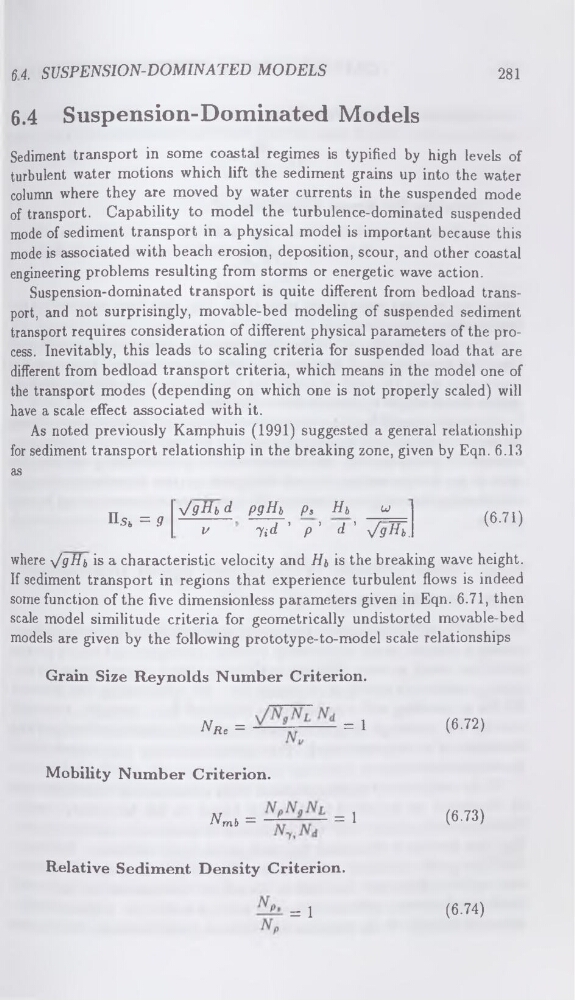
As noted previously Kamphuis (1991) suggested a general relationship
for sediment transport relationship in the breaking zone, given by Eqn. 6.13
as
ns6 = g
VgHb d pgHj p, Hb
w
v
lid ’ p’ d ’ y/gÜÜ,
(6-71)
where y/gHb is a characteristic velocity and Hb is the breaking wave height.
If sediment transport in regions that experience turbulent flows is indeed
some function of the five dimensionless parameters given in Eqn. 6.71, then
scale model similitude criteria for geometrically undistorted movable-bed
models are given by the following prototype-to-model scale relationships
Grain Size Reynolds Number Criterion.
NRe =
= 1
(6.72)
Mobility Number Criterion.
Nmi =
= 1
(6-73)
Relative Sediment Density Criterion.
= 1
(6.74)
281
6.4 Suspension-Dominated Models
Sediment transport in some coastal regimes is typified by high levels of
turbulent water motions which lift the sediment grains up into the water
column where they are moved by water currents in the suspended mode
of transport. Capability to model the turbulence-dominated suspended
mode of sediment transport in a physical model is important because this
mode is associated with beach erosion, deposition, scour, and other coastal
engineering problems resulting from storms or energetic wave action.
Suspension-dominated transport is quite different from bedload transport, and not surprisingly, movable-bed modeling of suspended sediment
transport requires consideration of different physical parameters of the process. Inevitably, this leads to scaling criteria for suspended load that are
different from bedload transport criteria, which means in the model one of
the transport modes (depending on which one is not properly scaled) will
have a scale effect associated with it.
As noted previously Kamphuis (1991) suggested a general relationship
for sediment transport relationship in the breaking zone, given by Eqn. 6.13
as
ns6 = g
VgHb d pgHj p, Hb
w
v
lid ’ p’ d ’ y/gÜÜ,
(6-71)
where y/gHb is a characteristic velocity and Hb is the breaking wave height.
If sediment transport in regions that experience turbulent flows is indeed
some function of the five dimensionless parameters given in Eqn. 6.71, then
scale model similitude criteria for geometrically undistorted movable-bed
models are given by the following prototype-to-model scale relationships
Grain Size Reynolds Number Criterion.
NRe =
= 1
(6.72)
Mobility Number Criterion.
Nmi =
= 1
(6-73)
Relative Sediment Density Criterion.
= 1
(6.74)