

254
CHAPTER 6. SEDIMENT TRANSPORT MODELS
These scale ratios assume a logarithmic boundary layer velocity profile under unidirectional currents (i.e., long-wave
velocity).
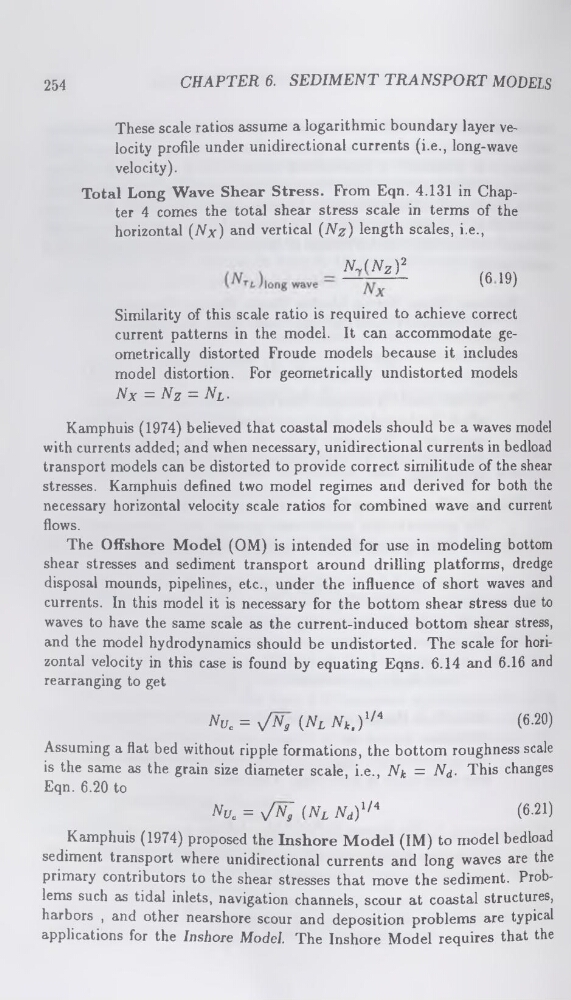
Total Long Wave Shear Stress. From Eqn. 4.131 in Chapter 4 comes the total shear stress scale in terms of the
horizontal (7V%) and vertical (Nz) length scales, i.e.,
NdNzY
(6 19)
Similarity of this scale ratio is required to achieve correct
current patterns in the model. It can accommodate geometrically distorted Froude models because it includes
model distortion. For geometrically undistorted models
NX = NZ = NL.
Kamphuis (1974) believed that coastal models should be a waves model
with currents added; and when necessary, unidirectional currents in bedload
transport models can be distorted to provide correct similitude of the shear
stresses. Kamphuis defined two model regimes and derived for both the
necessary horizontal velocity scale ratios for combined wave and current
flows.
The Offshore Model (OM) is intended for use in modeling bottom
shear stresses and sediment transport around drilling platforms, dredge
disposal mounds, pipelines, etc., under the influence of short waves and
currents. In this model it is necessary for the bottom shear stress due to
waves to have the same scale as the current-induced bottom shear stress,
and the model hydrodynamics should be undistorted. The scale for horizontal velocity in this case is found by equating Eqns. 6.14 and 6.16 and
rearranging to get
^uc = y/Ng (NLNk,Ÿ/4
(6.20)
Assuming a flat bed without ripple formations, the bottom roughness scale
is the same as the grain size diameter scale, i.e., Nk = Nd. This changes
Eqn. 6.20 to
NUc = y/N~g (NL NdŸ/4
(6-21)
Kamphuis (1974) proposed the Inshore Model (IM) to model bedload
sediment transport where unidirectional currents and long waves are the
primary contributors to the shear stresses that move the sediment. Problems such as tidal inlets, navigation channels, scour at coastal structures,
harbors , and other nearshore scour and deposition problems are typical
applications for the Inshore Model. The Inshore Model requires that the
CHAPTER 6. SEDIMENT TRANSPORT MODELS
These scale ratios assume a logarithmic boundary layer velocity profile under unidirectional currents (i.e., long-wave
velocity).
Total Long Wave Shear Stress. From Eqn. 4.131 in Chapter 4 comes the total shear stress scale in terms of the
horizontal (7V%) and vertical (Nz) length scales, i.e.,
NdNzY
(6 19)
Similarity of this scale ratio is required to achieve correct
current patterns in the model. It can accommodate geometrically distorted Froude models because it includes
model distortion. For geometrically undistorted models
NX = NZ = NL.
Kamphuis (1974) believed that coastal models should be a waves model
with currents added; and when necessary, unidirectional currents in bedload
transport models can be distorted to provide correct similitude of the shear
stresses. Kamphuis defined two model regimes and derived for both the
necessary horizontal velocity scale ratios for combined wave and current
flows.
The Offshore Model (OM) is intended for use in modeling bottom
shear stresses and sediment transport around drilling platforms, dredge
disposal mounds, pipelines, etc., under the influence of short waves and
currents. In this model it is necessary for the bottom shear stress due to
waves to have the same scale as the current-induced bottom shear stress,
and the model hydrodynamics should be undistorted. The scale for horizontal velocity in this case is found by equating Eqns. 6.14 and 6.16 and
rearranging to get
^uc = y/Ng (NLNk,Ÿ/4
(6.20)
Assuming a flat bed without ripple formations, the bottom roughness scale
is the same as the grain size diameter scale, i.e., Nk = Nd. This changes
Eqn. 6.20 to
NUc = y/N~g (NL NdŸ/4
(6-21)
Kamphuis (1974) proposed the Inshore Model (IM) to model bedload
sediment transport where unidirectional currents and long waves are the
primary contributors to the shear stresses that move the sediment. Problems such as tidal inlets, navigation channels, scour at coastal structures,
harbors , and other nearshore scour and deposition problems are typical
applications for the Inshore Model. The Inshore Model requires that the