

6.3. BEDLOAD-DOMINATED TRANSPORT MODELS
253
the movable-bed materials. Prototype-to-model shear stress scale ratios for
fully rough turbulent boundary layers in both prototype and model were
developed in Chapter 4 in the sections entitled Short-Wave Model Boundary Layer Similitude and Long-Wave Model Boundary Layer Similitude.
These relationships were published by Kamphuis (1973, 1974, 1975), and
the Chapter 4 shear stress scales are repeated here (with new equation
numbers) to facilitate the derivation of bedload sediment transport scaling
relationships.
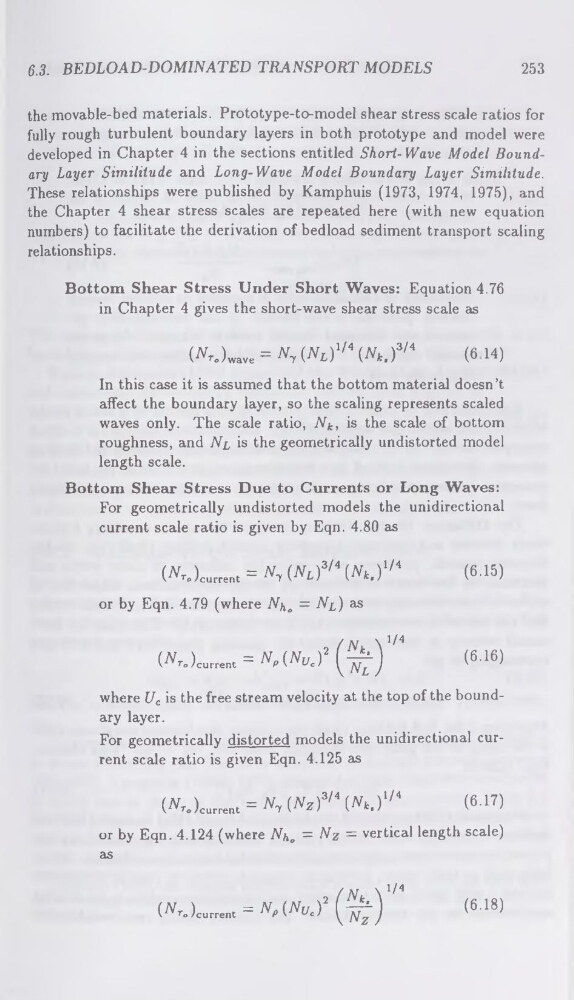
Bottom Shear Stress Under Short Waves: Equation 4.76
in Chapter 4 gives the short-wave shear stress scale as
(JVr.)»ave=W7(^)1/4(^.)3/4
(614)
In this case it is assumed that the bottom material doesn’t
affect the boundary layer, so the scaling represents scaled
waves only. The scale ratio, Nk, is the scale of bottom
roughness, and Nl is the geometrically undistorted model
length scale.
Bottom Shear Stress Due to Currents or Long Waves:
For geometrically undistorted models the unidirectional
current scale ratio is given by Eqn. 4.80 as
WJcurrent = * M^) 3/4m1/4
(6J5)
or by Eqn. 4.79 (where Nho = Nl) as
2 / Nk \ 1/4
W.)cutre„t = Np(NVc)2 (-^)
(6.16)
where Uc is the free stream velocity at the top of the boundary layer.
For geometrically distorted models the unidirectional current scale ratio is given Eqn. 4.125 as
(^)c„rrent = w7(w2)3/4(wt.),/4
(6.17)
or by Eqn. 4.124 (where Nh„ = Nz = vertical length scale)
as
x,fNt V'4
(^.)curreM = ^(^)2 (-^)
(6.18)
253
the movable-bed materials. Prototype-to-model shear stress scale ratios for
fully rough turbulent boundary layers in both prototype and model were
developed in Chapter 4 in the sections entitled Short-Wave Model Boundary Layer Similitude and Long-Wave Model Boundary Layer Similitude.
These relationships were published by Kamphuis (1973, 1974, 1975), and
the Chapter 4 shear stress scales are repeated here (with new equation
numbers) to facilitate the derivation of bedload sediment transport scaling
relationships.
Bottom Shear Stress Under Short Waves: Equation 4.76
in Chapter 4 gives the short-wave shear stress scale as
(JVr.)»ave=W7(^)1/4(^.)3/4
(614)
In this case it is assumed that the bottom material doesn’t
affect the boundary layer, so the scaling represents scaled
waves only. The scale ratio, Nk, is the scale of bottom
roughness, and Nl is the geometrically undistorted model
length scale.
Bottom Shear Stress Due to Currents or Long Waves:
For geometrically undistorted models the unidirectional
current scale ratio is given by Eqn. 4.80 as
WJcurrent = * M^) 3/4m1/4
(6J5)
or by Eqn. 4.79 (where Nho = Nl) as
2 / Nk \ 1/4
W.)cutre„t = Np(NVc)2 (-^)
(6.16)
where Uc is the free stream velocity at the top of the boundary layer.
For geometrically distorted models the unidirectional current scale ratio is given Eqn. 4.125 as
(^)c„rrent = w7(w2)3/4(wt.),/4
(6.17)
or by Eqn. 4.124 (where Nh„ = Nz = vertical length scale)
as
x,fNt V'4
(^.)curreM = ^(^)2 (-^)
(6.18)