

226
CHAPTER 5. COASTAL STRUCTURE MODELS
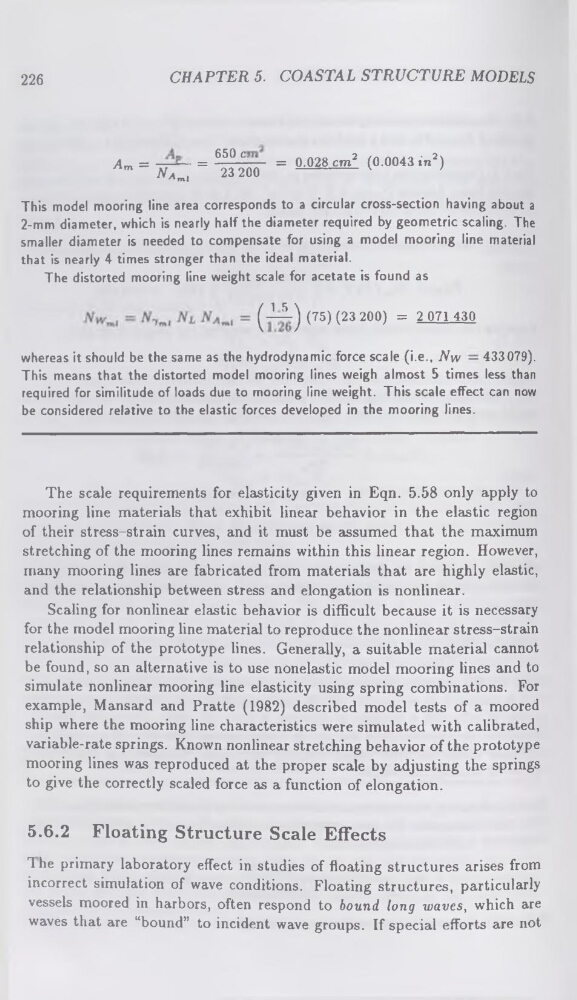
Am =
= 650 C— = 0.028 cm2 (0.0043 in2)
m NAml
23 200
--------------- V
’
This model mooring line area corresponds to a circular cross-section having about a
2-mm diameter, which is nearly half the diameter required by geometric scaling. The
smaller diameter is needed to compensate for using a model mooring line material
that is nearly 4 times stronger than the ideal material.
The distorted mooring line weight scale for acetate is found as
(
1 5 \
—J (75) (23 200) = 2 071 430
whereas it should be the same as the hydrodynamic force scale (i.e., Nw — 433079).
This means that the distorted model mooring lines weigh almost 5 times less than
required for similitude of loads due to mooring line weight. This scale effect can now
be considered relative to the elastic forces developed in the mooring lines.
The scale requirements for elasticity given in Eqn. 5.58 only apply to
mooring line materials that exhibit linear behavior in the elastic region
of their stress-strain curves, and it must be assumed that the maximum
stretching of the mooring lines remains within this linear region. However,
many mooring lines are fabricated from materials that are highly elastic,
and the relationship between stress and elongation is nonlinear.
Scaling for nonlinear elastic behavior is difficult because it is necessary
for the model mooring line material to reproduce the nonlinear stress-strain
relationship of the prototype lines. Generally, a suitable material cannot
be found, so an alternative is to use nonelastic model mooring lines and to
simulate nonlinear mooring line elasticity using spring combinations. For
example, Mansard and Pratte (1982) described model tests of a moored
ship where the mooring line characteristics were simulated with calibrated,
variable-rate springs. Known nonlinear stretching behavior of the prototype
mooring lines was reproduced at the proper scale by adjusting the springs
to give the correctly scaled force as a function of elongation.
5.6.2 Floating Structure Scale Effects
1 he primary laboratory effect in studies of floating structures arises from
incorrect simulation of wave conditions. Floating structures, particularly
vessels moored in harbors, often respond to bound long waves, which are
waves that are “bound” to incident wave groups. If special efforts are not
CHAPTER 5. COASTAL STRUCTURE MODELS
Am =
= 650 C— = 0.028 cm2 (0.0043 in2)
m NAml
23 200
--------------- V
’
This model mooring line area corresponds to a circular cross-section having about a
2-mm diameter, which is nearly half the diameter required by geometric scaling. The
smaller diameter is needed to compensate for using a model mooring line material
that is nearly 4 times stronger than the ideal material.
The distorted mooring line weight scale for acetate is found as
(
1 5 \
—J (75) (23 200) = 2 071 430
whereas it should be the same as the hydrodynamic force scale (i.e., Nw — 433079).
This means that the distorted model mooring lines weigh almost 5 times less than
required for similitude of loads due to mooring line weight. This scale effect can now
be considered relative to the elastic forces developed in the mooring lines.
The scale requirements for elasticity given in Eqn. 5.58 only apply to
mooring line materials that exhibit linear behavior in the elastic region
of their stress-strain curves, and it must be assumed that the maximum
stretching of the mooring lines remains within this linear region. However,
many mooring lines are fabricated from materials that are highly elastic,
and the relationship between stress and elongation is nonlinear.
Scaling for nonlinear elastic behavior is difficult because it is necessary
for the model mooring line material to reproduce the nonlinear stress-strain
relationship of the prototype lines. Generally, a suitable material cannot
be found, so an alternative is to use nonelastic model mooring lines and to
simulate nonlinear mooring line elasticity using spring combinations. For
example, Mansard and Pratte (1982) described model tests of a moored
ship where the mooring line characteristics were simulated with calibrated,
variable-rate springs. Known nonlinear stretching behavior of the prototype
mooring lines was reproduced at the proper scale by adjusting the springs
to give the correctly scaled force as a function of elongation.
5.6.2 Floating Structure Scale Effects
1 he primary laboratory effect in studies of floating structures arises from
incorrect simulation of wave conditions. Floating structures, particularly
vessels moored in harbors, often respond to bound long waves, which are
waves that are “bound” to incident wave groups. If special efforts are not