

5.6. FLOATING STRUCTURES
225
hull. The prototype mooring lines (hemp) have an area of 650 cm2 (100 in2), specific
gravity of Smi = 1.5, and a modulus of elasticity of 5.6 x 10⁴ MPa (8.1 x 10⁶ lb/in2).
Part I: Determine the ideal modulus of elasticity and specific gravity for the model
mooring lines. Assume (7™)m — 9.79 kN/m3 (62.3 lb/ft3) for fresh water, and (7W)P
= 10.05 kN/m3 (64.0 lb/ft3) for salt water.
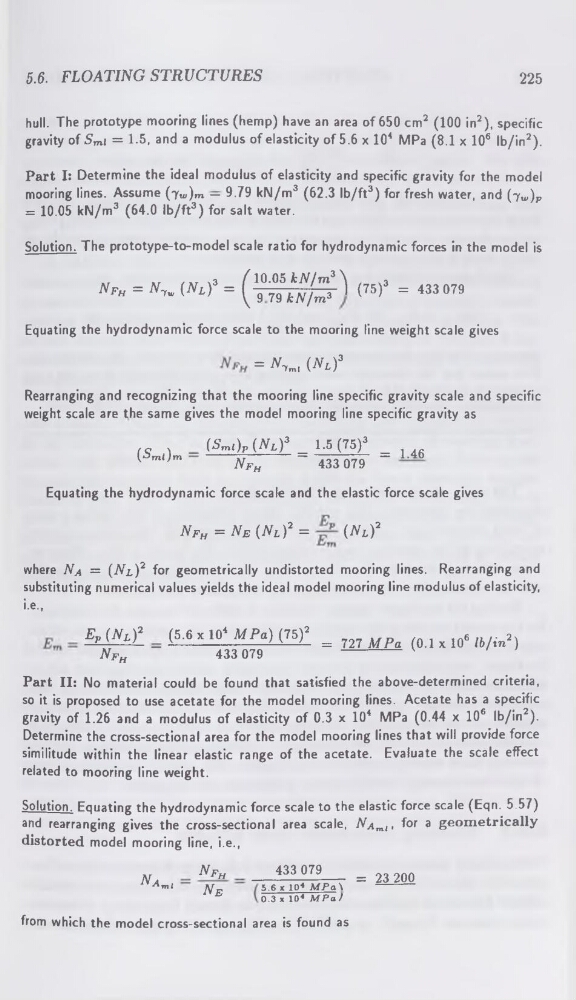
Solution. The prototype-to-model scale ratio for hydrodynamic forces in the model is
.
xr
/
\3
( 10.05 kN/m3 \
3
NFh = N„ (JVr) = (-9 7t,tAf/Zro3 } (75)’ = 433 079
Equating the hydrodynamic force scale to the mooring line weight scale gives
= N.ml (NL)3
Rearranging and recognizing that the mooring line specific gravity scale and specific
weight scale are the same gives the model mooring line specific gravity as
(Sml)m
(Smi)P (NL)3 = 1.5 (75)3
Nfh
433 079
= 1.46
Equating the hydrodynamic force scale and the elastic force scale gives
NFh = Ne (JVz.)2 =
(NL)2
where Na = (Nl)2 for geometrically undistorted mooring lines. Rearranging and
substituting numerical values yields the ideal model mooring line modulus of elasticity,
i.e.,
Ep (NL)2
(5.6 x 10⁴ MPa) (75)2
NFh ~
433 079
= 727 MPa (0.1 x 10⁶ lb/in2)
Part II: No material could be found that satisfied the above-determined criteria,
so it is proposed to use acetate for the model mooring lines. Acetate has a specific
gravity of 1.26 and a modulus of elasticity of 0.3 x 10⁴ MPa (0.44 x 10⁶ lb/in2).
Determine the cross-sectional area for the model mooring lines that will provide force
similitude within the linear elastic range of the acetate. Evaluate the scale effect
related to mooring line weight.
Solution. Equating the hydrodynamic force scale to the elastic force scale (Eqn. 5.57)
and rearranging gives the cross-sectional area scale, NAmt. for a geometrically
distorted model mooring line, i.e.,
Na ml
»FH
Ne
433 079
5.6 x 10⁴ MPa\
0.3 x 10⁴ MPa)
= 23 200
from which the model cross-sectional area is found as
225
hull. The prototype mooring lines (hemp) have an area of 650 cm2 (100 in2), specific
gravity of Smi = 1.5, and a modulus of elasticity of 5.6 x 10⁴ MPa (8.1 x 10⁶ lb/in2).
Part I: Determine the ideal modulus of elasticity and specific gravity for the model
mooring lines. Assume (7™)m — 9.79 kN/m3 (62.3 lb/ft3) for fresh water, and (7W)P
= 10.05 kN/m3 (64.0 lb/ft3) for salt water.
Solution. The prototype-to-model scale ratio for hydrodynamic forces in the model is
.
xr
/
\3
( 10.05 kN/m3 \
3
NFh = N„ (JVr) = (-9 7t,tAf/Zro3 } (75)’ = 433 079
Equating the hydrodynamic force scale to the mooring line weight scale gives
= N.ml (NL)3
Rearranging and recognizing that the mooring line specific gravity scale and specific
weight scale are the same gives the model mooring line specific gravity as
(Sml)m
(Smi)P (NL)3 = 1.5 (75)3
Nfh
433 079
= 1.46
Equating the hydrodynamic force scale and the elastic force scale gives
NFh = Ne (JVz.)2 =
(NL)2
where Na = (Nl)2 for geometrically undistorted mooring lines. Rearranging and
substituting numerical values yields the ideal model mooring line modulus of elasticity,
i.e.,
Ep (NL)2
(5.6 x 10⁴ MPa) (75)2
NFh ~
433 079
= 727 MPa (0.1 x 10⁶ lb/in2)
Part II: No material could be found that satisfied the above-determined criteria,
so it is proposed to use acetate for the model mooring lines. Acetate has a specific
gravity of 1.26 and a modulus of elasticity of 0.3 x 10⁴ MPa (0.44 x 10⁶ lb/in2).
Determine the cross-sectional area for the model mooring lines that will provide force
similitude within the linear elastic range of the acetate. Evaluate the scale effect
related to mooring line weight.
Solution. Equating the hydrodynamic force scale to the elastic force scale (Eqn. 5.57)
and rearranging gives the cross-sectional area scale, NAmt. for a geometrically
distorted model mooring line, i.e.,
Na ml
»FH
Ne
433 079
5.6 x 10⁴ MPa\
0.3 x 10⁴ MPa)
= 23 200
from which the model cross-sectional area is found as