

126
CHAPTER 4. HYDRODYNAMIC MODELS
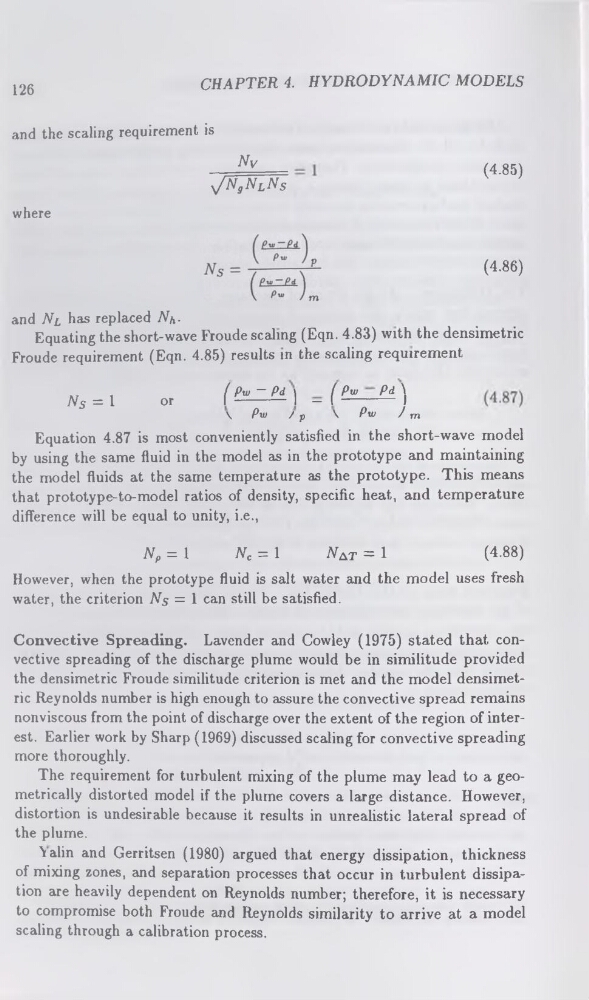
and the scaling requirement is
Ny
y/NgNLNs
(4.85)
where
(4.86)
and Nl has replaced NhEquating the short-wave Froude scaling (Eqn. 4.83) with the densimetric
Froude requirement (Eqn. 4.85) results in the scaling requirement
( pw — Pd\
( Pw pd\
Ns = 1
or
I ---------- I -
I - I
\
pw
/ p
\
Pw
J m
Equation 4.87 is most conveniently satisfied in the short-wave model
by using the same fluid in the model as in the prototype and maintaining
the model fluids at the same temperature as the prototype. This means
that prototype-to-model ratios of density, specific heat, and temperature
difference will be equal to unity, i.e.,
Np = 1
Nc = 1
N^t = 1
(4.88)
However, when the prototype fluid is salt water and the model uses fresh
water, the criterion Ns = 1 can still be satisfied.
Convective Spreading. Lavender and Cowley (1975) stated that convective spreading of the discharge plume would be in similitude provided
the densimetric Froude similitude criterion is met and the model densimetric Reynolds number is high enough to assure the convective spread remains
nonviscous from the point of discharge over the extent of the region of interest. Earlier work by Sharp (1969) discussed scaling for convective spreading
more thoroughly.
The requirement for turbulent mixing of the plume may lead to a geometrically distorted model if the plume covers a large distance. However,
distortion is undesirable because it results in unrealistic lateral spread of
the plume.
Aalin and Gerritsen (1980) argued that energy dissipation, thickness
of mixing zones, and separation processes that occur in turbulent dissipation are heavily dependent on Reynolds number; therefore, it is necessary
to compromise both Froude and Reynolds similarity to arrive at a model
scaling through a calibration process.
CHAPTER 4. HYDRODYNAMIC MODELS
and the scaling requirement is
Ny
y/NgNLNs
(4.85)
where
(4.86)
and Nl has replaced NhEquating the short-wave Froude scaling (Eqn. 4.83) with the densimetric
Froude requirement (Eqn. 4.85) results in the scaling requirement
( pw — Pd\
( Pw pd\
Ns = 1
or
I ---------- I -
I - I
\
pw
/ p
\
Pw
J m
Equation 4.87 is most conveniently satisfied in the short-wave model
by using the same fluid in the model as in the prototype and maintaining
the model fluids at the same temperature as the prototype. This means
that prototype-to-model ratios of density, specific heat, and temperature
difference will be equal to unity, i.e.,
Np = 1
Nc = 1
N^t = 1
(4.88)
However, when the prototype fluid is salt water and the model uses fresh
water, the criterion Ns = 1 can still be satisfied.
Convective Spreading. Lavender and Cowley (1975) stated that convective spreading of the discharge plume would be in similitude provided
the densimetric Froude similitude criterion is met and the model densimetric Reynolds number is high enough to assure the convective spread remains
nonviscous from the point of discharge over the extent of the region of interest. Earlier work by Sharp (1969) discussed scaling for convective spreading
more thoroughly.
The requirement for turbulent mixing of the plume may lead to a geometrically distorted model if the plume covers a large distance. However,
distortion is undesirable because it results in unrealistic lateral spread of
the plume.
Aalin and Gerritsen (1980) argued that energy dissipation, thickness
of mixing zones, and separation processes that occur in turbulent dissipation are heavily dependent on Reynolds number; therefore, it is necessary
to compromise both Froude and Reynolds similarity to arrive at a model
scaling through a calibration process.