

4.2. SHORT-WAVE HYDRODYNAMIC MODELS
125
Designing a physical model at reduced scale that maintains correct similitude for all six physical processes identified in the phenomenon of thermal
dispersion is impossible. Therefore, we resort to our usual practice of identifying those processes that are dominant for the particular problem being
studied, and attempting to satisfy the appropriate similitude criteria. Similitude of the remaining physical processes is compromised, and scale effects
will be present which must be examined in terms of their detrimental effect.
Jet Diffusion. At the point of discharge of the heated water into the
surrounding water, the inertia of the jet and the turbulent entrainment
of cool water are important. The first condition to be met is that the
model must be geometrically undistorted and scaled according to Froude
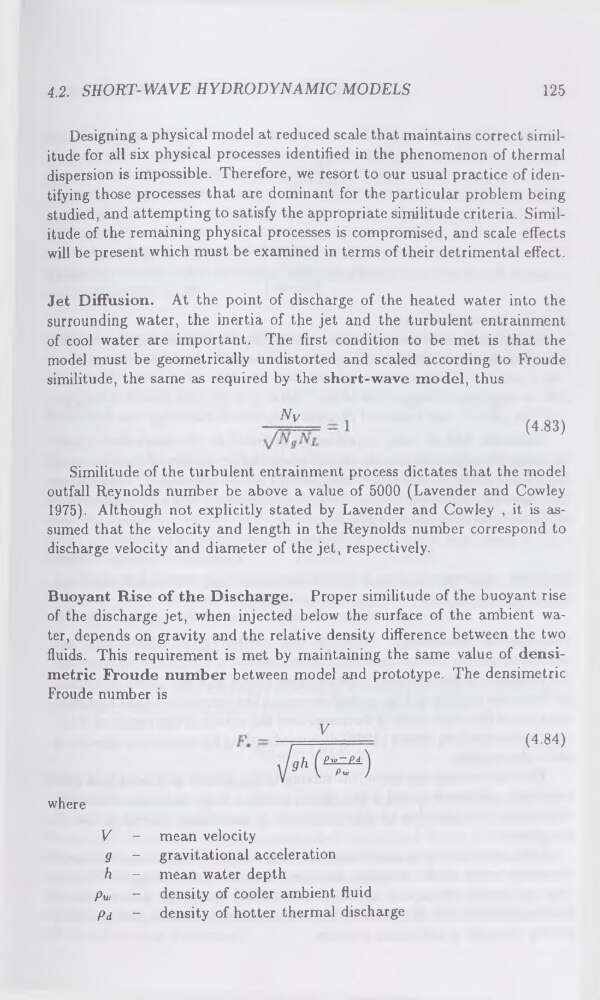
similitude, the same as required by the short-wave model, thus
Nv
(4.83)
Similitude of the turbulent entrainment process dictates that the model
outfall Reynolds number be above a value of 5000 (Lavender and Cowley
1975). Although not explicitly stated by Lavender and Cowley , it is assumed that the velocity and length in the Reynolds number correspond to
discharge velocity and diameter of the jet, respectively.
Buoyant Rise of the Discharge. Proper similitude of the buoyant rise
of the discharge jet, when injected below the surface of the ambient water, depends on gravity and the relative density difference between the two
fluids. This requirement is met by maintaining the same value of densimetric Froude number between model and prototype. The densimetric
Froude number is
(4.84)
where
V
- mean velocity
g
- gravitational acceleration
h
- mean water depth
pw
~ density of cooler ambient fluid
pd
~ density of hotter thermal discharge
125
Designing a physical model at reduced scale that maintains correct similitude for all six physical processes identified in the phenomenon of thermal
dispersion is impossible. Therefore, we resort to our usual practice of identifying those processes that are dominant for the particular problem being
studied, and attempting to satisfy the appropriate similitude criteria. Similitude of the remaining physical processes is compromised, and scale effects
will be present which must be examined in terms of their detrimental effect.
Jet Diffusion. At the point of discharge of the heated water into the
surrounding water, the inertia of the jet and the turbulent entrainment
of cool water are important. The first condition to be met is that the
model must be geometrically undistorted and scaled according to Froude
similitude, the same as required by the short-wave model, thus
Nv
(4.83)
Similitude of the turbulent entrainment process dictates that the model
outfall Reynolds number be above a value of 5000 (Lavender and Cowley
1975). Although not explicitly stated by Lavender and Cowley , it is assumed that the velocity and length in the Reynolds number correspond to
discharge velocity and diameter of the jet, respectively.
Buoyant Rise of the Discharge. Proper similitude of the buoyant rise
of the discharge jet, when injected below the surface of the ambient water, depends on gravity and the relative density difference between the two
fluids. This requirement is met by maintaining the same value of densimetric Froude number between model and prototype. The densimetric
Froude number is
(4.84)
where
V
- mean velocity
g
- gravitational acceleration
h
- mean water depth
pw
~ density of cooler ambient fluid
pd
~ density of hotter thermal discharge