

110
CHAPTER 4. HYDRODYNAMIC MODELS
to give
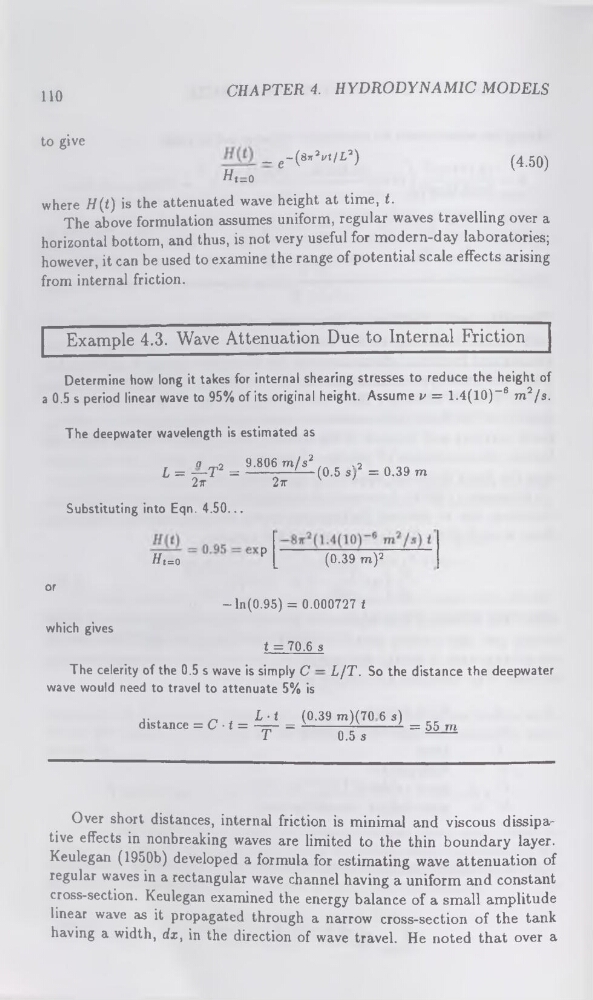
- e-(8’r2*/t/£2)
(4.50)
Over short distances, internal friction is minimal and viscous dissipative effects in nonbreaking waves are limited to the thin boundary layer.
Keulegan (1950b) developed a formula for estimating wave attenuation of
regular waves in a rectangular wave channel having a uniform and constant
cross-section. Keulegan examined the energy balance of a small amplitude
linear wave as it propagated through a narrow cross-section of the tank
having a width, dx, in the direction of wave travel. He noted that over a
Ht-o
where H(t) is the attenuated wave height at time, t.
The above formulation assumes uniform, regular waves travelling over a
horizontal bottom, and thus, is not very useful for modern-day laboratories;
however, it can be used to examine the range of potential scale effects arising
from internal friction.
Example 4.3. Wave Attenuation Due to Internal Friction
Determine how long it takes for internal shearing stresses to reduce the height of
a 0.5 s period linear wave to 95% of its original height. Assume v = 1.4(10)-6 m2 Is.
The deepwater wavelength is estimated as
o o
9.806 m/s2 .
.9
L = —T2 =------------^—(0.5 s 2 = 0.39 m
2r
2tt
V
’
Substituting into Eqn. 4.50...
H,.„
P [
(0.39 m)2
or
— ln(0.95) = 0.000727 t
which gives
t = 70.6 s
The celerity of the 0.5 s wave is simply C — L/T. So the distance the deepwater
wave would need to travel to attenuate 5% is
distance. C.l = 4^ = ^39-'n^0^)=55n.
T
0.5 s
-------
CHAPTER 4. HYDRODYNAMIC MODELS
to give
- e-(8’r2*/t/£2)
(4.50)
Over short distances, internal friction is minimal and viscous dissipative effects in nonbreaking waves are limited to the thin boundary layer.
Keulegan (1950b) developed a formula for estimating wave attenuation of
regular waves in a rectangular wave channel having a uniform and constant
cross-section. Keulegan examined the energy balance of a small amplitude
linear wave as it propagated through a narrow cross-section of the tank
having a width, dx, in the direction of wave travel. He noted that over a
Ht-o
where H(t) is the attenuated wave height at time, t.
The above formulation assumes uniform, regular waves travelling over a
horizontal bottom, and thus, is not very useful for modern-day laboratories;
however, it can be used to examine the range of potential scale effects arising
from internal friction.
Example 4.3. Wave Attenuation Due to Internal Friction
Determine how long it takes for internal shearing stresses to reduce the height of
a 0.5 s period linear wave to 95% of its original height. Assume v = 1.4(10)-6 m2 Is.
The deepwater wavelength is estimated as
o o
9.806 m/s2 .
.9
L = —T2 =------------^—(0.5 s 2 = 0.39 m
2r
2tt
V
’
Substituting into Eqn. 4.50...
H,.„
P [
(0.39 m)2
or
— ln(0.95) = 0.000727 t
which gives
t = 70.6 s
The celerity of the 0.5 s wave is simply C — L/T. So the distance the deepwater
wave would need to travel to attenuate 5% is
distance. C.l = 4^ = ^39-'n^0^)=55n.
T
0.5 s
-------