

4.2. SHORT-WAVE HYDRODYNAMIC MODELS
109
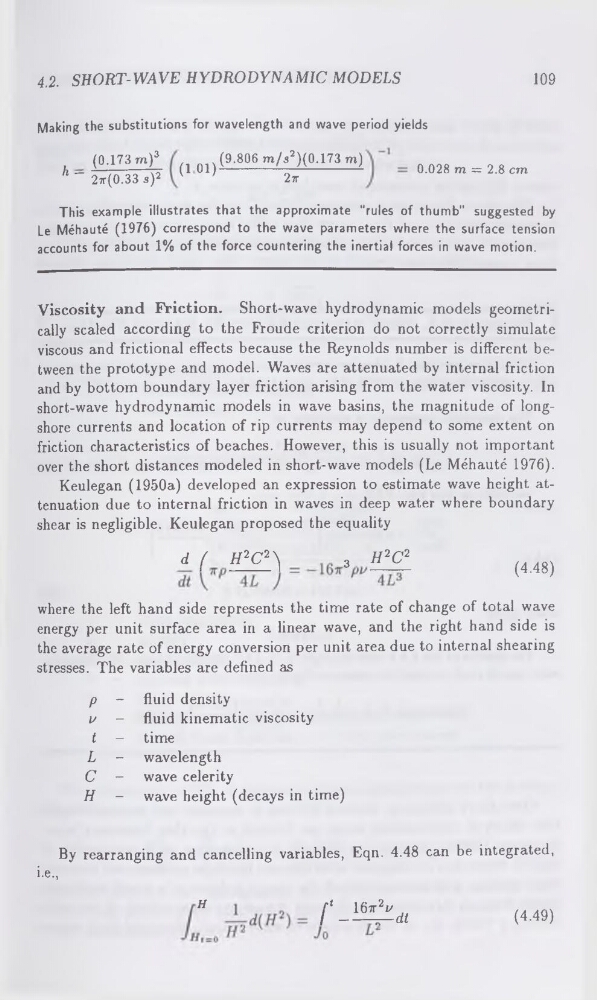
Making the substitutions for wavelength and wave period yields
(0.173 m)3
h ~ 27t(0.33s)2
(101)
(9.806 m/s2)(0.173 m)
2tt
0.028 m = 2.8 cm
This example illustrates that the approximate "rules of thumb” suggested by
Le Méhauté (1976) correspond to the wave parameters where the surface tension
accounts for about 1% of the force countering the inertial forces in wave motion.
H
(4.49)
Viscosity and Friction. Short-wave hydrodynamic models geometrically scaled according to the Froude criterion do not correctly simulate
viscous and frictional effects because the Reynolds number is different between the prototype and model. Waves are attenuated by internal friction
and by bottom boundary layer friction arising from the water viscosity. In
short-wave hydrodynamic models in wave basins, the magnitude of longshore currents and location of rip currents may depend to some extent on
friction characteristics of beaches. However, this is usually not important
over the short distances modeled in short-wave models (Le Méhauté 1976).
Keulegan (1950a) developed an expression to estimate wave height attenuation due to internal friction in waves in deep water where boundary
shear is negligible. Keulegan proposed the equality
d ( PC* 1}
3
W2C2
(4-48)
where the left hand side represents the time rate of change of total wave
energy per unit surface area in a linear wave, and the right hand side is
the average rate of energy conversion per unit area due to internal shearing
stresses. The variables are defined as
p - fluid density
p - fluid kinematic viscosity
t
- time
L
- wavelength
C - wave celerity
H - wave height (decays in time)
By rearranging and cancelling variables, Eqn. 4.48 can be integrated,
i.e.,
C 16tf2//
/------ ~—dt
109
Making the substitutions for wavelength and wave period yields
(0.173 m)3
h ~ 27t(0.33s)2
(101)
(9.806 m/s2)(0.173 m)
2tt
0.028 m = 2.8 cm
This example illustrates that the approximate "rules of thumb” suggested by
Le Méhauté (1976) correspond to the wave parameters where the surface tension
accounts for about 1% of the force countering the inertial forces in wave motion.
H
(4.49)
Viscosity and Friction. Short-wave hydrodynamic models geometrically scaled according to the Froude criterion do not correctly simulate
viscous and frictional effects because the Reynolds number is different between the prototype and model. Waves are attenuated by internal friction
and by bottom boundary layer friction arising from the water viscosity. In
short-wave hydrodynamic models in wave basins, the magnitude of longshore currents and location of rip currents may depend to some extent on
friction characteristics of beaches. However, this is usually not important
over the short distances modeled in short-wave models (Le Méhauté 1976).
Keulegan (1950a) developed an expression to estimate wave height attenuation due to internal friction in waves in deep water where boundary
shear is negligible. Keulegan proposed the equality
d ( PC* 1}
3
W2C2
(4-48)
where the left hand side represents the time rate of change of total wave
energy per unit surface area in a linear wave, and the right hand side is
the average rate of energy conversion per unit area due to internal shearing
stresses. The variables are defined as
p - fluid density
p - fluid kinematic viscosity
t
- time
L
- wavelength
C - wave celerity
H - wave height (decays in time)
By rearranging and cancelling variables, Eqn. 4.48 can be integrated,
i.e.,
C 16tf2//
/------ ~—dt