

4.2. SHORT-WAVE HYDRODYNAMIC MODELS
93
Short-wave models maintain similitude of turbulent dissipative processes.
From Condition 3 we see that
Viscous effects can only be modeled in a short-wave
model when both Froude and Reynolds criteria are met.
Chapter 3 discussed the difficulties in maintaining similarity of both Froude
and Reynolds numbers in the same model, and usually coastal models do
not fulfill the Reynolds criterion.
Condition 4 is automatically met because the prototype-to-model ratio of pressure force (Np) is considered the dependent force ratio in the
requirement for dynamic similitude (Eqn. 3.6, Chapter 3), and it is determined after all other force ratios have been established. In the case of
Froude scaling, the pressure scale is found by solving Eqn. 4.19 for Ny and
substituting into Eqn. 4.23. After rearranging the pressure scale is found
as
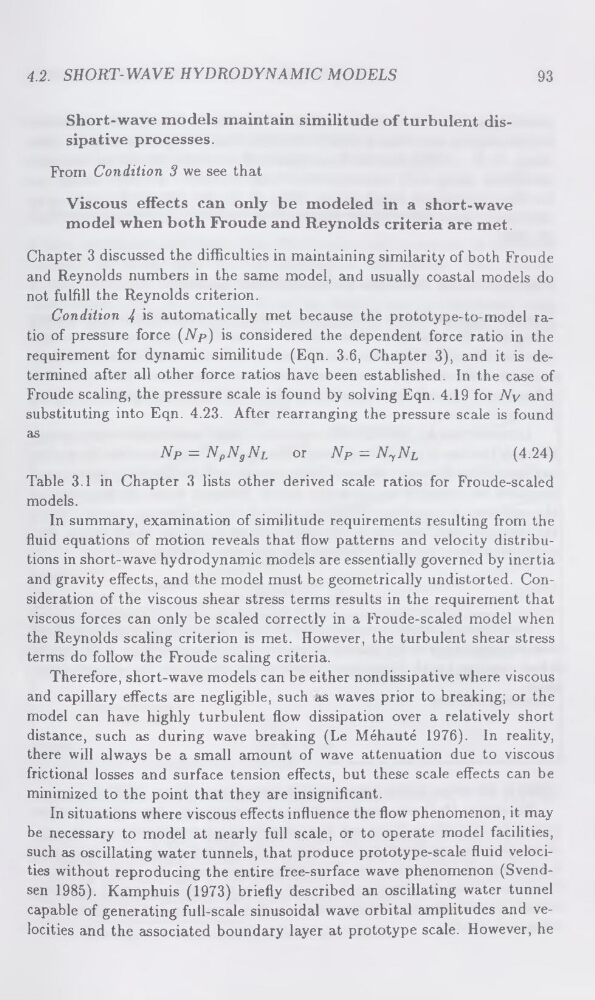
NP = NpNgNL
or
NP = NyNL
(4.24)
Table 3.1 in Chapter 3 lists other derived scale ratios for Froude-scaled
models.
In summary, examination of similitude requirements resulting from the
fluid equations of motion reveals that flow patterns and velocity distributions in short-wave hydrodynamic models are essentially governed by inertia
and gravity effects, and the model must be geometrically undistorted. Consideration of the viscous shear stress terms results in the requirement that
viscous forces can only be scaled correctly in a Froude-scaled model when
the Reynolds scaling criterion is met. However, the turbulent shear stress
terms do follow the Froude scaling criteria.
Therefore, short-wave models can be either nondissipative where viscous
and capillary effects are negligible, such cis waves prior to breaking; or the
model can have highly turbulent flow dissipation over a relatively short
distance, such as during wave breaking (Le Méhauté 1976). In reality,
there will always be a small amount of wave attenuation due to viscous
frictional losses and surface tension effects, but these scale effects can be
minimized to the point that they are insignificant.
In situations where viscous effects influence the flow phenomenon, it may
be necessary to model at nearly full scale, or to operate model facilities,
such as oscillating water tunnels, that produce prototype-scale fluid velocities without reproducing the entire free-surface wave phenomenon (Svendsen 1985). Kamphuis (1973) briefly described an oscillating water tunnel
capable of generating full-scale sinusoidal wave orbital amplitudes and velocities and the associated boundary layer at prototype scale. However, he
93
Short-wave models maintain similitude of turbulent dissipative processes.
From Condition 3 we see that
Viscous effects can only be modeled in a short-wave
model when both Froude and Reynolds criteria are met.
Chapter 3 discussed the difficulties in maintaining similarity of both Froude
and Reynolds numbers in the same model, and usually coastal models do
not fulfill the Reynolds criterion.
Condition 4 is automatically met because the prototype-to-model ratio of pressure force (Np) is considered the dependent force ratio in the
requirement for dynamic similitude (Eqn. 3.6, Chapter 3), and it is determined after all other force ratios have been established. In the case of
Froude scaling, the pressure scale is found by solving Eqn. 4.19 for Ny and
substituting into Eqn. 4.23. After rearranging the pressure scale is found
as
NP = NpNgNL
or
NP = NyNL
(4.24)
Table 3.1 in Chapter 3 lists other derived scale ratios for Froude-scaled
models.
In summary, examination of similitude requirements resulting from the
fluid equations of motion reveals that flow patterns and velocity distributions in short-wave hydrodynamic models are essentially governed by inertia
and gravity effects, and the model must be geometrically undistorted. Consideration of the viscous shear stress terms results in the requirement that
viscous forces can only be scaled correctly in a Froude-scaled model when
the Reynolds scaling criterion is met. However, the turbulent shear stress
terms do follow the Froude scaling criteria.
Therefore, short-wave models can be either nondissipative where viscous
and capillary effects are negligible, such cis waves prior to breaking; or the
model can have highly turbulent flow dissipation over a relatively short
distance, such as during wave breaking (Le Méhauté 1976). In reality,
there will always be a small amount of wave attenuation due to viscous
frictional losses and surface tension effects, but these scale effects can be
minimized to the point that they are insignificant.
In situations where viscous effects influence the flow phenomenon, it may
be necessary to model at nearly full scale, or to operate model facilities,
such as oscillating water tunnels, that produce prototype-scale fluid velocities without reproducing the entire free-surface wave phenomenon (Svendsen 1985). Kamphuis (1973) briefly described an oscillating water tunnel
capable of generating full-scale sinusoidal wave orbital amplitudes and velocities and the associated boundary layer at prototype scale. However, he