

92
CHAPTER 4. HYDRODYNAMIC MODELS
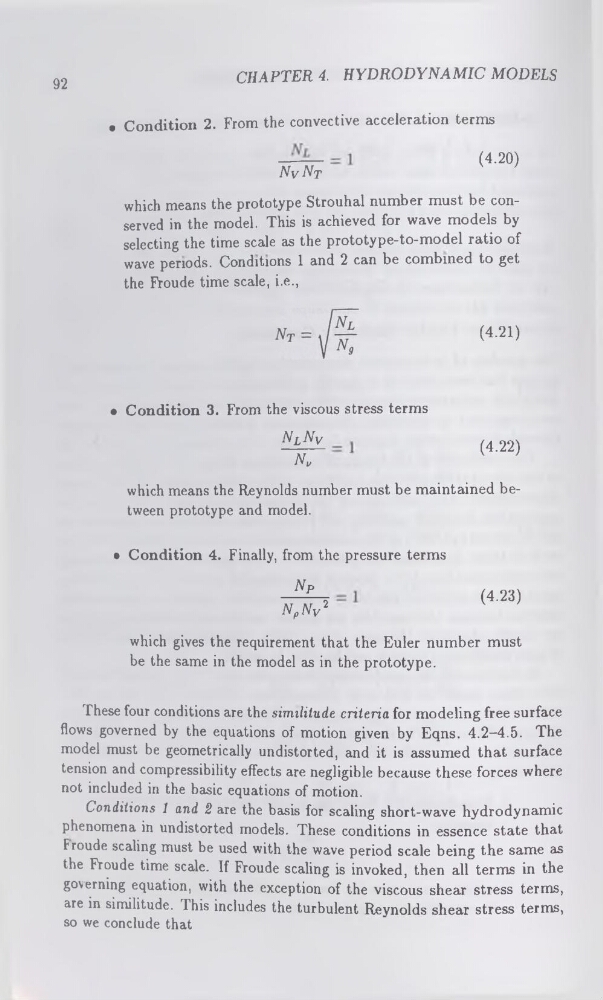
• Condition 2. From the convective acceleration terms
Ny Nt
(4.20)
which means the prototype Strouhal number must be conserved in the model. This is achieved for wave models by
selecting the time scale as the prototype-to-model ratio of
wave periods. Conditions 1 and 2 can be combined to get
the Froude time scale, i.e.,
(4.21)
• Condition 3. From the viscous stress terms
NlNv
N„
(4-22)
which means the Reynolds number must be maintained between prototype and model.
• Condition 4. Finally, from the pressure terms
NP
NfiNv2
(4.23)
which gives the requirement that the Euler number must
be the same in the model as in the prototype.
These four conditions are the similitude criteria for modeling free surface
flows governed by the equations of motion given by Eqns. 4.2-4.5. The
model must be geometrically undistorted, and it is assumed that surface
tension and compressibility effects are negligible because these forces where
not included in the basic equations of motion.
Conditions 1 and 2 are the basis for scaling short-wave hydrodynamic
phenomena in undistorted models. These conditions in essence state that
Iroude scaling must be used with the wave period scale being the same as
the Froude time scale. If Froude scaling is invoked, then all terms in the
governing equation, with the exception of the viscous shear stress terms,
are in similitude. This includes the turbulent Reynolds shear stress terms,
so we conclude that
CHAPTER 4. HYDRODYNAMIC MODELS
• Condition 2. From the convective acceleration terms
Ny Nt
(4.20)
which means the prototype Strouhal number must be conserved in the model. This is achieved for wave models by
selecting the time scale as the prototype-to-model ratio of
wave periods. Conditions 1 and 2 can be combined to get
the Froude time scale, i.e.,
(4.21)
• Condition 3. From the viscous stress terms
NlNv
N„
(4-22)
which means the Reynolds number must be maintained between prototype and model.
• Condition 4. Finally, from the pressure terms
NP
NfiNv2
(4.23)
which gives the requirement that the Euler number must
be the same in the model as in the prototype.
These four conditions are the similitude criteria for modeling free surface
flows governed by the equations of motion given by Eqns. 4.2-4.5. The
model must be geometrically undistorted, and it is assumed that surface
tension and compressibility effects are negligible because these forces where
not included in the basic equations of motion.
Conditions 1 and 2 are the basis for scaling short-wave hydrodynamic
phenomena in undistorted models. These conditions in essence state that
Iroude scaling must be used with the wave period scale being the same as
the Froude time scale. If Froude scaling is invoked, then all terms in the
governing equation, with the exception of the viscous shear stress terms,
are in similitude. This includes the turbulent Reynolds shear stress terms,
so we conclude that