

4.2. SHORT-WAVE HYDRODYNAMIC MODELS
87
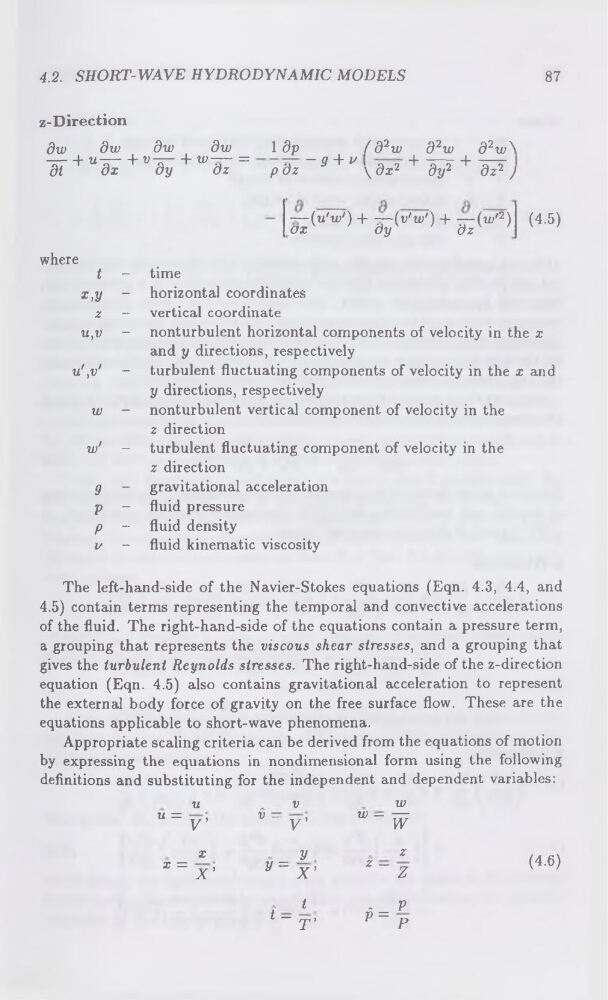
z-Direction
dw
dw
dw
dw
1 dp
/ d2w d2w
d2w\
— 4- u — + v-^~ 4- w— =
- g 4- v
4- -y-y 4- -y-y
dt
dx
dy
dz
pdz
\ dx2 dy2
dz2 J
—{u'w') + — (v'w') 4- —(w'2)
ox
dy
dz
(4-5)
where
t - time
x,y - horizontal coordinates
z - vertical coordinate
u,v - nonturbulent horizontal components of velocity in the x
and y directions, respectively
u' ,v' - turbulent fluctuating components of velocity in the x and
y directions, respectively
w - nonturbulent vertical component of velocity in the
z direction
w' - turbulent fluctuating component of velocity in the
z direction
g - gravitational acceleration
p - fluid pressure
p - fluid density
v - fluid kinematic viscosity
The left-hand-side of the Navier-Stokes equations (Eqn. 4.3, 4.4, and
4.5) contain terms representing the temporal and convective accelerations
of the fluid. The right-hand-side of the equations contain a pressure term,
a grouping that represents the viscous shear stresses, and a grouping that
gives the turbulent Reynolds stresses. The right-hand-side of the z-direction
equation (Eqn. 4.5) also contains gravitational acceleration to represent
the external body force of gravity on the free surface flow. These are the
equations applicable to short-wave phenomena.
Appropriate scaling criteria can be derived from the equations of motion
by expressing the equations in nondimensional form using the following
definitions and substituting for the independent and dependent variables:
U
U=V'
V
v~ V'
w
w — —
W
X
x= X'
y
y=x'
z
z~ Z
t
* “ T’
-
P
P=P
(4.6)
87
z-Direction
dw
dw
dw
dw
1 dp
/ d2w d2w
d2w\
— 4- u — + v-^~ 4- w— =
- g 4- v
4- -y-y 4- -y-y
dt
dx
dy
dz
pdz
\ dx2 dy2
dz2 J
—{u'w') + — (v'w') 4- —(w'2)
ox
dy
dz
(4-5)
where
t - time
x,y - horizontal coordinates
z - vertical coordinate
u,v - nonturbulent horizontal components of velocity in the x
and y directions, respectively
u' ,v' - turbulent fluctuating components of velocity in the x and
y directions, respectively
w - nonturbulent vertical component of velocity in the
z direction
w' - turbulent fluctuating component of velocity in the
z direction
g - gravitational acceleration
p - fluid pressure
p - fluid density
v - fluid kinematic viscosity
The left-hand-side of the Navier-Stokes equations (Eqn. 4.3, 4.4, and
4.5) contain terms representing the temporal and convective accelerations
of the fluid. The right-hand-side of the equations contain a pressure term,
a grouping that represents the viscous shear stresses, and a grouping that
gives the turbulent Reynolds stresses. The right-hand-side of the z-direction
equation (Eqn. 4.5) also contains gravitational acceleration to represent
the external body force of gravity on the free surface flow. These are the
equations applicable to short-wave phenomena.
Appropriate scaling criteria can be derived from the equations of motion
by expressing the equations in nondimensional form using the following
definitions and substituting for the independent and dependent variables:
U
U=V'
V
v~ V'
w
w — —
W
X
x= X'
y
y=x'
z
z~ Z
t
* “ T’
-
P
P=P
(4.6)