

86
CHAPTER 4. HYDRODYNAMIC MODELS
• Wave breaking (2-d and 3-d)
• Wave forces on structures (2-d and 3-d)
• Wave reflection and transmission (2-d and 3-d)
• Wave/current interaction (2-d and 3-d)
• Wave runup and overtopping (2-d and 3-d)
• Wave groupiness effects (2-d and 3-d)
• Boundary layers and turbulence (2-d and 3-d)
3
• Tracer studies to provide qualitative sediment paths (3-d)
4
• Inlets with short waves on steady currents (3-d)
Note that turbulence is a three-dimensional process, but it can be studied in a twodimensional wave facility. It is best to model turbulence at full scale.
Tracer studies are discussed in Chapter 6.
4.2.1 Scaling Requirements for Short-Wave Models
Governing Equations of Motion
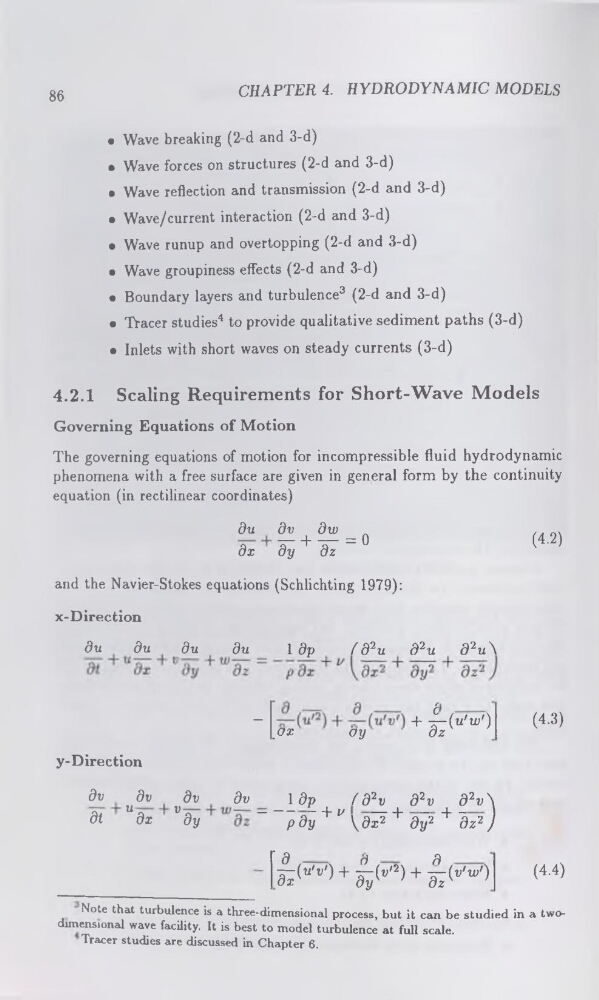
The governing equations of motion for incompressible fluid hydrodynamic
phenomena with a free surface are given in general form by the continuity
equation (in rectilinear coordinates)
du dv dw
n"ô—t "ô— = 0
dx dy dz
(4.2)
and the Navier-Stokes equations (Schlichting 1979):
x-Direction
du
du
du
du
1 dp
/ d2u
d2u
d2u\
-
+ J-fu'w')
(4.3)
_ox
ay
az
y-Direction
dv
dv
dv
dv
1 dp
f d2v
d2v
d2v\
dt Udx Vdy
” ~^dÿ + u \d^ + dÿ2 + Ih2 )
“ d
c)
F)
T-(^'^) + -X-(v'2) + — (v'w')
ox
dy
dz
(4.4)
CHAPTER 4. HYDRODYNAMIC MODELS
• Wave breaking (2-d and 3-d)
• Wave forces on structures (2-d and 3-d)
• Wave reflection and transmission (2-d and 3-d)
• Wave/current interaction (2-d and 3-d)
• Wave runup and overtopping (2-d and 3-d)
• Wave groupiness effects (2-d and 3-d)
• Boundary layers and turbulence (2-d and 3-d)
3
• Tracer studies to provide qualitative sediment paths (3-d)
4
• Inlets with short waves on steady currents (3-d)
Note that turbulence is a three-dimensional process, but it can be studied in a twodimensional wave facility. It is best to model turbulence at full scale.
Tracer studies are discussed in Chapter 6.
4.2.1 Scaling Requirements for Short-Wave Models
Governing Equations of Motion
The governing equations of motion for incompressible fluid hydrodynamic
phenomena with a free surface are given in general form by the continuity
equation (in rectilinear coordinates)
du dv dw
n"ô—t "ô— = 0
dx dy dz
(4.2)
and the Navier-Stokes equations (Schlichting 1979):
x-Direction
du
du
du
du
1 dp
/ d2u
d2u
d2u\
-
+ J-fu'w')
(4.3)
_ox
ay
az
y-Direction
dv
dv
dv
dv
1 dp
f d2v
d2v
d2v\
dt Udx Vdy
” ~^dÿ + u \d^ + dÿ2 + Ih2 )
“ d
c)
F)
T-(^'^) + -X-(v'2) + — (v'w')
ox
dy
dz
(4.4)