

3. Sédiment Transport
61
and Hb =breaking wave height, W =width of surf zone, Vleo = average
longshore current due to breaking waves, Cf = friction factor (assume 0.01),
X = distance to dye patch from shoreline. (V/Vo)lh is the dimensionless
longshore current based on Longuet-Higgins [1970]. It is assumed that the
LEO breaking wave height is a good approximation of the significant breaking wave height and that the mixing parameter in Longuet-Higgins’ theory
is 0.4.
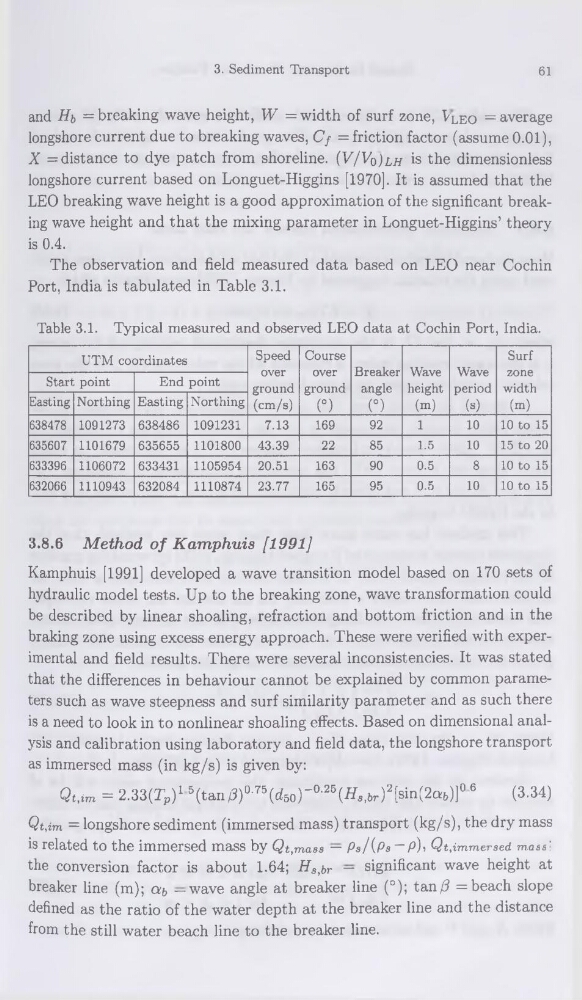
The observation and field measured data based on LEO near Cochin
Port, India is tabulated in Table 3.1.
Table 3.1. Typical measured and observed LEO data at Cochin Port, India.
UTM coordinates
Speed
over
ground
(cm/s)
Course
over
ground
(°)
Breaker
angle
(°)
Wave
height
(m)
Wave
period
(s)
Surf
zone
width
(m)
Start point
End point
Easting Northing Easting Northing
638478 1091273 638486 1091231
7.13
169
92
1
10
10 to 15
635607 1101679 635655 1101800 43.39
22
85
1.5
10
15 to 20
633396 1106072 633431 1105954 20.51
163
90
0.5
8
10 to 15
632066 1110943 632084 1110874 23.77
165
95
0.5
10
10 to 15
3.8.6 Method of Kamphuis [1991]
Kamphuis [1991] developed a wave transition model based on 170 sets of
hydraulic model tests. Up to the breaking zone, wave transformation could
be described by linear shoaling, refraction and bottom friction and in the
braking zone using excess energy approach. These were verified with experimental and field results. There were several inconsistencies. It was stated
that the différences in behaviour cannot be explained by common parameters such as wave steepness and surf similarity parameter and as such there
is a need to look in to nonlinear shoaling effects. Based on dimensional analysis and calibration using laboratory and field data, the longshore transport
as immersed mass (in kg/s) is given by:
Qt,im = 2.33CT,,)1 5(tan/3)“-75(d5o)-o'25(^>)2[sin(2at)]o
Qt,im = longshore sédiment (immersed mass) transport (kg/s), the dry mass
is related to the immersed mass by Qt,mass — Ps/(Ps~~P)> Qt,immersed mass',
the conversion factor is about 1.64; Hs^r — significant wave height at
breaker line (m); &b — wave angle at breaker line (°); tan/3 =beach slope
defined as the ratio of the water depth at the breaker line and the distance
from the still water beach line to the breaker line.
61
and Hb =breaking wave height, W =width of surf zone, Vleo = average
longshore current due to breaking waves, Cf = friction factor (assume 0.01),
X = distance to dye patch from shoreline. (V/Vo)lh is the dimensionless
longshore current based on Longuet-Higgins [1970]. It is assumed that the
LEO breaking wave height is a good approximation of the significant breaking wave height and that the mixing parameter in Longuet-Higgins’ theory
is 0.4.
The observation and field measured data based on LEO near Cochin
Port, India is tabulated in Table 3.1.
Table 3.1. Typical measured and observed LEO data at Cochin Port, India.
UTM coordinates
Speed
over
ground
(cm/s)
Course
over
ground
(°)
Breaker
angle
(°)
Wave
height
(m)
Wave
period
(s)
Surf
zone
width
(m)
Start point
End point
Easting Northing Easting Northing
638478 1091273 638486 1091231
7.13
169
92
1
10
10 to 15
635607 1101679 635655 1101800 43.39
22
85
1.5
10
15 to 20
633396 1106072 633431 1105954 20.51
163
90
0.5
8
10 to 15
632066 1110943 632084 1110874 23.77
165
95
0.5
10
10 to 15
3.8.6 Method of Kamphuis [1991]
Kamphuis [1991] developed a wave transition model based on 170 sets of
hydraulic model tests. Up to the breaking zone, wave transformation could
be described by linear shoaling, refraction and bottom friction and in the
braking zone using excess energy approach. These were verified with experimental and field results. There were several inconsistencies. It was stated
that the différences in behaviour cannot be explained by common parameters such as wave steepness and surf similarity parameter and as such there
is a need to look in to nonlinear shoaling effects. Based on dimensional analysis and calibration using laboratory and field data, the longshore transport
as immersed mass (in kg/s) is given by:
Qt,im = 2.33CT,,)1 5(tan/3)“-75(d5o)-o'25(^>)2[sin(2at)]o
Qt,im = longshore sédiment (immersed mass) transport (kg/s), the dry mass
is related to the immersed mass by Qt,mass — Ps/(Ps~~P)> Qt,immersed mass',
the conversion factor is about 1.64; Hs^r — significant wave height at
breaker line (m); &b — wave angle at breaker line (°); tan/3 =beach slope
defined as the ratio of the water depth at the breaker line and the distance
from the still water beach line to the breaker line.