

60
Coastal Engineering: Theory and Practice
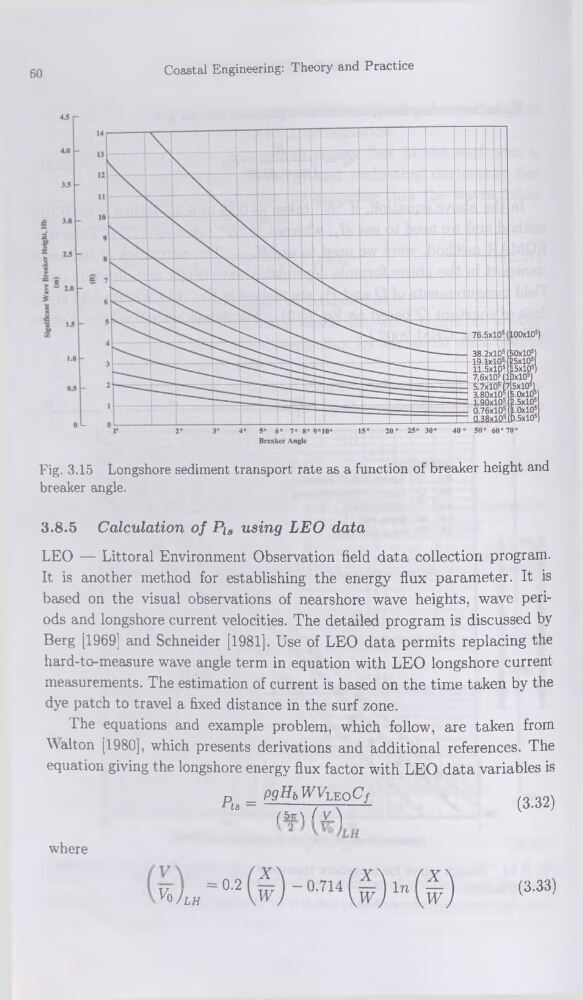
Fig. 3.15 Longshore sédiment transport rate as a function of breaker height and
breaker angle.
3.8.5 Calculation of Pia using LEO data
LEO — Littoral Environment Observation field data collection program.
It is another method for establishing the energy flux parameter. It is
based on the visual observations of nearshore wave heights, wave periods and longshore carrent velocities. The detailed program is discussed by
Berg [1969] and Schneider [1981]. Use of LEO data permits replacing the
hard-to-measure wave angle term in équation with LEO longshore current
measurements. The estimation of current is based on the time taken by the
dye patch to travel a fixed distance in the surf zone.
The équations and example problem, which follow, are taken from
Walton [1980], which présents dérivations and additional references. The
équation giving the longshore energy flux factor with LEO data variables is
(3.32)
where
V
=0-2
v^Jlh
p _ pgHbWv^oCf
*18 —
/---- \------(5tt\ ( VJ
(3.33)
Coastal Engineering: Theory and Practice
Fig. 3.15 Longshore sédiment transport rate as a function of breaker height and
breaker angle.
3.8.5 Calculation of Pia using LEO data
LEO — Littoral Environment Observation field data collection program.
It is another method for establishing the energy flux parameter. It is
based on the visual observations of nearshore wave heights, wave periods and longshore carrent velocities. The detailed program is discussed by
Berg [1969] and Schneider [1981]. Use of LEO data permits replacing the
hard-to-measure wave angle term in équation with LEO longshore current
measurements. The estimation of current is based on the time taken by the
dye patch to travel a fixed distance in the surf zone.
The équations and example problem, which follow, are taken from
Walton [1980], which présents dérivations and additional references. The
équation giving the longshore energy flux factor with LEO data variables is
(3.32)
where
V
=0-2
v^Jlh
p _ pgHbWv^oCf
*18 —
/---- \------(5tt\ ( VJ
(3.33)