

3. Sédiment Transport
43
LAND
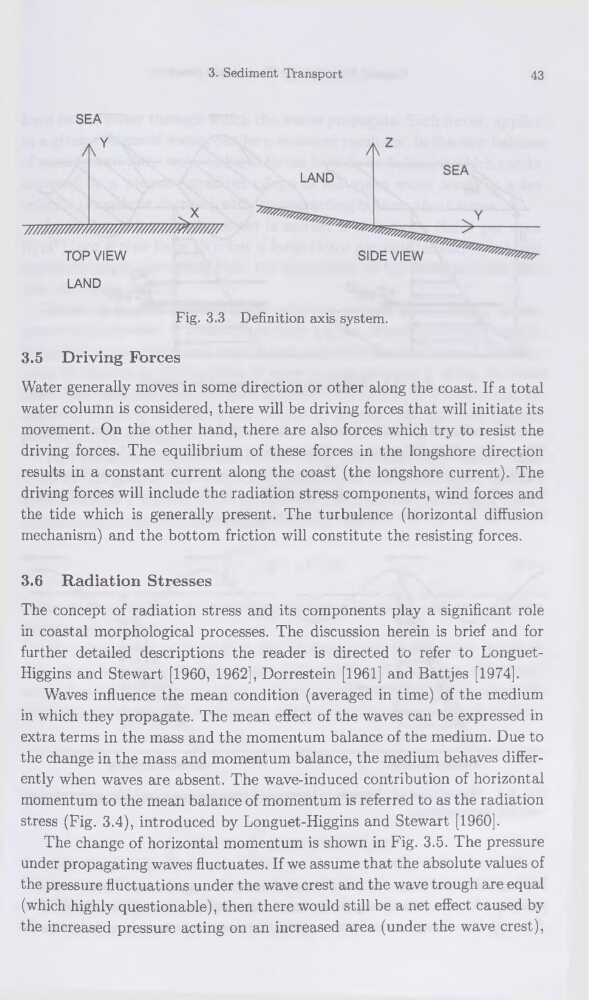
Fig. 3.3 Définition axis System.
3.5 Driving Forces
Water generally moves in some direction or other along the coast. If a total
water column is considered, there will be driving forces that will initiate its
movement. On the other hand, there are also forces which try to resist the
driving forces. The equilibrium of these forces in the longshore direction
results in a constant current along the coast (the longshore current). The
driving forces will include the radiation stress components, wind forces and
the tide which is generally présent. The turbulence (horizontal diffusion
mechanism) and the bottom friction will constitute the resisting forces.
3.6 Radiation Stresses
The concept of radiation stress and its components play a significant rôle
in Coastal morphological processes. The discussion herein is brief and for
further detailed descriptions the reader is directed to refer to LonguetHiggins and Stewart [1960, 1962], Dorrestein [1961] and Battjes [1974].
Waves influence the mean condition (averaged in time) of the medium
in which they propagate. The mean effect of the waves can be expressed in
extra terms in the mass and the momentum balance of the medium. Due to
the change in the mass and momentum balance, the medium behaves differently when waves are absent. The wave-induced contribution of horizontal
momentum to the mean balance of momentum is referred to as the radiation
stress (Fig. 3.4), introduced by Longuet-Higgins and Stewart [I960].
The change of horizontal momentum is shown in Fig. 3.5. The pressure
under propagating waves fluctuâtes. If we assume that the absolute values of
the pressure fluctuations under the wave crest and the wave trough are equal
(which highly questionable), then there would still be a net effect caused by
the increased pressure acting on an increased area (under the wave crest),
43
LAND
Fig. 3.3 Définition axis System.
3.5 Driving Forces
Water generally moves in some direction or other along the coast. If a total
water column is considered, there will be driving forces that will initiate its
movement. On the other hand, there are also forces which try to resist the
driving forces. The equilibrium of these forces in the longshore direction
results in a constant current along the coast (the longshore current). The
driving forces will include the radiation stress components, wind forces and
the tide which is generally présent. The turbulence (horizontal diffusion
mechanism) and the bottom friction will constitute the resisting forces.
3.6 Radiation Stresses
The concept of radiation stress and its components play a significant rôle
in Coastal morphological processes. The discussion herein is brief and for
further detailed descriptions the reader is directed to refer to LonguetHiggins and Stewart [1960, 1962], Dorrestein [1961] and Battjes [1974].
Waves influence the mean condition (averaged in time) of the medium
in which they propagate. The mean effect of the waves can be expressed in
extra terms in the mass and the momentum balance of the medium. Due to
the change in the mass and momentum balance, the medium behaves differently when waves are absent. The wave-induced contribution of horizontal
momentum to the mean balance of momentum is referred to as the radiation
stress (Fig. 3.4), introduced by Longuet-Higgins and Stewart [I960].
The change of horizontal momentum is shown in Fig. 3.5. The pressure
under propagating waves fluctuâtes. If we assume that the absolute values of
the pressure fluctuations under the wave crest and the wave trough are equal
(which highly questionable), then there would still be a net effect caused by
the increased pressure acting on an increased area (under the wave crest),