

2. Characteristics and Motion of Sédiments
29
where
v/c = is the fall velocity at concentration C.
Vf0 = is the fall velocity in clear fluid.
n = 4.6 for low Re and n = 2.3 for high Re.
In some fluids, particles of silt and clay tend to collect together in flocs
is many times greater than that of individual particles so that under these
circumstances, an initially uniform suspension of particles may produce
accelerated settling.
2.10 Effect of Turbulence
At very small Re, drag exerted by the fluid on a body in a stream is directly
proportional to the relative velocity. Thus, random fluctuations in velocity
will hâve no effect on the mean drag, which will remain proportional to the
mean velocity. On the other hand, in the région where Cp is approximately
constant, drag is proportional to the square of the velocity. Under these
circumstances the mean drag will no longer be proportional to the mean
velocity if random fluctuations are présent.
2.11 Permeability and Porosity
Permeability is the property of the soil to transmit water and air through
its pores. The higher the degree of permeability, the greater will be the
extent of seepage. The permeability of a bed of sédiments is usually defined
in ter ms of the flow produced by a given pressure gradient.
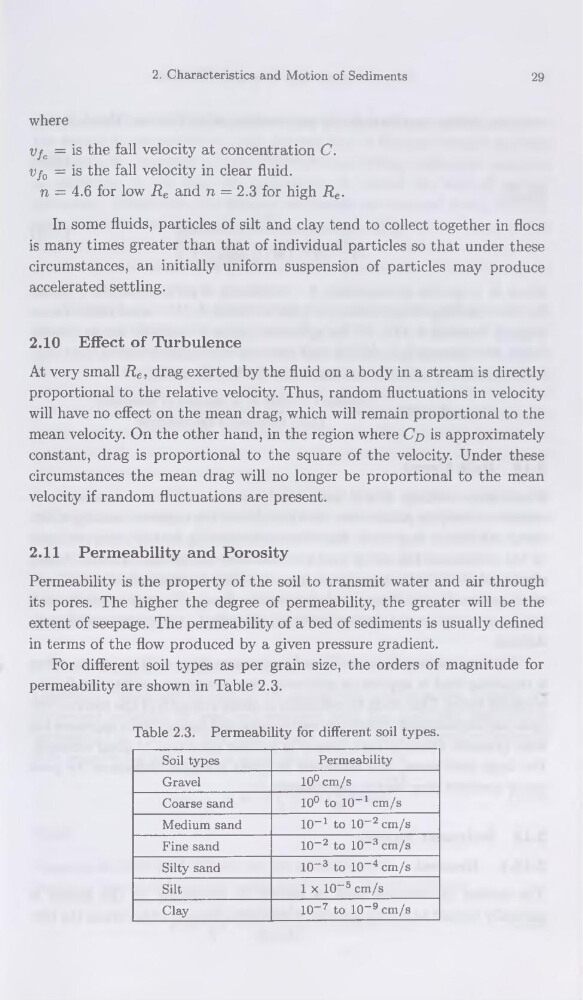
For different soil types as per grain size, the orders of magnitude for
permeability are shown in Table 2.3.
Table 2.3. Permeability for different soil types.
Soil types
Permeability
Gravel
10° cm/s
Coarse sand
10° to 10-1 cm/s
Medium sand
10“1 to 10-2 cm/s
Fine sand
10~2 to 10~3 cm/s
Silty sand
10-3 to 10-4 cm/s
Silt
1 x 10⁻⁵ cm/s
Clay
10-7 to 10-9 cm/s
29
where
v/c = is the fall velocity at concentration C.
Vf0 = is the fall velocity in clear fluid.
n = 4.6 for low Re and n = 2.3 for high Re.
In some fluids, particles of silt and clay tend to collect together in flocs
is many times greater than that of individual particles so that under these
circumstances, an initially uniform suspension of particles may produce
accelerated settling.
2.10 Effect of Turbulence
At very small Re, drag exerted by the fluid on a body in a stream is directly
proportional to the relative velocity. Thus, random fluctuations in velocity
will hâve no effect on the mean drag, which will remain proportional to the
mean velocity. On the other hand, in the région where Cp is approximately
constant, drag is proportional to the square of the velocity. Under these
circumstances the mean drag will no longer be proportional to the mean
velocity if random fluctuations are présent.
2.11 Permeability and Porosity
Permeability is the property of the soil to transmit water and air through
its pores. The higher the degree of permeability, the greater will be the
extent of seepage. The permeability of a bed of sédiments is usually defined
in ter ms of the flow produced by a given pressure gradient.
For different soil types as per grain size, the orders of magnitude for
permeability are shown in Table 2.3.
Table 2.3. Permeability for different soil types.
Soil types
Permeability
Gravel
10° cm/s
Coarse sand
10° to 10-1 cm/s
Medium sand
10“1 to 10-2 cm/s
Fine sand
10~2 to 10~3 cm/s
Silty sand
10-3 to 10-4 cm/s
Silt
1 x 10⁻⁵ cm/s
Clay
10-7 to 10-9 cm/s