

28
Coastal Engineering: Theory and Practice
in shape on the fall velocity is much less significant for small grain sizes than
for large. Approximate formulae may be obtained for relatively coarse and
relatively fine sédiments. For quartz sand in water at 20°C the particle size
will be between 3 mm and 90 mm. The fall velocity for different shape
factors, SF is given as
Vf = 6.5 Z)1/2
SF = 1
SF = 0.7 Vf = 4.2 Z)1/2
SF = 0.3 Vf = 2.8 T>1/2
For grain size less than 0.1 mm, Vf = 92 x 104 Z)2.
In the above formulae, Vf is in m/s and D is in meters.
2.7 Angle of Repose
It is the steepest angle formed by a heap of sédiments without losing its
slope and is on the verge of collapsing. It is to be noted that the friction
force restraints in addition to the inertia, opposing the movement of noncohesive sédiments at contacts. The capacity of a particle to resist sliding
motion relative to its submerged gravity component normal to the sliding
is expressed as the friction coefficient
therefore it represents the ratio
of the tangential résistive force to the downward normal force.
2.8 Effect of Température
A change in température modifies the coefficient of viscosity of the fluid
and hence the Reynolds no:
It is clear that a change in Re will hâve
a significant effect on the Cd and hence on the fall velocity at small values
of Re but a relatively small effect in the range 400 < Re < 200,000.
Température also has an effect on the density of the water. However, the
change in density is so small compared with the change in v that density
variation may be neglected for ail practical purposes.
2.9 Effect of Sédiment Concentration
A small cloud of grains in an otherwise clear fluid will settle faster than a
single grain.
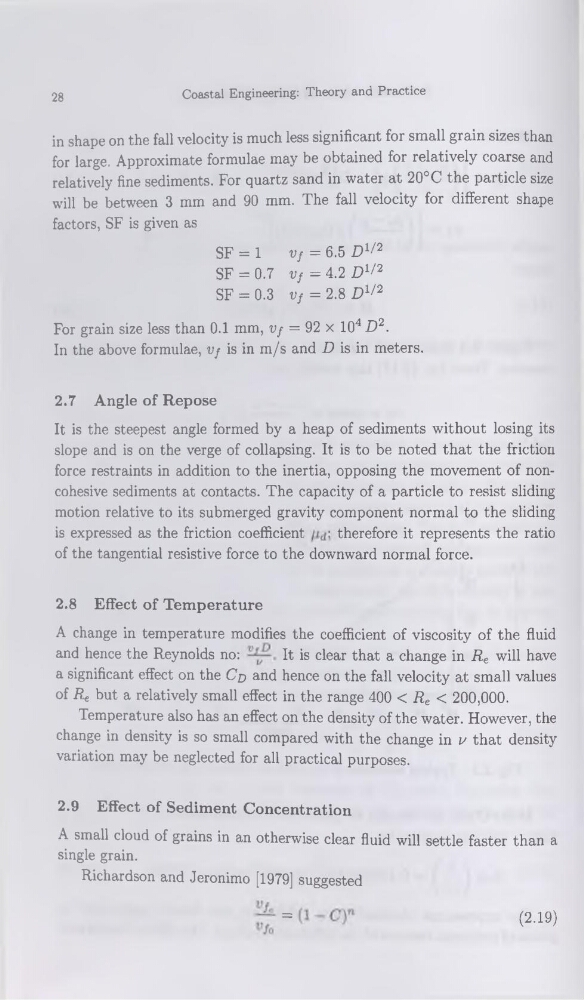
Richardson and Jeronimo [1979] suggested
=
(2.19)
Coastal Engineering: Theory and Practice
in shape on the fall velocity is much less significant for small grain sizes than
for large. Approximate formulae may be obtained for relatively coarse and
relatively fine sédiments. For quartz sand in water at 20°C the particle size
will be between 3 mm and 90 mm. The fall velocity for different shape
factors, SF is given as
Vf = 6.5 Z)1/2
SF = 1
SF = 0.7 Vf = 4.2 Z)1/2
SF = 0.3 Vf = 2.8 T>1/2
For grain size less than 0.1 mm, Vf = 92 x 104 Z)2.
In the above formulae, Vf is in m/s and D is in meters.
2.7 Angle of Repose
It is the steepest angle formed by a heap of sédiments without losing its
slope and is on the verge of collapsing. It is to be noted that the friction
force restraints in addition to the inertia, opposing the movement of noncohesive sédiments at contacts. The capacity of a particle to resist sliding
motion relative to its submerged gravity component normal to the sliding
is expressed as the friction coefficient
therefore it represents the ratio
of the tangential résistive force to the downward normal force.
2.8 Effect of Température
A change in température modifies the coefficient of viscosity of the fluid
and hence the Reynolds no:
It is clear that a change in Re will hâve
a significant effect on the Cd and hence on the fall velocity at small values
of Re but a relatively small effect in the range 400 < Re < 200,000.
Température also has an effect on the density of the water. However, the
change in density is so small compared with the change in v that density
variation may be neglected for ail practical purposes.
2.9 Effect of Sédiment Concentration
A small cloud of grains in an otherwise clear fluid will settle faster than a
single grain.
Richardson and Jeronimo [1979] suggested
=
(2.19)