

26
Coastal Engineering: Theory and Practice
Thus
PI = LL - PL.
(2-9)
2.5 Shape
The shape factor of a sédiment particle is governed by its géométrie shape
and is given as,
SF = f
01
j
\(D2D^)
where £>i, D2, D3 are respectively the lengths of the shortest, intermediate
and longest mutually perpendicular axes.
2.6 Fall Velocity (vy)
When the flow is dominated by suspended sédiments, its gravitational fall
velocity is of great interest. The fall velocity acts as a restoring force against
the turbulence entraining forces driving the sédiments. Natural sédiments in
real time are scarcely spherical, although an approximation of fall velocity
over rigid sphere is used for theoretical calculations. The fall velocity in
fact, dictâtes the quantity of sédiments that can deposit in a channel, like
the approach channel of a harbour and its magnitude is directly governs the
quantity of maintenance dredging. In other words, the fall velocity is the
terminal velocity attained by an isolated solid grain settling due to gravity
in a still, unbounded, less dense fluid.
The fall velocity, Vf is the final equilibrium velocity reached by the
falling sphere. Under these circumstances the drag of the fluid must exactly
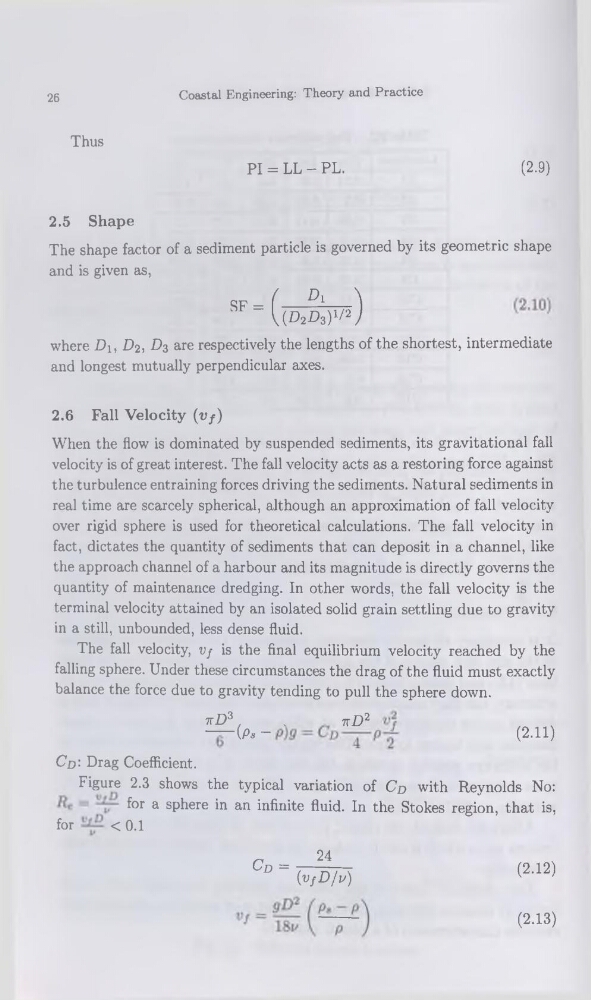
balance the force due to gravity tending to pull the sphere down.
7T-D3,
.
7tL>2
—(P« “
(2.11)
Cr>: Drag Coefficient.
Figure 2.3 shows the typical variation of Cp with Reynolds No:
for a sphere in an infinité fluid. In the Stokes région, that is,
for
< 0.1
24
Cd = ~(vfD/v\
(2,12)
M'
Coastal Engineering: Theory and Practice
Thus
PI = LL - PL.
(2-9)
2.5 Shape
The shape factor of a sédiment particle is governed by its géométrie shape
and is given as,
SF = f
01
j
\(D2D^)
where £>i, D2, D3 are respectively the lengths of the shortest, intermediate
and longest mutually perpendicular axes.
2.6 Fall Velocity (vy)
When the flow is dominated by suspended sédiments, its gravitational fall
velocity is of great interest. The fall velocity acts as a restoring force against
the turbulence entraining forces driving the sédiments. Natural sédiments in
real time are scarcely spherical, although an approximation of fall velocity
over rigid sphere is used for theoretical calculations. The fall velocity in
fact, dictâtes the quantity of sédiments that can deposit in a channel, like
the approach channel of a harbour and its magnitude is directly governs the
quantity of maintenance dredging. In other words, the fall velocity is the
terminal velocity attained by an isolated solid grain settling due to gravity
in a still, unbounded, less dense fluid.
The fall velocity, Vf is the final equilibrium velocity reached by the
falling sphere. Under these circumstances the drag of the fluid must exactly
balance the force due to gravity tending to pull the sphere down.
7T-D3,
.
7tL>2
—(P« “
(2.11)
Cr>: Drag Coefficient.
Figure 2.3 shows the typical variation of Cp with Reynolds No:
for a sphere in an infinité fluid. In the Stokes région, that is,
for
< 0.1
24
Cd = ~(vfD/v\
(2,12)
M'