

2. Characteristics and Motion of Sédiments
23
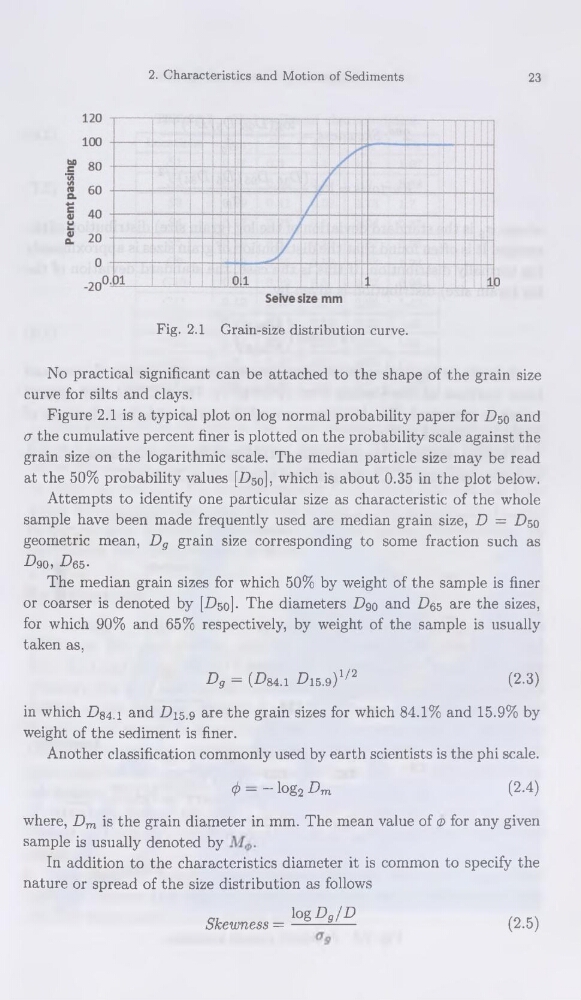
Fig. 2.1 Grain-size distribution curve.
No practical significant can be attached to the shape of the grain size
curve for silts and clays.
Figure 2.1 is a typical plot on log normal probability paper for D$o and
cr the cumulative percent finer is plotted on the probability scale against the
grain size on the logarithmic scale. The médian particle size may be read
at the 50% probability values [D50], which is about 0.35 in the plot below.
Attempts to identify one particular size as characteristic of the whole
sample hâve been made frequently used are médian grain size, D = jD50
géométrie mean, Dg grain size corresponding to some fraction such as
D90, 7?65The médian grain sizes for which 50% by weight of the sample is finer
or coarser is denoted by [P50]. The diameters Dqq and Dq$ are the sizes,
for which 90% and 65% respectively, by weight of the sample is usually
taken as,
D„ = (D84.i _D15.s)i/2
(2.3)
in which 7?84.i and H15.9 are the grain sizes for which 84.1% and 15.9% by
weight of the sédiment is finer.
Another classification commonly used by earth scientists is the phi scale.
$ — ~ log2 Dm
(2.4)
where, Dm is the grain diameter in mm. The mean value of 0 for any given
sample is usually denoted by
In addition to the characteristics diameter it is common to specify the
nature or spread of the size distribution as follows
Skewness = iogD^D
(2.5)
23
Fig. 2.1 Grain-size distribution curve.
No practical significant can be attached to the shape of the grain size
curve for silts and clays.
Figure 2.1 is a typical plot on log normal probability paper for D$o and
cr the cumulative percent finer is plotted on the probability scale against the
grain size on the logarithmic scale. The médian particle size may be read
at the 50% probability values [D50], which is about 0.35 in the plot below.
Attempts to identify one particular size as characteristic of the whole
sample hâve been made frequently used are médian grain size, D = jD50
géométrie mean, Dg grain size corresponding to some fraction such as
D90, 7?65The médian grain sizes for which 50% by weight of the sample is finer
or coarser is denoted by [P50]. The diameters Dqq and Dq$ are the sizes,
for which 90% and 65% respectively, by weight of the sample is usually
taken as,
D„ = (D84.i _D15.s)i/2
(2.3)
in which 7?84.i and H15.9 are the grain sizes for which 84.1% and 15.9% by
weight of the sédiment is finer.
Another classification commonly used by earth scientists is the phi scale.
$ — ~ log2 Dm
(2.4)
where, Dm is the grain diameter in mm. The mean value of 0 for any given
sample is usually denoted by
In addition to the characteristics diameter it is common to specify the
nature or spread of the size distribution as follows
Skewness = iogD^D
(2.5)