

22
Coastal Engineering: Theory and Practice
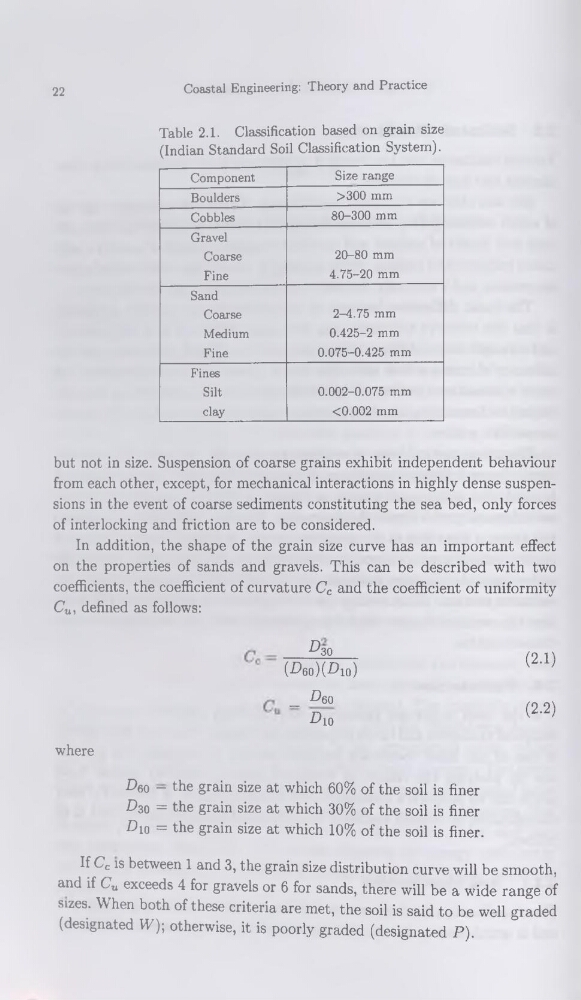
Table 2.1. Classification based on grain size
(Indian Standard Soil Classification System).
Component
Size range
Boulders
>300 mm
Cobbles
80-300 mm
Gravel
Coarse
Fine
20-80 mm
4.75-20 mm
Sand
Coarse
Medium
Fine
2-4.75 mm
0.425-2 mm
0.075-0.425 mm
Fines
Silt
clay
0.002-0.075 mm
<0.002 mm
but not in size. Suspension of coarse grains exhibit independent behaviour
from each other, except, for mechanical interactions in highly dense suspensions in the event of coarse sédiments constituting the sea bed, only forces
of interlocking and friction are to be considered.
In addition, the shape of the grain size curve has an important effect
on the properties of sands and gravels. This can be described with two
coefficients, the coefficient of curvature Cc and the coefficient of uniformity
Cu, defined as follows:
£*30
(£>6o)(-D1o)
_ Dqo
Dio
(2-1)
(2-2)
where
Dqq — the grain size at which 60% of the soil is finer
Dm = the grain size at which 30% of the soil is finer
Dio = the grain size at which 10% of the soil is finer.
If Cc is between 1 and 3, the grain size distribution curve will be smooth,
and if Cu exceeds 4 for gravels or 6 for sands, there will be a wide range of
sizes. When both of these criteria are met, the soil is said to be well graded
(designated IV); otherwise, it is poorly graded (designated P).
Coastal Engineering: Theory and Practice
Table 2.1. Classification based on grain size
(Indian Standard Soil Classification System).
Component
Size range
Boulders
>300 mm
Cobbles
80-300 mm
Gravel
Coarse
Fine
20-80 mm
4.75-20 mm
Sand
Coarse
Medium
Fine
2-4.75 mm
0.425-2 mm
0.075-0.425 mm
Fines
Silt
clay
0.002-0.075 mm
<0.002 mm
but not in size. Suspension of coarse grains exhibit independent behaviour
from each other, except, for mechanical interactions in highly dense suspensions in the event of coarse sédiments constituting the sea bed, only forces
of interlocking and friction are to be considered.
In addition, the shape of the grain size curve has an important effect
on the properties of sands and gravels. This can be described with two
coefficients, the coefficient of curvature Cc and the coefficient of uniformity
Cu, defined as follows:
£*30
(£>6o)(-D1o)
_ Dqo
Dio
(2-1)
(2-2)
where
Dqq — the grain size at which 60% of the soil is finer
Dm = the grain size at which 30% of the soil is finer
Dio = the grain size at which 10% of the soil is finer.
If Cc is between 1 and 3, the grain size distribution curve will be smooth,
and if Cu exceeds 4 for gravels or 6 for sands, there will be a wide range of
sizes. When both of these criteria are met, the soil is said to be well graded
(designated IV); otherwise, it is poorly graded (designated P).