

334
Coastal Engineering: Theory and Practice
domain is simplified into two-dimensional horizontal domain. This reduces
one order of the number of équations to be solved.
The following procedure explains the Boussinesq approximation mathematically.
1. At an élévation, a Taylor sériés expansion is made on the velocity potential and/or horizontal and vertical water particle velocities.
2. Similar to the solution procedure of any infinité sériés, only a finite
number of terms is selected without omitting any terms from the first
term. That is, nth term was not selected without selecting (n- l)th tenu.
3. In the Taylor expansion, the partial dérivatives corresponding to vertical coordinates are replaced with partial dérivatives with respect to
horizontal dérivatives. While doing so, the conservation of mass following incompressible fluid assumption is ensured and the irrotationality of
flow is ensured by enforcing zéro curl condition.
4. Final partial differential équations are represented only in terms of the
horizontal coordinates and time for dynamic problems.
10.7.1 Boussinesq équations
Consider the potential flow problem in 2D (z-horizontal and z-vertical with
the origin at left and at still water level). The water depth (d) is constant.
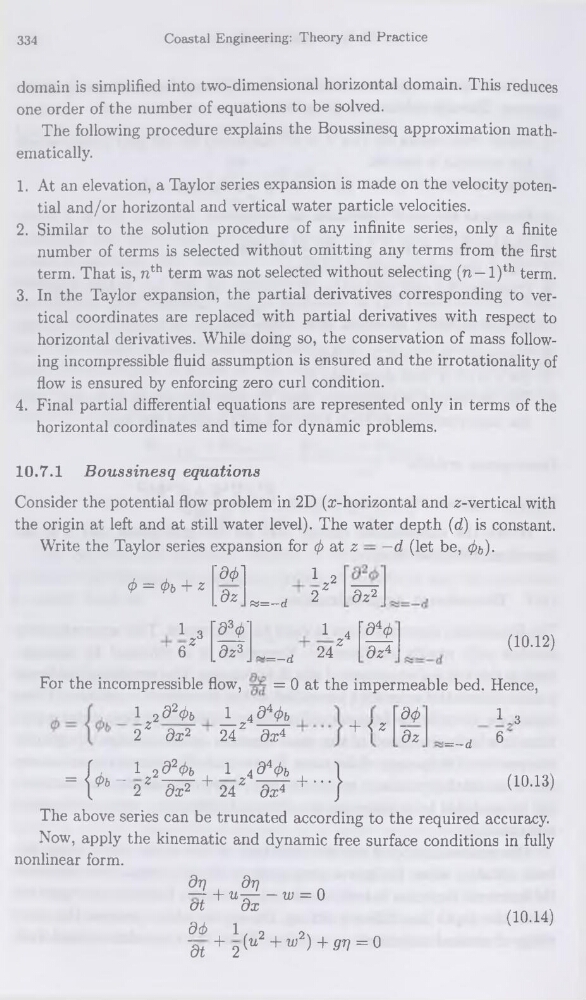
Write the Taylor sériés expansion for 0 at z — — d (let be, 0b).
0 = 0b + Z wi
12
_dz^=_d 2Z dz2
1 3
ç>z
~d30~
1 4 '<940
_dz3_ ~=_d 24Z dz4
(10.12)
For the incompressible flow,
= 0 at the imperméable bed. Hence,
12dy
2Z dx2
1 4^
— z -----24
~dz
1 3
’=~d
6
r
1 2â20b
1 4<940b
1
= h-22â^ + 24^ + -}
<1(U3>
The above sériés can be truncated according to the required accuracy.
Now, apply the kinematic and dynamic free surface conditions in fully
nonlinear form.
dq
dq
~ +u—- - w = 0
ot
dx
0 1 2
2x
-ft + 2 y +w )+pî? = °
(10.14)
Coastal Engineering: Theory and Practice
domain is simplified into two-dimensional horizontal domain. This reduces
one order of the number of équations to be solved.
The following procedure explains the Boussinesq approximation mathematically.
1. At an élévation, a Taylor sériés expansion is made on the velocity potential and/or horizontal and vertical water particle velocities.
2. Similar to the solution procedure of any infinité sériés, only a finite
number of terms is selected without omitting any terms from the first
term. That is, nth term was not selected without selecting (n- l)th tenu.
3. In the Taylor expansion, the partial dérivatives corresponding to vertical coordinates are replaced with partial dérivatives with respect to
horizontal dérivatives. While doing so, the conservation of mass following incompressible fluid assumption is ensured and the irrotationality of
flow is ensured by enforcing zéro curl condition.
4. Final partial differential équations are represented only in terms of the
horizontal coordinates and time for dynamic problems.
10.7.1 Boussinesq équations
Consider the potential flow problem in 2D (z-horizontal and z-vertical with
the origin at left and at still water level). The water depth (d) is constant.
Write the Taylor sériés expansion for 0 at z — — d (let be, 0b).
0 = 0b + Z wi
12
_dz^=_d 2Z dz2
1 3
ç>z
~d30~
1 4 '<940
_dz3_ ~=_d 24Z dz4
(10.12)
For the incompressible flow,
= 0 at the imperméable bed. Hence,
12dy
2Z dx2
1 4^
— z -----24
~dz
1 3
’=~d
6
r
1 2â20b
1 4<940b
1
= h-22â^ + 24^ + -}
<1(U3>
The above sériés can be truncated according to the required accuracy.
Now, apply the kinematic and dynamic free surface conditions in fully
nonlinear form.
dq
dq
~ +u—- - w = 0
ot
dx
0
2x
-ft + 2 y +w )+pî? = °
(10.14)