

330
Coastal Engineering: Theory and Practice
the solution in zone, Q;/ is the summation of the incident wave and the
outgoing wave due to diffraction and refraction inside Qj. The outgoing
wave leaving T2 is considered as the wave emanating from the source, g(S)
at r2 that satisfies the radiation boundary condition at infinity. The wave
height and phase should be continuous across r2. This condition leads to
additional équations to détermine the intensity of source distribution, g(S).
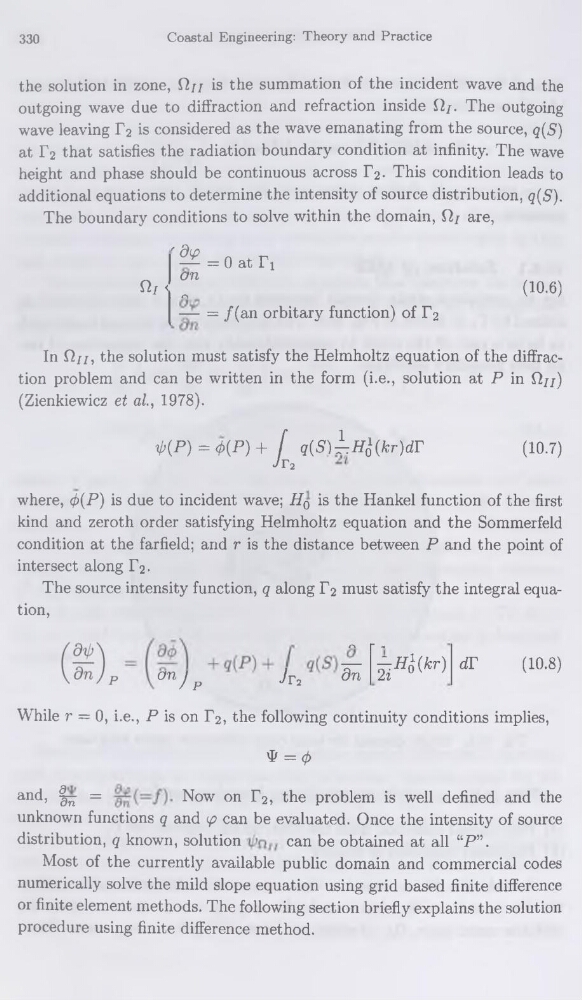
The boundary conditions to solve within the domain, Qj are,
Qz <
' dtp
—- = 0 at T1
on
O
— = /(an orbitary function) of T2
(10.6)
In Q/z, the solution must satisfy the Helmholtz équation of the diffraction problem and can be written in the form (i.e., solution at P in Q//)
(Zienkiewicz et al., 1978).
(10.7)
where, (.?) is due to incident wave; Hq is the Hankel function of the first
kind and zeroth order satisfying Helmholtz équation and the Sommerfeld
condition at the farfield; and r is the distance between P and the point of
intersect along T2.
The source intensity function, q along T2 must satisfy the intégral équation,
on /
/r„
/ p
Jr2
rx
r H
— i-.Hhkr) dl?
dn 2i 0 v 7
(10.8)
While r = 0, i.e., P is on T2, the following continuity conditions implies,
^ = 0
and, fïï' =
N°w on r2, the problem is well defined and the
unknown functions q and ç? can be evaluated. Once the intensity of source
distribution, q known, solution
can be obtained at ail “P”.
Most of the currently available public domain and commercial codes
numerically solve the mild slope équation using grid based finite différence
or finite element methods. The following section briefly explains the solution
procedure using finite différence method.
Coastal Engineering: Theory and Practice
the solution in zone, Q;/ is the summation of the incident wave and the
outgoing wave due to diffraction and refraction inside Qj. The outgoing
wave leaving T2 is considered as the wave emanating from the source, g(S)
at r2 that satisfies the radiation boundary condition at infinity. The wave
height and phase should be continuous across r2. This condition leads to
additional équations to détermine the intensity of source distribution, g(S).
The boundary conditions to solve within the domain, Qj are,
Qz <
' dtp
—- = 0 at T1
on
O
— = /(an orbitary function) of T2
(10.6)
In Q/z, the solution must satisfy the Helmholtz équation of the diffraction problem and can be written in the form (i.e., solution at P in Q//)
(Zienkiewicz et al., 1978).
(10.7)
where, (.?) is due to incident wave; Hq is the Hankel function of the first
kind and zeroth order satisfying Helmholtz équation and the Sommerfeld
condition at the farfield; and r is the distance between P and the point of
intersect along T2.
The source intensity function, q along T2 must satisfy the intégral équation,
on /
/r„
/ p
Jr2
rx
r H
— i-.Hhkr) dl?
dn 2i 0 v 7
(10.8)
While r = 0, i.e., P is on T2, the following continuity conditions implies,
^ = 0
and, fïï' =
N°w on r2, the problem is well defined and the
unknown functions q and ç? can be evaluated. Once the intensity of source
distribution, q known, solution
can be obtained at ail “P”.
Most of the currently available public domain and commercial codes
numerically solve the mild slope équation using grid based finite différence
or finite element methods. The following section briefly explains the solution
procedure using finite différence method.