

328
Coastal Engineering: Theory and Practice
is weak. The depth averaged mild-slope équation was derived by integrating the Laplace’s équation over the depth, following the approach of Smith
and Sprinks (1975). Even though MSE wave models hâve many practical
advantages, this combined refraction-diffraction model demands immense
computational efforts while dealing with short wave propagation in the
nearshore région. This is due to that the nature of the équation, i.e., an
inséparable elliptic partial differential équation. Application of this model
in harbor résonance modelling is an exemption as the water depth, in this
case would be high, rather than a mild sloped bed.
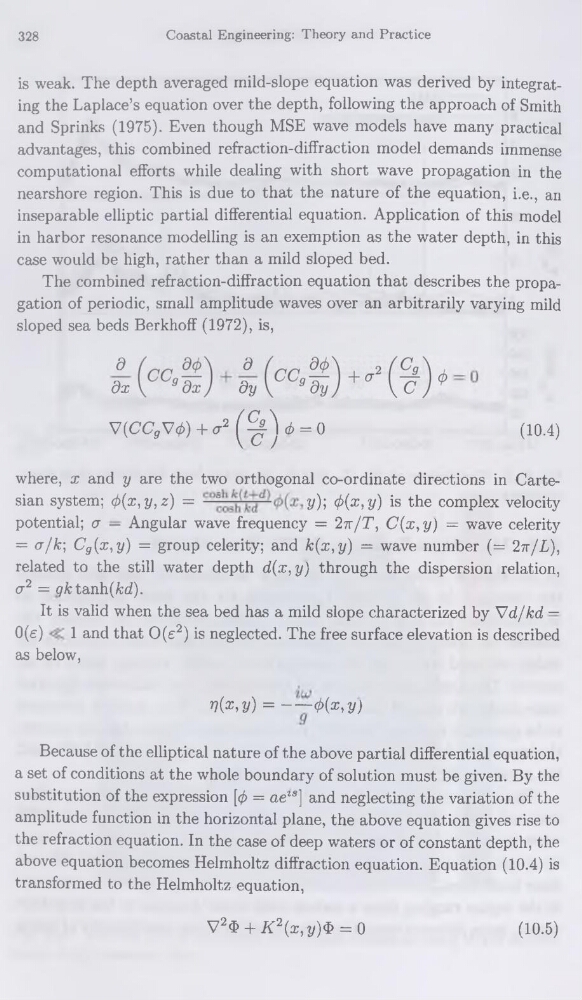
The combined refraction-diffraction équation that describes the propagation of periodic, small amplitude waves over an arbitrarily varying mild
sloped sea beds Berkhoff (1972), is,
d
dx
d
dy
V(CCffV0) + <72 f^K = 0
\ G J
(10.4)
where, x and y are the two orthogonal co-ordinate directions in Cartesian System; 0(x, y,z) =
y); (/)(x,y') is the complex velocity
potential; a — Angular wave frequency = 'ï/nlT, C(x,y) = wave celerity
= a/k-, Cg(x,y) = group celerity; and k(x,y) = wave number (= ( 2v/L'),
related to the still water depth d(x,y) through the dispersion relation,
cr2 = (/fctanh^d).
It is valid when the sea bed has a mild slope characterized by ^d/kd —
0(s)
1 and that O(s2) is neglected. The free surface élévation is described
as below,
y(x,y) =----- c/)(x,y)
Because of the elliptical nature of the above partial differential équation,
a set of conditions at the whole boundary of solution must be given. By the
substitution of the expression [0 =
the refraction équation. In the case of deep waters or of constant depth, the
above équation becomes Helmholtz diffraction équation. Equation (10.4) is
transformed to the Helmholtz équation,
V2$ + K2(x,y}$ = 0
(10.5)
Coastal Engineering: Theory and Practice
is weak. The depth averaged mild-slope équation was derived by integrating the Laplace’s équation over the depth, following the approach of Smith
and Sprinks (1975). Even though MSE wave models hâve many practical
advantages, this combined refraction-diffraction model demands immense
computational efforts while dealing with short wave propagation in the
nearshore région. This is due to that the nature of the équation, i.e., an
inséparable elliptic partial differential équation. Application of this model
in harbor résonance modelling is an exemption as the water depth, in this
case would be high, rather than a mild sloped bed.
The combined refraction-diffraction équation that describes the propagation of periodic, small amplitude waves over an arbitrarily varying mild
sloped sea beds Berkhoff (1972), is,
d
dx
d
dy
V(CCffV0) + <72 f^K = 0
\ G J
(10.4)
where, x and y are the two orthogonal co-ordinate directions in Cartesian System; 0(x, y,z) =
y); (/)(x,y') is the complex velocity
potential; a — Angular wave frequency = 'ï/nlT, C(x,y) = wave celerity
= a/k-, Cg(x,y) = group celerity; and k(x,y) = wave number (= ( 2v/L'),
related to the still water depth d(x,y) through the dispersion relation,
cr2 = (/fctanh^d).
It is valid when the sea bed has a mild slope characterized by ^d/kd —
0(s)
1 and that O(s2) is neglected. The free surface élévation is described
as below,
y(x,y) =----- c/)(x,y)
Because of the elliptical nature of the above partial differential équation,
a set of conditions at the whole boundary of solution must be given. By the
substitution of the expression [0 =
the refraction équation. In the case of deep waters or of constant depth, the
above équation becomes Helmholtz diffraction équation. Equation (10.4) is
transformed to the Helmholtz équation,
V2$ + K2(x,y}$ = 0
(10.5)