

1. Introduction
17
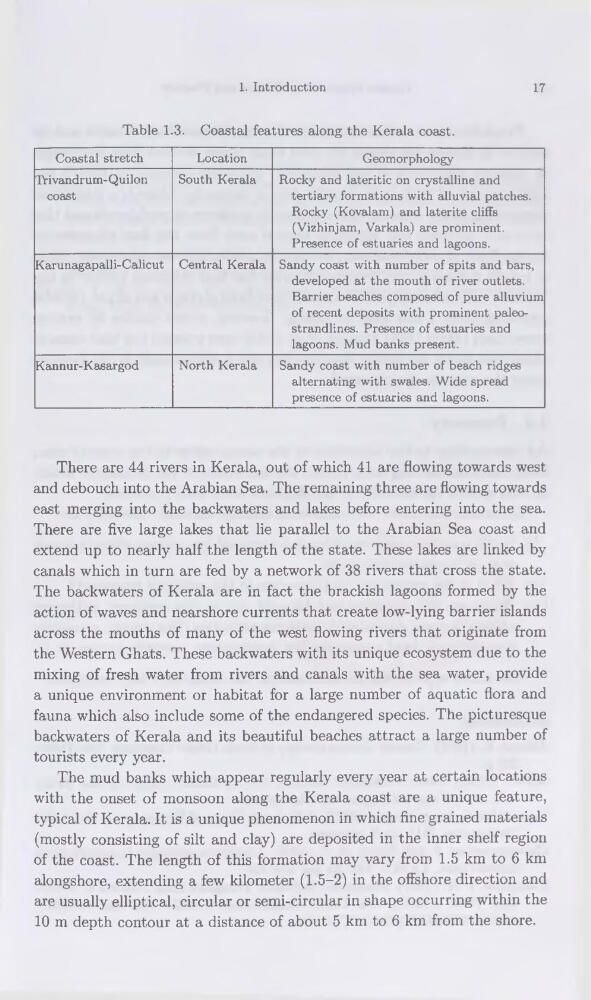
Table 1.3. Coastal features along the Kérala coast.
Coastal stretch
Location
Geomorphology
Trivandrum-Quilon
coast
South Kérala
Rocky and lateritic on crystalline and
tertiary formations with alluvial patches.
Rocky (Kovalam) and latérite cliffs
(Vizhinjam, Varkala) are prominent.
Presence of estuaries and lagoons.
Karunagapalli-Calicut Central Kérala Sandy coast with number of spits and bars,
developed at the mouth of river outlets.
Barrier beaches composed of pure alluvium
of recent deposits with prominent paleostrandlines. Presence of estuaries and
lagoons. Mud banks présent.
Kannur-Kasargod
North Kérala
Sandy coast with number of beach ridges
alternating with swales. Wide spread
presence of estuaries and lagoons.
There are 44 rivers in Kérala, ont of which 41 are flowing towards west
and debouch into the Arabian Sea. The remaining three are flowing towards
east merging into the backwaters and lakes before entering into the sea.
There are five large lakes that lie parallel to the Arabian Sea coast and
extend up to nearly half the length of the State. These lakes are linked by
canals which in turn are fed by a network of 38 rivers that cross the State.
The backwaters of Kérala are in fact the brackish lagoons formed by the
action of waves and nearshore currents that create low-lying barrier islands
across the mouths of many of the west flowing rivers that originate from
the Western Ghats. These backwaters with its unique ecosystem due to the
mixing of fresh water from rivers and canals with the sea water, provide
a unique environment or habitat for a large number of aquatic flora and
fauna which also include some of the endangered species. The picturesque
backwaters of Kérala and its beautiful beaches attract a large number of
tourists every year.
The mud banks which appear regularly every year at certain locations
with the onset of monsoon along the Kérala coast are a unique feature,
typical of Kérala. It is a unique phenomenon in which fine grained materials
(mostly consisting of silt and clay) are deposited in the inner shelf région
of the coast. The length of this formation may vary from 1.5 km to 6 km
alongshore, extending a few kilometer (1.5-2) in the offshore direction and
are usually elliptical, circular or semi-circular in shape occurring within the
10 m depth contour at a distance of about 5 km to 6 km from the shore.
17
Table 1.3. Coastal features along the Kérala coast.
Coastal stretch
Location
Geomorphology
Trivandrum-Quilon
coast
South Kérala
Rocky and lateritic on crystalline and
tertiary formations with alluvial patches.
Rocky (Kovalam) and latérite cliffs
(Vizhinjam, Varkala) are prominent.
Presence of estuaries and lagoons.
Karunagapalli-Calicut Central Kérala Sandy coast with number of spits and bars,
developed at the mouth of river outlets.
Barrier beaches composed of pure alluvium
of recent deposits with prominent paleostrandlines. Presence of estuaries and
lagoons. Mud banks présent.
Kannur-Kasargod
North Kérala
Sandy coast with number of beach ridges
alternating with swales. Wide spread
presence of estuaries and lagoons.
There are 44 rivers in Kérala, ont of which 41 are flowing towards west
and debouch into the Arabian Sea. The remaining three are flowing towards
east merging into the backwaters and lakes before entering into the sea.
There are five large lakes that lie parallel to the Arabian Sea coast and
extend up to nearly half the length of the State. These lakes are linked by
canals which in turn are fed by a network of 38 rivers that cross the State.
The backwaters of Kérala are in fact the brackish lagoons formed by the
action of waves and nearshore currents that create low-lying barrier islands
across the mouths of many of the west flowing rivers that originate from
the Western Ghats. These backwaters with its unique ecosystem due to the
mixing of fresh water from rivers and canals with the sea water, provide
a unique environment or habitat for a large number of aquatic flora and
fauna which also include some of the endangered species. The picturesque
backwaters of Kérala and its beautiful beaches attract a large number of
tourists every year.
The mud banks which appear regularly every year at certain locations
with the onset of monsoon along the Kérala coast are a unique feature,
typical of Kérala. It is a unique phenomenon in which fine grained materials
(mostly consisting of silt and clay) are deposited in the inner shelf région
of the coast. The length of this formation may vary from 1.5 km to 6 km
alongshore, extending a few kilometer (1.5-2) in the offshore direction and
are usually elliptical, circular or semi-circular in shape occurring within the
10 m depth contour at a distance of about 5 km to 6 km from the shore.