

258
Coastal Engineering: Theory and Practice
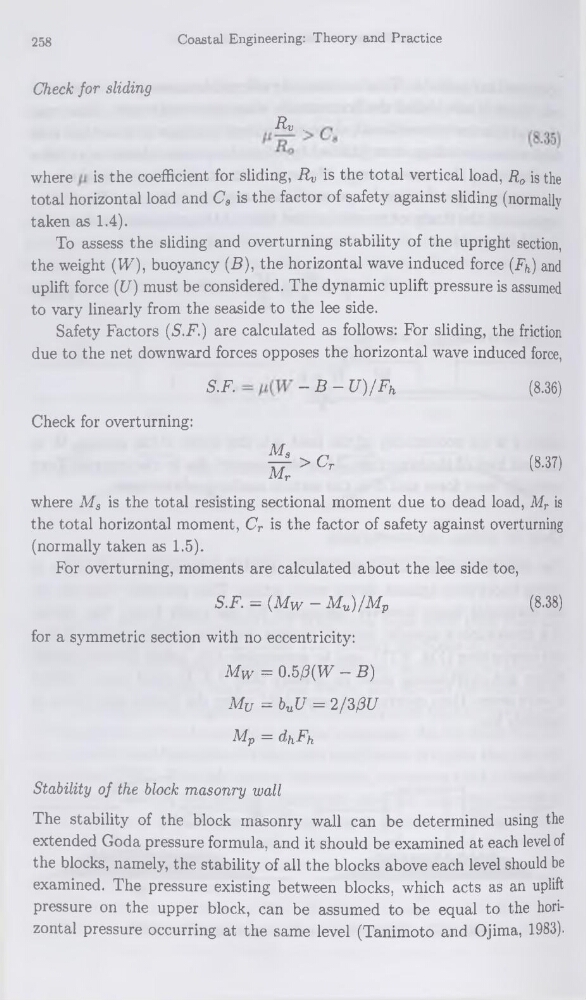
Check for sliding
RJV .
.
where is the coefficient for sliding, Rv is the total vertical load, Ro is the
total horizontal load and Cs is the factor of safety against sliding (normally
taken as 1.4).
To assess the sliding and overturning stability of the upright section,
the weight (W), buoyancy (B), the horizontal wave induced force (Fft) and
uplift force (B) must be considered. The dynamic uplift pressure is assumed
to vary linearly from the seaside to the lee side.
Safety Factors (5.F.) are calculated as follows: For sliding, the friction
due to the net downward forces opposes the horizontal wave induced force,
S.F.
-B- U)/Fh
(8.36)
Check for overturning:
^>Cr
(8.37)
where Ms is the total resisting sectional moment due to dead load, Mr is
the total horizontal moment, Cr is the factor of safety against overturning
(normally taken as 1.5).
For overturning, moments are calculated about the lee side toe,
S.F. = (Mw - Mu)/Mp
(8.38)
for a symmetric section with no eccentricity:
Mw = O.5/3(VF - B)
Mu = buU = 2/3/3B
A/p = dfoFh
Stability of the block masonry wall
The stability of the block masonry wall can be determined using the
extended Goda pressure formula, and it should be examined at each level of
the blocks, namely, the stability of ail the blocks above each level should be
examined. The pressure existing between blocks, which acts as an uplift
pressure on the upper block, can be assumed to be equal to the horizontal pressure occurring at the same level (Tanimoto and Ojima, 1983).
Coastal Engineering: Theory and Practice
Check for sliding
RJV .
.
where is the coefficient for sliding, Rv is the total vertical load, Ro is the
total horizontal load and Cs is the factor of safety against sliding (normally
taken as 1.4).
To assess the sliding and overturning stability of the upright section,
the weight (W), buoyancy (B), the horizontal wave induced force (Fft) and
uplift force (B) must be considered. The dynamic uplift pressure is assumed
to vary linearly from the seaside to the lee side.
Safety Factors (5.F.) are calculated as follows: For sliding, the friction
due to the net downward forces opposes the horizontal wave induced force,
S.F.
-B- U)/Fh
(8.36)
Check for overturning:
^>Cr
(8.37)
where Ms is the total resisting sectional moment due to dead load, Mr is
the total horizontal moment, Cr is the factor of safety against overturning
(normally taken as 1.5).
For overturning, moments are calculated about the lee side toe,
S.F. = (Mw - Mu)/Mp
(8.38)
for a symmetric section with no eccentricity:
Mw = O.5/3(VF - B)
Mu = buU = 2/3/3B
A/p = dfoFh
Stability of the block masonry wall
The stability of the block masonry wall can be determined using the
extended Goda pressure formula, and it should be examined at each level of
the blocks, namely, the stability of ail the blocks above each level should be
examined. The pressure existing between blocks, which acts as an uplift
pressure on the upper block, can be assumed to be equal to the horizontal pressure occurring at the same level (Tanimoto and Ojima, 1983).