

256
Coastal Engineering: Theory and Practice
dimension of the selected structure type to ensure that the principal loadings remain below the structure’s résistance when suitably factored. In the
design of related süch structures, the main emphasis has historically been on
balancing the horizontal (and perhaps up-lift) forces against caisson weight
hence the friction forces.
These are mainly mass concrete/masonry structures with the primary
purpose of maintaining tranquility behind the structure. The vertical wall
structure is designed so that there is no tension in the structure. The dead
weight of the structure resists ail the external loads. Typical vertical and
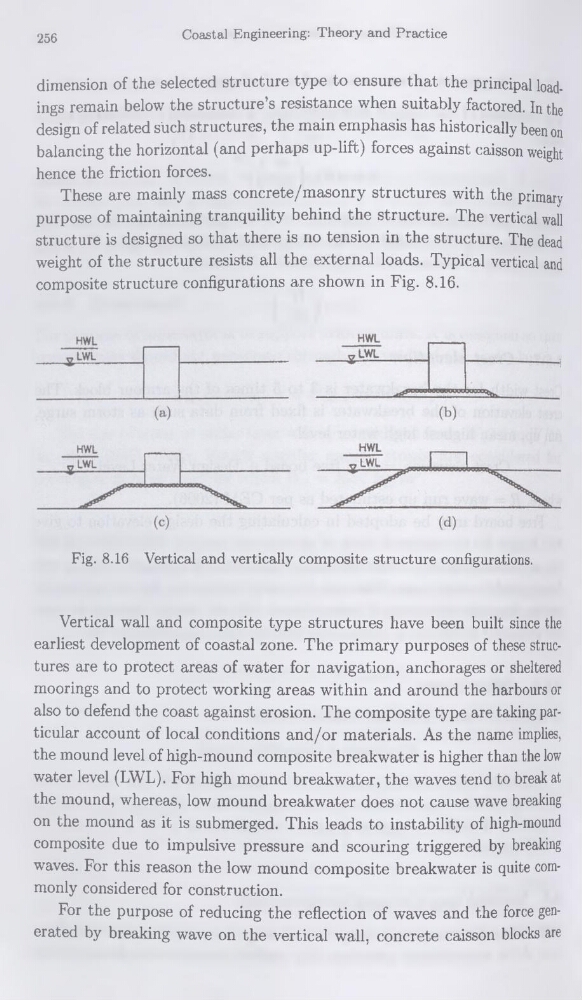
composite structure configurations are shown in Fig. 8.16.
Fig. 8.16 Vertical and vertically composite structure configurations.
Vertical wall and composite type structures hâve been built since the
earliest development of Coastal zone. The primary purposes of these structures are to protect areas of water for navigation, anchorages or sheltered
moorings and to protect working areas within and around the harbours or
also to defend the coast against érosion. The composite type are taking particular account of local conditions and/or materials. As the name implies,
the mound level of high-mound composite breakwater is higher than the low
water level (LWL). For high mound breakwater, the waves tend to break at
the mound, whereas, low mound breakwater does not cause wave breaking
on the mound as it is submerged. This leads to instability of high-mound
composite due to impulsive pressure and scouring triggered by breaking
waves. For this reason the low mound composite breakwater is quite commonly considered for construction.
For the purpose of reducing the reflection of waves and the force generated by breaking wave on the vertical wall, concrète caisson blocks are
Coastal Engineering: Theory and Practice
dimension of the selected structure type to ensure that the principal loadings remain below the structure’s résistance when suitably factored. In the
design of related süch structures, the main emphasis has historically been on
balancing the horizontal (and perhaps up-lift) forces against caisson weight
hence the friction forces.
These are mainly mass concrete/masonry structures with the primary
purpose of maintaining tranquility behind the structure. The vertical wall
structure is designed so that there is no tension in the structure. The dead
weight of the structure resists ail the external loads. Typical vertical and
composite structure configurations are shown in Fig. 8.16.
Fig. 8.16 Vertical and vertically composite structure configurations.
Vertical wall and composite type structures hâve been built since the
earliest development of Coastal zone. The primary purposes of these structures are to protect areas of water for navigation, anchorages or sheltered
moorings and to protect working areas within and around the harbours or
also to defend the coast against érosion. The composite type are taking particular account of local conditions and/or materials. As the name implies,
the mound level of high-mound composite breakwater is higher than the low
water level (LWL). For high mound breakwater, the waves tend to break at
the mound, whereas, low mound breakwater does not cause wave breaking
on the mound as it is submerged. This leads to instability of high-mound
composite due to impulsive pressure and scouring triggered by breaking
waves. For this reason the low mound composite breakwater is quite commonly considered for construction.
For the purpose of reducing the reflection of waves and the force generated by breaking wave on the vertical wall, concrète caisson blocks are