

8. Design of Coastal Structures
255
8 5.6 Thickness of armour and underlayer
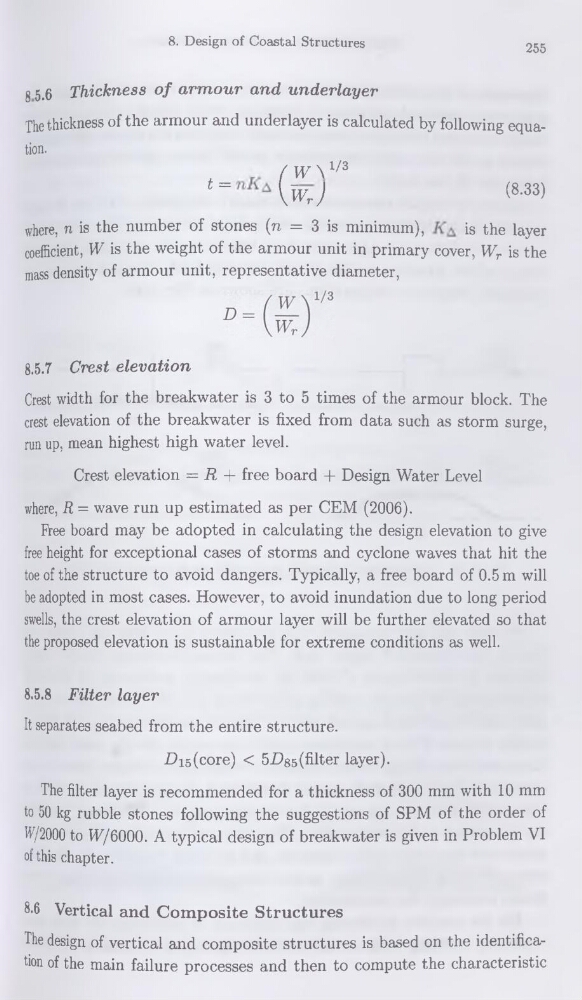
The thickness of the armour and underlayer is calculated by following équation.
( W \ 1/3
* =
( ÏVr J
(8'33)
where, n is the number of stones (n = 3 is minimum),
is the layer
coefficient, W is the weight of the armour unit in primary cover, Wr is the
mass density of armour unit, représentative diameter,
8.5.7 Crest élévation
Crest width for the breakwater is 3 to 5 times of the armour block. The
crest élévation of the breakwater is fixed from data such as storm surge,
run up, mean highest high water level.
Crest élévation = R + free board + Design Water Level
where, R = wave run up estimated as per CEM (2006).
Free board may be adopted in calculating the design élévation to give
free height for exceptional cases of storms and cyclone waves that hit the
toeofthe structure to avoid dangers. Typically, a free board of 0.5 m will
be adopted in most cases. However, to avoid inundation due to long period
swells, the crest élévation of armour layer will be further elevated so that
the proposed élévation is sustainable for extreme conditions as well.
8.5.8 Filter layer
It séparâtes seabed from the entire structure.
£>i5(core) < 5D$5(filter layer).
The filter layer is recommended for a thickness of 300 mm with 10 mm
to 50 kg rubble stones following the suggestions of SPM of the order of
T/2000 to W/6000. A typical design of breakwater is given in Problem VI
of this chapter.
8-6 Vertical and Composite Structures
The design of vertical and composite structures is based on the identification of the main failure processes and then to compute the characteristic
255
8 5.6 Thickness of armour and underlayer
The thickness of the armour and underlayer is calculated by following équation.
( W \ 1/3
* =
( ÏVr J
(8'33)
where, n is the number of stones (n = 3 is minimum),
is the layer
coefficient, W is the weight of the armour unit in primary cover, Wr is the
mass density of armour unit, représentative diameter,
8.5.7 Crest élévation
Crest width for the breakwater is 3 to 5 times of the armour block. The
crest élévation of the breakwater is fixed from data such as storm surge,
run up, mean highest high water level.
Crest élévation = R + free board + Design Water Level
where, R = wave run up estimated as per CEM (2006).
Free board may be adopted in calculating the design élévation to give
free height for exceptional cases of storms and cyclone waves that hit the
toeofthe structure to avoid dangers. Typically, a free board of 0.5 m will
be adopted in most cases. However, to avoid inundation due to long period
swells, the crest élévation of armour layer will be further elevated so that
the proposed élévation is sustainable for extreme conditions as well.
8.5.8 Filter layer
It séparâtes seabed from the entire structure.
£>i5(core) < 5D$5(filter layer).
The filter layer is recommended for a thickness of 300 mm with 10 mm
to 50 kg rubble stones following the suggestions of SPM of the order of
T/2000 to W/6000. A typical design of breakwater is given in Problem VI
of this chapter.
8-6 Vertical and Composite Structures
The design of vertical and composite structures is based on the identification of the main failure processes and then to compute the characteristic