

8. Design of Coastal Structures
253
exterior stone or concrète units through two or more layers of intermediate
sized materials to small quarry run sizes at the core and finer material
beneath it.
8.5.2
Armour loyer
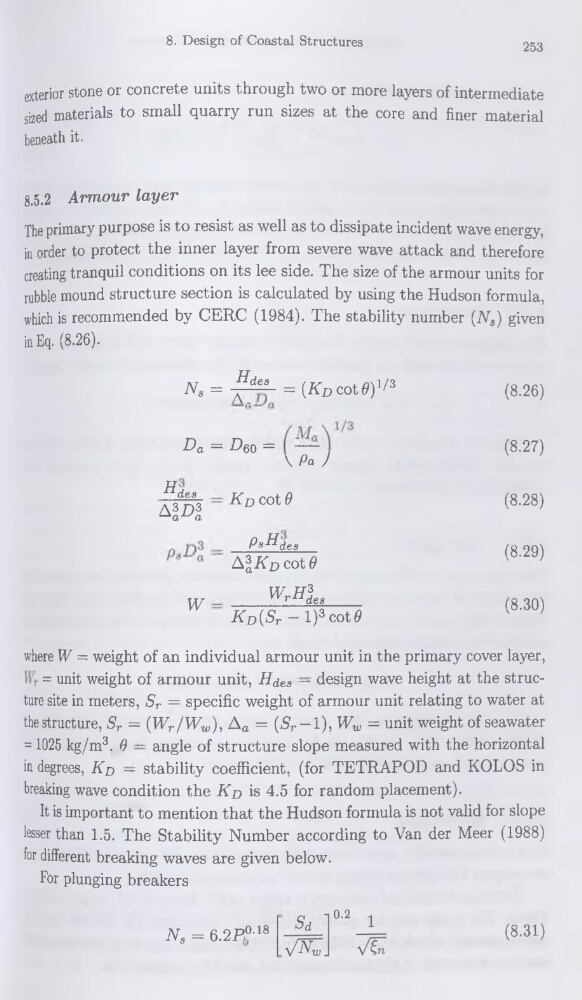
The primary purpose is to resist as well as to dissipate incident wave energy,
in order to protect the inner layer from severe wave attack and therefore
creating tranquil conditions on its lee side. The size of the armour units for
rubble mound structure section is calculated by using the Hudson formula,
which is recommended by CERC (1984). The stability number (2VS) given
in Eq. (8.26).
Ns =
^2L = (KDCO Da = p60 = —
\Pa J
Hde,
A^ ’
Ko cot 6
P 3 H des
PK^Kd cot 6
w
WrH3 de,
KD(Sr ~ l)3COt0
(8.26)
(8.27)
(8.28)
(8.29)
(8.30)
where W = weight of an individual armour unit in the primary cover layer,
= unit weight of armour unit, H des — design wave height at the structure site in meters, Sr ~ spécifie weight of armour unit relating to water at
the structure, Sr = (Wr/Ww), Aa = (Sr-1), Ww = unit weight of seawater
= 1025 kg/m3. 6 — angle of structure slope measured with the horizontal
in degrees, Kd — stability coefficient, (for TETRAPOD and KOLOS in
breaking wave condition the Kd is 4.5 for random placement).
It is important to mention that the Hudson formula is not valid for slope
lesser than 1.5. The Stability Number according to Van der Meer (1988)
for different breaking waves are given below.
For plunging breakers
(8.31)
Ns = 6.2P°'18
253
exterior stone or concrète units through two or more layers of intermediate
sized materials to small quarry run sizes at the core and finer material
beneath it.
8.5.2
Armour loyer
The primary purpose is to resist as well as to dissipate incident wave energy,
in order to protect the inner layer from severe wave attack and therefore
creating tranquil conditions on its lee side. The size of the armour units for
rubble mound structure section is calculated by using the Hudson formula,
which is recommended by CERC (1984). The stability number (2VS) given
in Eq. (8.26).
Ns =
^2L = (KDCO Da = p60 = —
\Pa J
Hde,
A^ ’
Ko cot 6
P 3 H des
PK^Kd cot 6
w
WrH3 de,
KD(Sr ~ l)3COt0
(8.26)
(8.27)
(8.28)
(8.29)
(8.30)
where W = weight of an individual armour unit in the primary cover layer,
= unit weight of armour unit, H des — design wave height at the structure site in meters, Sr ~ spécifie weight of armour unit relating to water at
the structure, Sr = (Wr/Ww), Aa = (Sr-1), Ww = unit weight of seawater
= 1025 kg/m3. 6 — angle of structure slope measured with the horizontal
in degrees, Kd — stability coefficient, (for TETRAPOD and KOLOS in
breaking wave condition the Kd is 4.5 for random placement).
It is important to mention that the Hudson formula is not valid for slope
lesser than 1.5. The Stability Number according to Van der Meer (1988)
for different breaking waves are given below.
For plunging breakers
(8.31)
Ns = 6.2P°'18