

252
Coastal Engineering: Theory and Practice
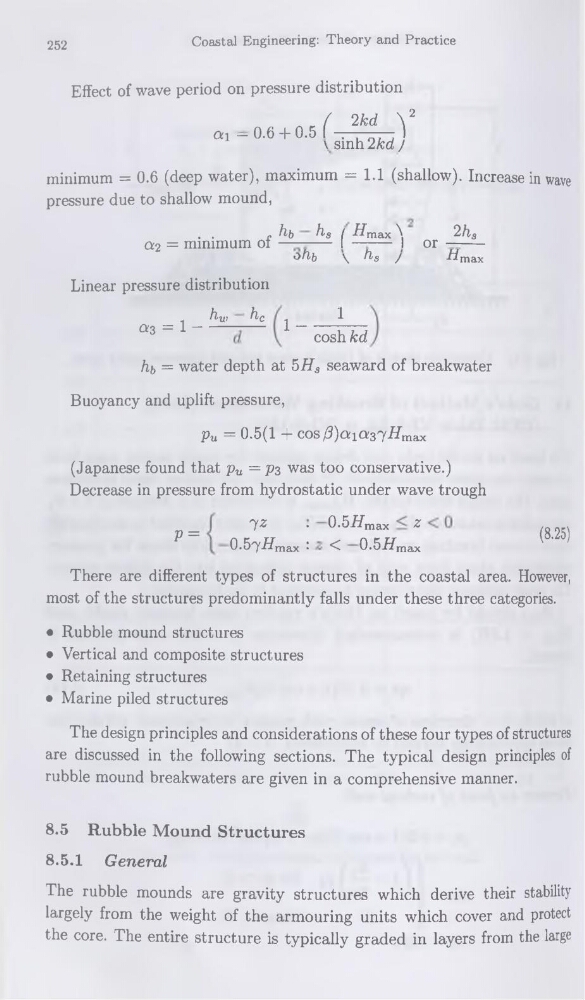
Effect of wave period on pressure distribution
„ n r ( 2kd \2
ai — 0.6 + 0.5 I .
I
\ sinh 2kd J
minimum = 0.6 (deep water), maximum = 1.1 (shallow). Increase in wave
pressure due to shallow mound,
. .
e hb hs i Hmax \
2hs
ct2 = minimum ot ——— I —— I or —---ohb
y tlg /
^max
Linear pressure distribution
hui
hic
Q3 = 1_—__
1
1-------- 77^
cosh kd
hb = water depth at 5Ha seaward of breakwater
Buoyancy and uplift pressure,
Pu = 0.5(1 + COS/3)aiQ!37Æmax
(Japanese found that pu = pz was too conservative.)
Decrease in pressure from hydrostatic under wave trough
p =
72
• 0.5-Hmax
Z
0.57-ffmax :
< 0.5Æmax
(8.25)
There are different types of structures in the Coastal area. However,
most of the structures predominantly falls under these three categories.
• Rubble mound structures
• Vertical and composite structures
• Retaining structures
• Marine piled structures
The design principles and considérations of these four types of structures
are discussed in the following sections. The typical design principles of
rubble mound breakwaters are given in a comprehensive manner.
8.5 Rubble Mound Structures
8.5.1 General
The rubble mounds are gravity structures which dérivé their stability
largely from the weight of the armouring units which cover and protect
the core. The entire structure is typically graded in layers from the large
Coastal Engineering: Theory and Practice
Effect of wave period on pressure distribution
„ n r ( 2kd \2
ai — 0.6 + 0.5 I .
I
\ sinh 2kd J
minimum = 0.6 (deep water), maximum = 1.1 (shallow). Increase in wave
pressure due to shallow mound,
. .
e hb hs i Hmax \
2hs
ct2 = minimum ot ——— I —— I or —---ohb
y tlg /
^max
Linear pressure distribution
hui
hic
Q3 = 1_—__
1
1-------- 77^
cosh kd
hb = water depth at 5Ha seaward of breakwater
Buoyancy and uplift pressure,
Pu = 0.5(1 + COS/3)aiQ!37Æmax
(Japanese found that pu = pz was too conservative.)
Decrease in pressure from hydrostatic under wave trough
p =
72
• 0.5-Hmax
Z
0.57-ffmax :
< 0.5Æmax
(8.25)
There are different types of structures in the Coastal area. However,
most of the structures predominantly falls under these three categories.
• Rubble mound structures
• Vertical and composite structures
• Retaining structures
• Marine piled structures
The design principles and considérations of these four types of structures
are discussed in the following sections. The typical design principles of
rubble mound breakwaters are given in a comprehensive manner.
8.5 Rubble Mound Structures
8.5.1 General
The rubble mounds are gravity structures which dérivé their stability
largely from the weight of the armouring units which cover and protect
the core. The entire structure is typically graded in layers from the large