

246
Coastal Engineering: Theory and Practice
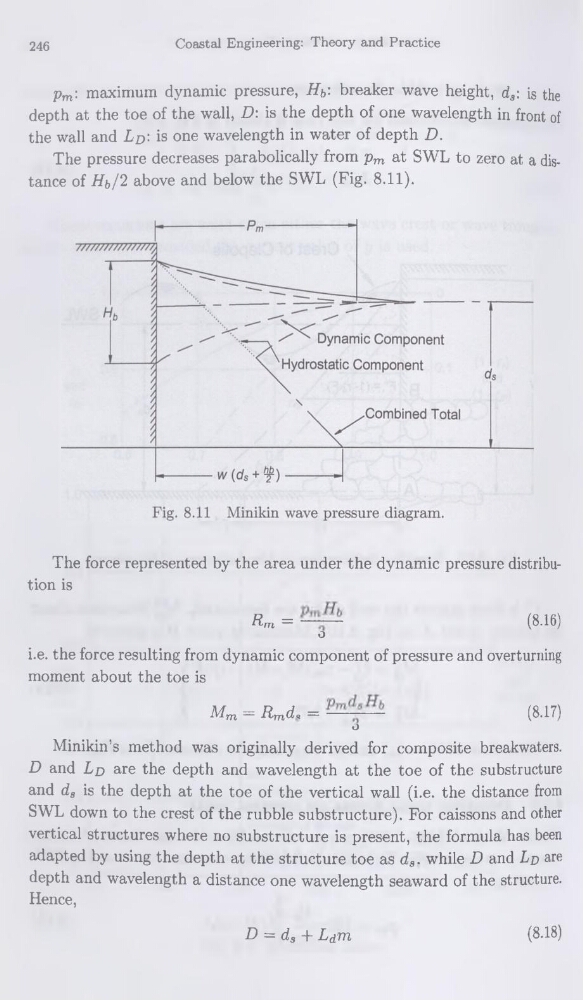
pm: maximum dynamic pressure, Hb: breaker wave height, da: is the
depth at the toe of the wall, D: is the depth of one wavelength in front of
the wall and LD: is one wavelength in water of depth D.
The pressure decreases parabolically from pm at SWL to zéro at a distance of Hb/2 above and below the SWL (Fig. 8.11).
The force represented by the area under the dynamic pressure distribution is
Rm =
(8.16)
O
i.e. the force resulting from dynamic component of pressure and overturning
moment about the toe is
Mm = Rmd. =
(8.17)
O
Minikin’s method was originally derived for composite breakwaters.
D and Ld are the depth and wavelength at the toe of the substructure
and da is the depth at the toe of the vertical wall (i.e. the distance from
SWL down to the crest of the rubble substructure). For caissons and other
vertical structures where no substructure is présent, the formula has been
adapted by using the depth at the structure toe as da. while D and Ld are
depth and wavelength a distance one wavelength seaward of the structure.
Hence,
D = da + Ldm
(8.18)
Coastal Engineering: Theory and Practice
pm: maximum dynamic pressure, Hb: breaker wave height, da: is the
depth at the toe of the wall, D: is the depth of one wavelength in front of
the wall and LD: is one wavelength in water of depth D.
The pressure decreases parabolically from pm at SWL to zéro at a distance of Hb/2 above and below the SWL (Fig. 8.11).
The force represented by the area under the dynamic pressure distribution is
Rm =
(8.16)
O
i.e. the force resulting from dynamic component of pressure and overturning
moment about the toe is
Mm = Rmd. =
(8.17)
O
Minikin’s method was originally derived for composite breakwaters.
D and Ld are the depth and wavelength at the toe of the substructure
and da is the depth at the toe of the vertical wall (i.e. the distance from
SWL down to the crest of the rubble substructure). For caissons and other
vertical structures where no substructure is présent, the formula has been
adapted by using the depth at the structure toe as da. while D and Ld are
depth and wavelength a distance one wavelength seaward of the structure.
Hence,
D = da + Ldm
(8.18)