

232
Coastal Engineering: Theory and Practice
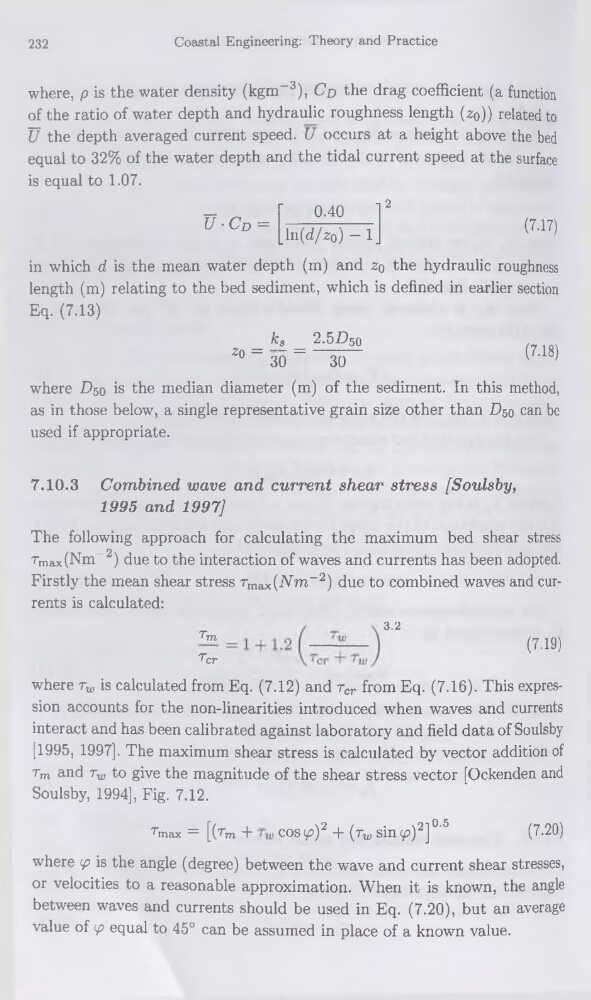
where, p is the water density (kgm~3), Cd the drag coefficient (a function
of the ratio of water depth and hydraulic roughness length (z0)) related to
Ü the depth averaged current speed. U occurs at a height above the bed
equal to 32% of the water depth and the tidal current speed at the surface
is equal to 1.07.
—
F
0.40
l2
U'Cd= [ln(d/^o)-lj
(7'17)
in which d is the mean water depth (m) and Zq the hydraulic roughness
length (m) relating to the bed sédiment, which is defined in earlier section
Eq. (7.13)
_ ka _ 2.5£>5o
*0 “ 3Ô ~ 30
(7.18)
where D50 is the médian diameter (m) of the sédiment. In this method,
as in those below, a single représentative grain size other than D50 can be
used if appropriate.
7.10.3 Combined wave and current shear stress [Soulsby,
1995 and 1997]
The following approach for calculating the maximum bed shear stress
îmax(Nm”2) due to the interaction of waves and currents has been adopted.
Firstly the mean shear stress Tmax(Nm~2') due to combined waves and currents is calculated:
Tm
Ter
3.2
(7.19)
where tw is calculated from Eq. (7.12) and rcr from Eq. (7.16). This expression accounts for the non-linearities introduced when waves and currents
interact and has been calibrated against laboratory and field data of Soulsby
[1995, 1997], The maximum shear stress is calculated by vector addition of
rm and tw to give the magnitude of the shear stress vector [Ockenden and
Soulsby, 1994], Fig. 7.12.
Tmax = [(rm +
cos ç?)2 + (rw sinç?)2]0,5
(7.20)
where cp is the angle (degree) between the wave and current shear stresses,
or velocities to a reasonable approximation. When it is known, the angle
between waves and currents should be used in Eq. (7.20), but an average
value of ip equal to 45° can be assumed in place of a known value.
Coastal Engineering: Theory and Practice
where, p is the water density (kgm~3), Cd the drag coefficient (a function
of the ratio of water depth and hydraulic roughness length (z0)) related to
Ü the depth averaged current speed. U occurs at a height above the bed
equal to 32% of the water depth and the tidal current speed at the surface
is equal to 1.07.
—
F
0.40
l2
U'Cd= [ln(d/^o)-lj
(7'17)
in which d is the mean water depth (m) and Zq the hydraulic roughness
length (m) relating to the bed sédiment, which is defined in earlier section
Eq. (7.13)
_ ka _ 2.5£>5o
*0 “ 3Ô ~ 30
(7.18)
where D50 is the médian diameter (m) of the sédiment. In this method,
as in those below, a single représentative grain size other than D50 can be
used if appropriate.
7.10.3 Combined wave and current shear stress [Soulsby,
1995 and 1997]
The following approach for calculating the maximum bed shear stress
îmax(Nm”2) due to the interaction of waves and currents has been adopted.
Firstly the mean shear stress Tmax(Nm~2') due to combined waves and currents is calculated:
Tm
Ter
3.2
(7.19)
where tw is calculated from Eq. (7.12) and rcr from Eq. (7.16). This expression accounts for the non-linearities introduced when waves and currents
interact and has been calibrated against laboratory and field data of Soulsby
[1995, 1997], The maximum shear stress is calculated by vector addition of
rm and tw to give the magnitude of the shear stress vector [Ockenden and
Soulsby, 1994], Fig. 7.12.
Tmax = [(rm +
cos ç?)2 + (rw sinç?)2]0,5
(7.20)
where cp is the angle (degree) between the wave and current shear stresses,
or velocities to a reasonable approximation. When it is known, the angle
between waves and currents should be used in Eq. (7.20), but an average
value of ip equal to 45° can be assumed in place of a known value.