

7. Scour Around Marine Structures
231
of shear stress by which sédiment particles begin to move across the
seabed).
The mobility of the sédiment can be quantified by comparing the shear
stress calculated according to below formulae with the critical shear stress,
defined by
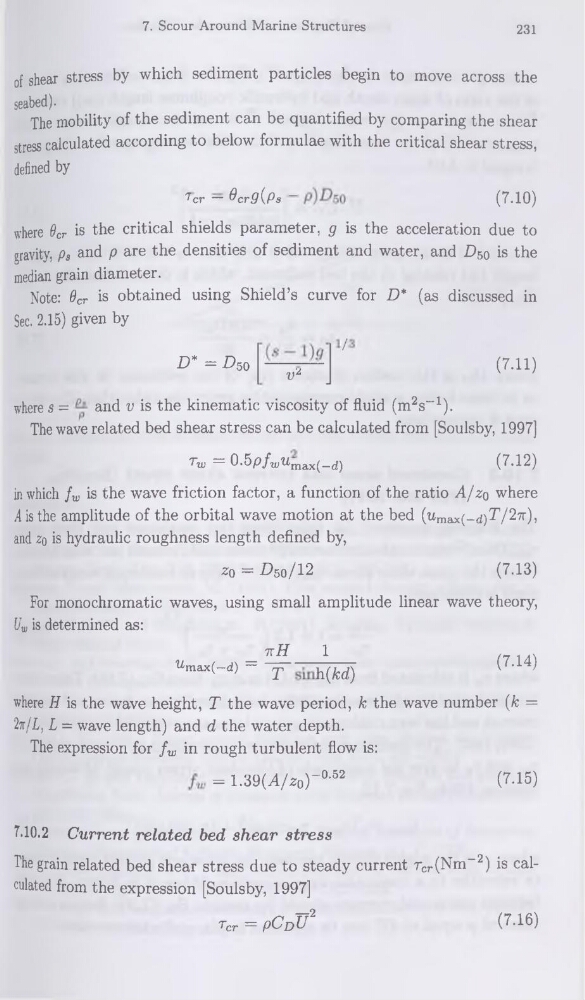
Ter — ^crQ^Ps
(7.10)
where ûcr is the critical shields parameter, g is the accélération due to
gravity, ps and p are the densities of sédiment and water, and £>50 is the
médian grain diameter.
Note: 9cr is obtained using Shield’s curve for D* (as discussed in
Sec. 2.15) given by
P* =-D5o
'
(7.11)
vz J
where s = and v is the kinematic viscosity of fluid (m2s-1).
The wave related bed shear stress can be calculated from [Soulsby, 1997]
rw = 0.5p/wumax^_rf^
(7.12)
in which fw is the wave friction factor, a function of the ratio A/zq where
A is the amplitude of the orbital wave motion at the bed ('Umax(-d)ï1/27r),
and zq is hydraulic roughness length defined by,
zo = D5o/12
(7.13)
For monochromatic waves, using small amplitude linear wave theory,
Uw is determined as:
711/
1
,
.
^max(-d) = ^T-h(M
(7,14)
where H is the wave height, T the wave period, k the wave number (k =
2ir/L, L = wave length) and d the water depth.
The expression for fw in rough turbulent flow is:
= 1.39(A/^o)'°'52
(7-15)
7.10.2
Current related bed shear stress
The grain related bed shear stress due to steady current rcr(Nm-2) is calculated from the expression [Soulsby, 1997]
r„ = pCDÜ2
(7-16)
231
of shear stress by which sédiment particles begin to move across the
seabed).
The mobility of the sédiment can be quantified by comparing the shear
stress calculated according to below formulae with the critical shear stress,
defined by
Ter — ^crQ^Ps
(7.10)
where ûcr is the critical shields parameter, g is the accélération due to
gravity, ps and p are the densities of sédiment and water, and £>50 is the
médian grain diameter.
Note: 9cr is obtained using Shield’s curve for D* (as discussed in
Sec. 2.15) given by
P* =-D5o
'
(7.11)
vz J
where s = and v is the kinematic viscosity of fluid (m2s-1).
The wave related bed shear stress can be calculated from [Soulsby, 1997]
rw = 0.5p/wumax^_rf^
(7.12)
in which fw is the wave friction factor, a function of the ratio A/zq where
A is the amplitude of the orbital wave motion at the bed ('Umax(-d)ï1/27r),
and zq is hydraulic roughness length defined by,
zo = D5o/12
(7.13)
For monochromatic waves, using small amplitude linear wave theory,
Uw is determined as:
711/
1
,
.
^max(-d) = ^T-h(M
(7,14)
where H is the wave height, T the wave period, k the wave number (k =
2ir/L, L = wave length) and d the water depth.
The expression for fw in rough turbulent flow is:
= 1.39(A/^o)'°'52
(7-15)
7.10.2
Current related bed shear stress
The grain related bed shear stress due to steady current rcr(Nm-2) is calculated from the expression [Soulsby, 1997]
r„ = pCDÜ2
(7-16)