

6. Wave Run-up and Overtopping
205
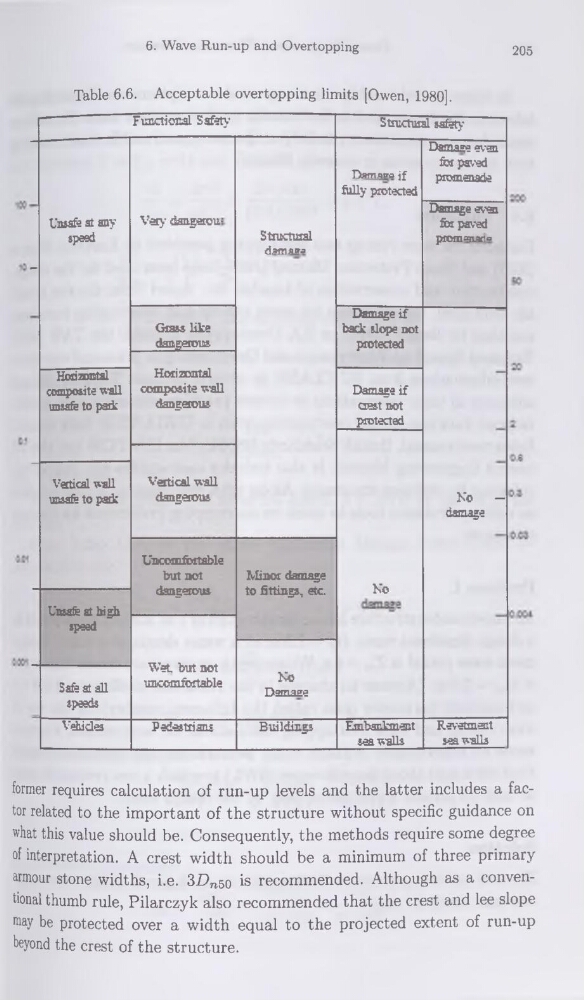
Table 6.6. Acceptable overtopping limita [Owen, 1980].
Functional Safety
Structural safety
-
Unsafe at any
speed
Very dangerouStructural
S,an Jga
Rtan.aga jf
folly protected
Damage even
for paved
promenade
Damage even
for paved
promar-ya
Gtass like
dangerous
Damage if
bad: slope not
protected
No
—
damage
Horizontal
composite wall
dangerous
Horizontal
composite wall
unrâfe to pari;
Damage if
crest not
protected
No
Vertical wall
dangerous
Vertical wall
unrafe to part
Uncomfortable
but not
dangerous
Miner damage
to fittings, etc.
Unsafe at high
spaed
Wet, but not
uncomfortable
No
Damaae
Safe at ail
speeds
Véhides
P edastri ans
Buildings
Embankment
seawalls
Revetment
seawalls
former requires calculation of run-up levels and the latter includes a factor related to the important of the structure without spécifie guidance on
what this value should be. Consequently, the methods require some degree
of interprétation. A crest width should be a minimum of three primary
armour stone widths, i.e. 3Z)n5o is recommended. Although as a conventional thumb rule, Pilarczyk also recommended that the crest and lee slope
may be protected over a width equal to the projected extent of run-up
beyond the crest of the structure.
205
Table 6.6. Acceptable overtopping limita [Owen, 1980].
Functional Safety
Structural safety
-
Unsafe at any
speed
Very dangerouStructural
S,an Jga
Rtan.aga jf
folly protected
Damage even
for paved
promenade
Damage even
for paved
promar-ya
Gtass like
dangerous
Damage if
bad: slope not
protected
No
—
damage
Horizontal
composite wall
dangerous
Horizontal
composite wall
unrâfe to pari;
Damage if
crest not
protected
No
Vertical wall
dangerous
Vertical wall
unrafe to part
Uncomfortable
but not
dangerous
Miner damage
to fittings, etc.
Unsafe at high
spaed
Wet, but not
uncomfortable
No
Damaae
Safe at ail
speeds
Véhides
P edastri ans
Buildings
Embankment
seawalls
Revetment
seawalls
former requires calculation of run-up levels and the latter includes a factor related to the important of the structure without spécifie guidance on
what this value should be. Consequently, the methods require some degree
of interprétation. A crest width should be a minimum of three primary
armour stone widths, i.e. 3Z)n5o is recommended. Although as a conventional thumb rule, Pilarczyk also recommended that the crest and lee slope
may be protected over a width equal to the projected extent of run-up
beyond the crest of the structure.