

196
Coastal Engineering: Theory and Practice
Table 6.3. Empirical coefficients - simply
sloping sea walls [Besley, 1999].
Sea wall slope
A
B
1:1
7.94E - 3
20.1
1:1.5
8.84E - 3
19.9
1:2
9.39E - 3
21.6
1:2.5
1.03E - 2
24.5
1:3
1.09E - 2
28.7
1:3.5
1.12E - 2
34.1
1:4
1.16E - 2
41.0
1:4.5
1.20E - 2
47.7
1:5
1.31E - 2
55.6
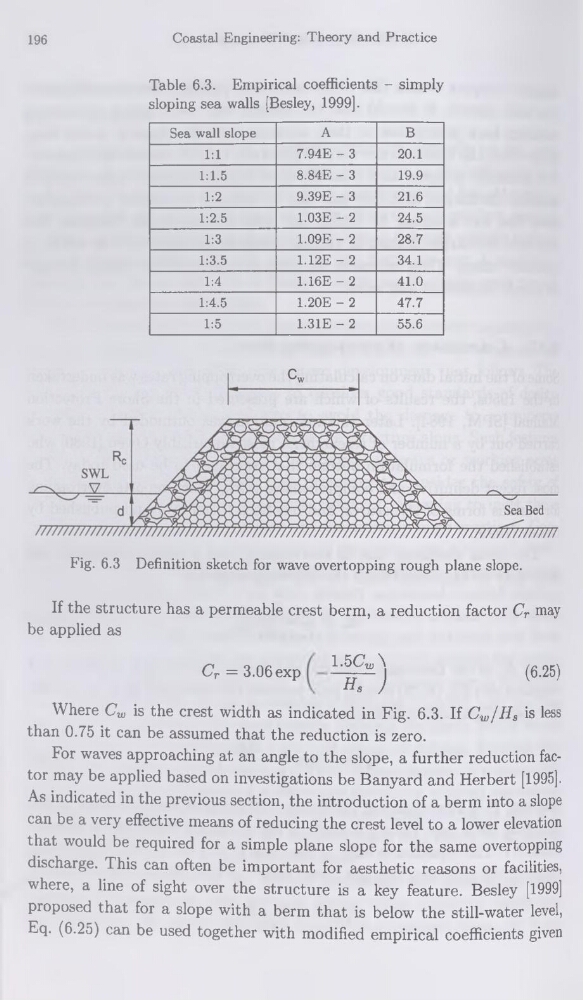
Fig. 6.3 Définition sketch for wave overtopping rough plane slope.
If the structure has a permeable crest berm, a réduction factor Cr may
be applied as
Cr = 3.06 exp
1.5CW\
Hs )
(6.25)
Where Cw is the crest width as indicated in Fig. 6.3. If Cw/Hs is less
than 0.75 it can be assumed that the réduction is zéro.
For waves approaching at an angle to the slope, a further réduction factor may be applied based on investigations be Banyard and Herbert [1995].
As indicated in the previous section, the introduction of a berm into a slope
can be a very effective means of reducing the crest level to a lower élévation
that would be required for a simple plane slope for the same overtopping
discharge. This can often be important for aesthetic reasons or facilities,
where, a line of sight over the structure is a key feature. Besley [1999]
proposed that for a slope with a berm that is below the still-water level,
Eq. (6.25) can be used together with modified empirical coefficients given
Coastal Engineering: Theory and Practice
Table 6.3. Empirical coefficients - simply
sloping sea walls [Besley, 1999].
Sea wall slope
A
B
1:1
7.94E - 3
20.1
1:1.5
8.84E - 3
19.9
1:2
9.39E - 3
21.6
1:2.5
1.03E - 2
24.5
1:3
1.09E - 2
28.7
1:3.5
1.12E - 2
34.1
1:4
1.16E - 2
41.0
1:4.5
1.20E - 2
47.7
1:5
1.31E - 2
55.6
Fig. 6.3 Définition sketch for wave overtopping rough plane slope.
If the structure has a permeable crest berm, a réduction factor Cr may
be applied as
Cr = 3.06 exp
1.5CW\
Hs )
(6.25)
Where Cw is the crest width as indicated in Fig. 6.3. If Cw/Hs is less
than 0.75 it can be assumed that the réduction is zéro.
For waves approaching at an angle to the slope, a further réduction factor may be applied based on investigations be Banyard and Herbert [1995].
As indicated in the previous section, the introduction of a berm into a slope
can be a very effective means of reducing the crest level to a lower élévation
that would be required for a simple plane slope for the same overtopping
discharge. This can often be important for aesthetic reasons or facilities,
where, a line of sight over the structure is a key feature. Besley [1999]
proposed that for a slope with a berm that is below the still-water level,
Eq. (6.25) can be used together with modified empirical coefficients given