

6
Coastal Engineering: Theory and Practice
part of wave in
Shallow water
deep water
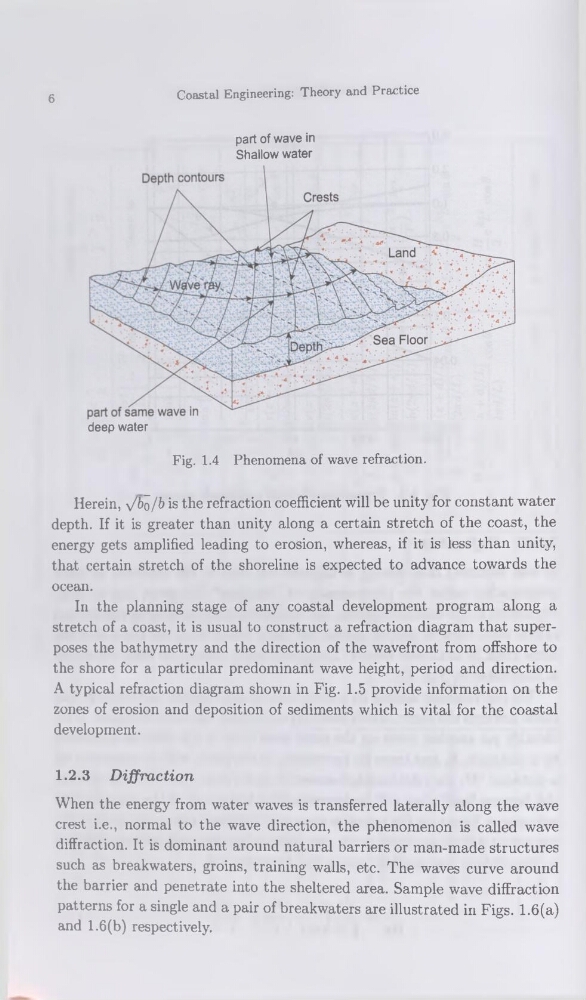
Fig. 1.4 Phenomena of wave refraction.
Herein, x/6ô/t> is the refraction coefficient will be unity for constant water
depth. If it is greater than unity along a certain stretch of the coast, the
energy gets amplified leading to érosion, whereas, if it is less than unity,
that certain stretch of the shoreline is expected to advance towards the
océan.
In the planning stage of any coastal development program along a
stretch of a coast, it is usual to construct a refraction diagram that superposes the bathymetry and the direction of the wavefront from offshore to
the shore for a particular prédominant wave height, period and direction.
A typical refraction diagram shown in Fig. 1.5 provide information on the
zones of érosion and déposition of sédiments which is vital for the coastal
development.
1.2.3 Diffraction
When the energy from water waves is transferred laterally along the wave
crest i.e., normal to the wave direction, the phenomenon is called wave
diffraction. It is dominant around natural barriers or man-made structures
such as breakwaters, groins, training walls, etc. The waves curve around
the barrier and penetrate into the sheltered area. Sample wave diffraction
patterns for a single and a pair of breakwaters are illustrated in Figs. 1.6(a)
and 1.6(b) respectively.
Coastal Engineering: Theory and Practice
part of wave in
Shallow water
deep water
Fig. 1.4 Phenomena of wave refraction.
Herein, x/6ô/t> is the refraction coefficient will be unity for constant water
depth. If it is greater than unity along a certain stretch of the coast, the
energy gets amplified leading to érosion, whereas, if it is less than unity,
that certain stretch of the shoreline is expected to advance towards the
océan.
In the planning stage of any coastal development program along a
stretch of a coast, it is usual to construct a refraction diagram that superposes the bathymetry and the direction of the wavefront from offshore to
the shore for a particular prédominant wave height, period and direction.
A typical refraction diagram shown in Fig. 1.5 provide information on the
zones of érosion and déposition of sédiments which is vital for the coastal
development.
1.2.3 Diffraction
When the energy from water waves is transferred laterally along the wave
crest i.e., normal to the wave direction, the phenomenon is called wave
diffraction. It is dominant around natural barriers or man-made structures
such as breakwaters, groins, training walls, etc. The waves curve around
the barrier and penetrate into the sheltered area. Sample wave diffraction
patterns for a single and a pair of breakwaters are illustrated in Figs. 1.6(a)
and 1.6(b) respectively.